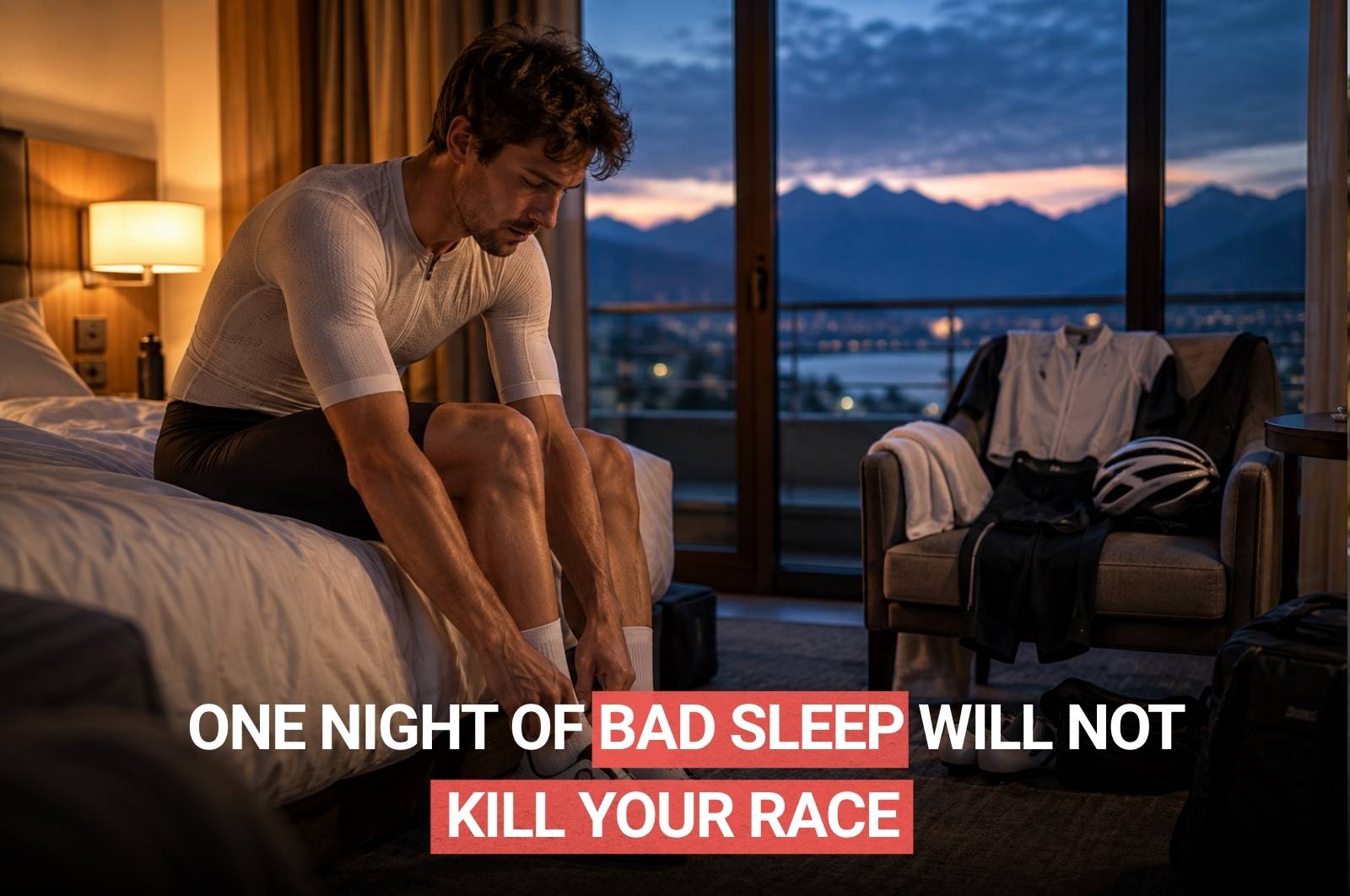
Stanford researchers extended athletes' sleep to 10 hours a night and watched their sprint times, reaction speed, and shooting accuracy improve in weeks
For a sport like cycling, where seconds and watts matter, those margins translate.
What Sleep Actually Does To A Cyclist's Body
Sleep is not rest. It is active maintenance.
During the deep slow-wave stages, your pituitary releases roughly 70 percent of your daily growth hormone.
That hormone is the main signal that tells your damaged muscle fibers to repair, your tendons to remodel, and your glycogen stores to refill.
Skip sleep, you skip that signal.
REM sleep handles a different job. It is when motor learning consolidates, which is why you ride smoother after a good night's sleep and like a baby giraffe after a bad one.
Cut sleep short and three measurable things happen within days. Insulin sensitivity drops, meaning your body handles ride fueling worse.
Cortisol climbs, which keeps you in a low-grade catabolic state. And perceived exertion at any given wattage goes up, sometimes by 17 percent or more for the same workload.
That last one is brutal for a rider. The same Z3 effort that felt fine on Monday feels like threshold by Friday, and you blame your legs.
It is not your legs.
How Much Sleep Cyclists Actually Need
The textbook answer is 7 to 9 hours.
The athlete answer is higher. Multiple position statements, including those from the American Academy of Sleep Medicine and the International Olympic Committee consensus, suggest that endurance athletes in heavy training blocks should target 8 to 10 hours.
The reason is simple. Training adds physical stress on top of the normal cellular wear that sleep repairs, so the maintenance window has to grow to match.
Most enthusiast cyclists in the 100 to 200 miles per month range run somewhere between 6.5 and 7.5 hours during the week.
If full nights are not available, the pros backfill with naps.
Team Sky (now INEOS Grenadiers) famously built nap protocols into grand tour stage routines.
The Slovenian national team has been open about Tadej Pogacar's habit of a daily 20 to 30 minute afternoon nap during training blocks.
The science backs them up. Studies on shift workers and athletes show that a 20 to 30 minute nap restores alertness and reaction speed without triggering deep sleep inertia.
Longer naps of 60 to 90 minutes during heavy training blocks can boost growth hormone release and double down on the recovery signal.
Naps are not weakness. They are a tool the best riders on earth use on purpose.
Where The Sleep Story Falls Short
You cannot bank sleep.
Sleeping 11 hours on Saturday does not undo five nights of 6.5 hours, no matter what your Whoop band tries to tell you.
Research on sleep debt shows partial recovery from weekend lie-ins, but cognitive performance and metabolic markers do not fully reset for 2 to 3 nights.
That is rough news for the Friday-night-out, Saturday-morning-race crowd.
The other limit is genetic. A small fraction of the population (well under 5 percent) carries the rare DEC2 gene variant that lets them function on 4 to 6 hours without measurable decline.
The rest of us who think we are in that category are usually just running on caffeine and adrenaline, with the deficit hiding inside our cortisol and our irritability.
Sleep also has an upper limit.
Consistently sleeping more than 9.5 to 10 hours per night has been weakly linked in observational research to worse health outcomes, though the cause and effect there is messy.
The sweet spot is 8 to 9 hours, consistently, in the same time window every night.
How To Build Sleep Like You Build A Training Plan
The most useful thing a cyclist can do is treat sleep as a training input, not a leftover.
Fix your wake time first
Fixed wake time, every day, including weekends. The body's circadian rhythm cares more about wake consistency than bedtime variability.
A wind-down window of 45 to 60 minutes before bed, with screens dimmed or off.
Blue light suppresses melatonin release by up to 50 percent in some studies, which delays sleep onset and shortens deep sleep.
The environment matters more than the supplement
Bedroom temperature between 60 and 67 °F (15.5 and 19.5 °C). Cool rooms produce more slow-wave sleep, which is the recovery-relevant stage.
No caffeine after roughly 2 pm if you are a normal metabolizer, earlier if you are slow. The science we covered in 10 best supplements for cyclists applies in reverse here.
Alcohol is a sleep destroyer dressed up as a sedative.
It knocks you out fast and then fragments the second half of the night, particularly REM.
One beer is fine; three is a recovery tax.
The Bottom Line
Most cyclists are leaving free watts on the nightstand.
The training is dialed, the bike fit is sorted, the nutrition has been tuned to the gram. The mattress is an afterthought.
You can spend $400 on a power meter and $80 a month on supplements, or you can move your bedtime by 45 minutes and sleep through one extra REM cycle.
The second one is free.
It is also, by a comfortable margin, the better deal.