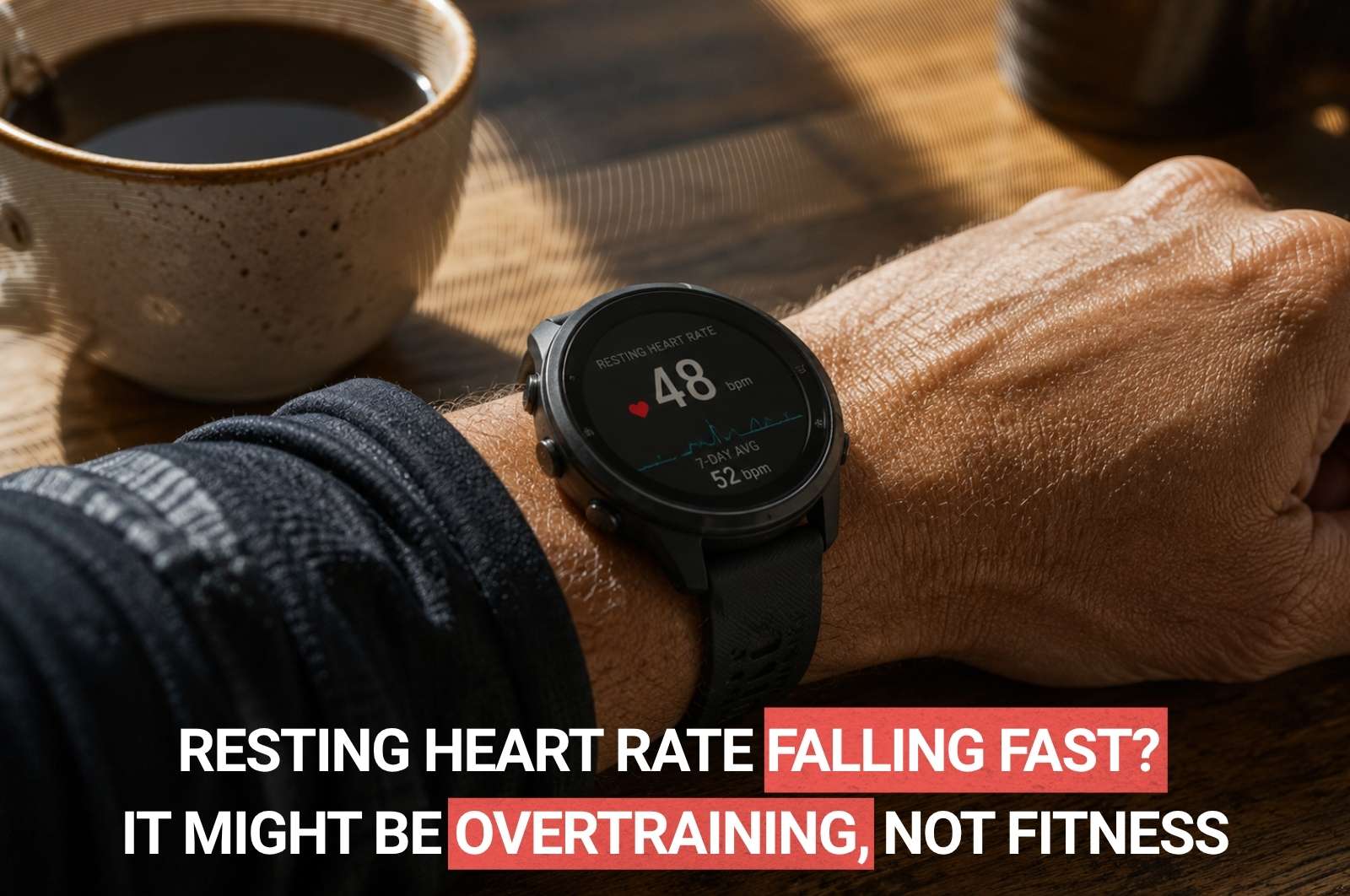
Peer-reviewed research on functionally overreached endurance athletes shows heart rate recovery gets faster during overtraining. The signal amateurs read as fitness is often the first sign of collapse.
Every serious cyclist has watched their resting heart rate drop and felt proud.
Fifty-eight became fifty-two, fifty-two became forty-eight, and every trend line on the wearable pointed toward more fitness.
For most riders, that is what is actually happening. For some, it is not.
There is a specific window in which a rapidly falling resting heart rate signals functional overreaching, not aerobic adaptation.
The physiology looks nearly identical from the outside, and the consequences of confusing them are severe.
We are going to walk through the peer-reviewed evidence, the specific pattern to watch for, and the two markers that separate real fitness gains from the pre-crash phase of an overtrained nervous system.
The Fitness Story Everyone Knows
Endurance training reduces resting heart rate.
That has been settled science since the 1970s, and the mechanism is well understood.
Repeated aerobic work increases stroke volume.
Your heart pumps more blood per beat, so it needs to beat fewer times to deliver the same oxygen at rest.
Well-trained cyclists commonly sit at 40 to 50 bpm resting.
Elite endurance athletes occasionally record readings in the high 30s.
A downward trend across weeks or months of consistent training is normally a positive signal. That is the story your Garmin, your Whoop, and your Strava app will tell you.
The Fitness Story That Is Wrong
Here is what those apps will not tell you.
A 2015 study on 31 experienced triathletes tracked heart rate recovery, blood lactate, and catecholamines across an overload training period.
Ten of the 21 overload subjects developed clear signs of functional overreaching by mid-block.
The functionally overreached group did not show a slower heart rate recovery.
They showed a faster one, with an average improvement of 8 bpm on the recovery curve.
Read that again. The athletes who were breaking down had heart rate recovery numbers that looked better than the athletes who were adapting.
The findings have been replicated in later studies on both cyclists and runners.
The Mechanism That Fools Everyone
The reason a broken-down athlete can look fitter than an adapting one is called parasympathetic hyperactivity.
When the sympathetic nervous system is exhausted from prolonged high training load, the parasympathetic system compensates.
It drives heart rate down at rest, drives heart rate recovery up after intervals, and reduces peak heart rate during hard efforts.
Every one of those markers looks like a fitness gain in isolation.
Taken together, they are the alarm system.
The body is not becoming more efficient. It is protecting itself from a stress it can no longer absorb.
The Two-Marker Test That Separates Fitness From Collapse
You cannot use resting heart rate alone to tell the difference. Two additional markers do the work.
Marker one: peak heart rate at hard efforts.
In genuine adaptation, your maximum heart rate at threshold or above stays stable and your power at that heart rate climbs.
In functional overreaching, the opposite happens.
Peak heart rate drops but power stays flat or falls with it.
If you cannot hit the heart rate numbers you used to see at your standard threshold intervals, and your power is not proportionally higher, that is the pattern to worry about.
The nervous system is capping the effort even when your legs will let you go harder.
Marker two: subjective fatigue and mood. This one is unglamorous, but the peer-reviewed literature is unambiguous.
Functionally overreached athletes report persistent perceived fatigue in the two-to-four week window before performance collapse. They also report reduced enthusiasm for training, irritability, and often disrupted sleep despite exhaustion.
A resting heart rate drop of 8 bpm in six weeks, combined with a peak HR that has fallen 5 to 10 bpm and two weeks of feeling flat, is the classic signature.
Every one of those data points is subtle in isolation, but together they are diagnostic.
You may be tracking heart rate variability rather than raw resting heart rate.
That is a better metric, but it does not fully solve the problem.
HRV typically falls during acute overreaching and often rises during chronic functional overreaching.
So a rising HRV score paired with rising fatigue is the exact same warning sign as a falling resting heart rate paired with fatigue.
The problem is not the metric. The problem is reading any single number in isolation.
Our internal guide to cardiac drift and heart-rate creep on long rides covers a related pattern that can help you cross-check. Rising cardiac drift during otherwise-normal endurance rides is another leading indicator of accumulating fatigue.
When to Be Concerned
Not every falling resting heart rate is a warning.
Most of them are exactly what they appear to be.
Here is the specific profile to worry about, and it starts with training load.
You have added significant training volume or intensity in the last four to eight weeks, and your resting HR has dropped rapidly, ideally documented on a wearable.
Your peak HR at hard efforts has also dropped, and your power at threshold is flat or falling.
You feel persistently tired despite sleep, and your enthusiasm for riding has dropped.
If four or more of those describe your last month, the fitness story is probably wrong. Something else is happening in your autonomic nervous system.
The Hidden Load Nobody Tracks
Training is only one input into overreaching.
Life stress, sleep debt, and nutritional inadequacy stack directly on top of training load in your nervous system's accounting.
You cannot analyze your training in isolation from your life.
A ten-hour training week during a stable, well-slept month is a completely different physiological load than a ten-hour week during a divorce or a newborn.
Your wearable does not know that. It sees the training but not the context.
The Practical Protocol
If you suspect functional overreaching, do not do a "test day" to confirm it. Testing an already-fatigued nervous system produces uninterpretable data.
Instead, drop training volume by 50% for one week.
Keep the intensity low, prioritize sleep, and eat carbohydrate at pre-training levels rather than pre-race levels.
Then reassess after that reduced week.
If your resting HR normalizes upward slightly, your peak HR returns to previous highs, and your fatigue lifts, you had it, and you can rebuild carefully with a reduced training load.
If nothing changes after a week, extend the deload.
Two to four weeks of substantial reduction can be needed for full recovery, and pushing through it can turn functional overreaching into chronic non-functional overreaching, which takes months.
Where This Analysis Falls Short
Nothing here replaces a proper conversation with a sports medicine physician.
If you have chest pain, palpitations, syncope, or any other cardiac symptoms alongside the heart rate pattern, that is an urgent medical situation and not an overtraining question.
The peer-reviewed studies referenced also focus on well-trained endurance athletes.
If you are new to structured training, an 8 bpm drop over six weeks is almost certainly adaptation rather than overreaching, and the confusion window shifts.
And crucially, the two-marker test is a screening tool, not a diagnosis.
Real functional overreaching should be confirmed by a coach or clinician with access to your full training file and blood work.
What Your Watch Is Actually Telling You
Your wearable can count beats and calculate variability.
It cannot tell you what those numbers mean in the context of your life, your training block, or your accumulated fatigue.
That is a job that still requires a human, a training diary, and a willingness to look at more than one number at a time.
If your resting heart rate is dropping fast, congratulations, probably.
Just check the other three markers before you celebrate.

.webp)