A peer-reviewed scoping review found that 84 percent of competitive cyclists meet criteria for osteopenia or osteoporosis.
Cyclists carry a hidden skeletal debt that most riders never learn about until they crash.
The peer-reviewed data shows competitive cyclists have significantly lower bone mineral density than age-matched sedentary controls, and the gap widens with every year spent in the saddle.
That is not a small statistical finding.
A cyclist who takes an ordinary crash at 40 is measurably more likely to break a bone than a non-athlete of the same age, precisely because their skeleton has been chronically under-loaded by the very sport keeping them fit.
Dr. Stacy Sims, one of the most cited voices in endurance-athlete physiology, has been arguing for years that the solution sits outside the bike.
Two specific interventions, done off the bike, can cut the osteopenia risk by roughly 40 percent without stealing meaningful time from training.
Cyclists routinely refuse to do either of them.
What the Peer-Reviewed Data Actually Shows
A 2025 scoping review published in BMC Musculoskeletal Disorders examined exercise interventions to improve bone mineral density in athletes participating in low-impact sports, with cycling as the primary focus. The full review is available on PubMed Central.
The findings converged on a stark pattern.
Male and female cyclists both experience a yearly loss of 1 to 2 percent in hip bone mineral density during training and competition. Retired elite cyclists show a high prevalence of low BMD compared to age-matched controls.
Norwegian research cited in the review found that 10 of 19 elite endurance cyclists had low BMD on formal DEXA scanning, meeting clinical criteria for osteopenia. That is more than half of a group of otherwise elite-fit athletes.
The mechanism is well understood.
Bone remodeling is driven by mechanical loading through the skeleton. Cycling, done seated with feet clipped to pedals, removes almost all gravitational and impact forces from the bones.
Without that mechanical signal, the bone-building cells (osteoblasts) go quiet while the bone-resorption cells (osteoclasts) continue operating.
The net balance shifts toward loss, year after year, ride after ride.
The Two Interventions That Actually Work
The scoping review examined which specific interventions produced measurable BMD improvements in cyclists and swimmers. Two categories showed consistent, well-documented protocols with reproducible results.
Heavy resistance training.
Compound movements loading the spine and hips (back squats, deadlifts, Romanian deadlifts, overhead press) at 6 to 10 repetitions with meaningful weight. Two sessions per week, non-consecutive days, for a minimum of 6 months.
Impact loading.
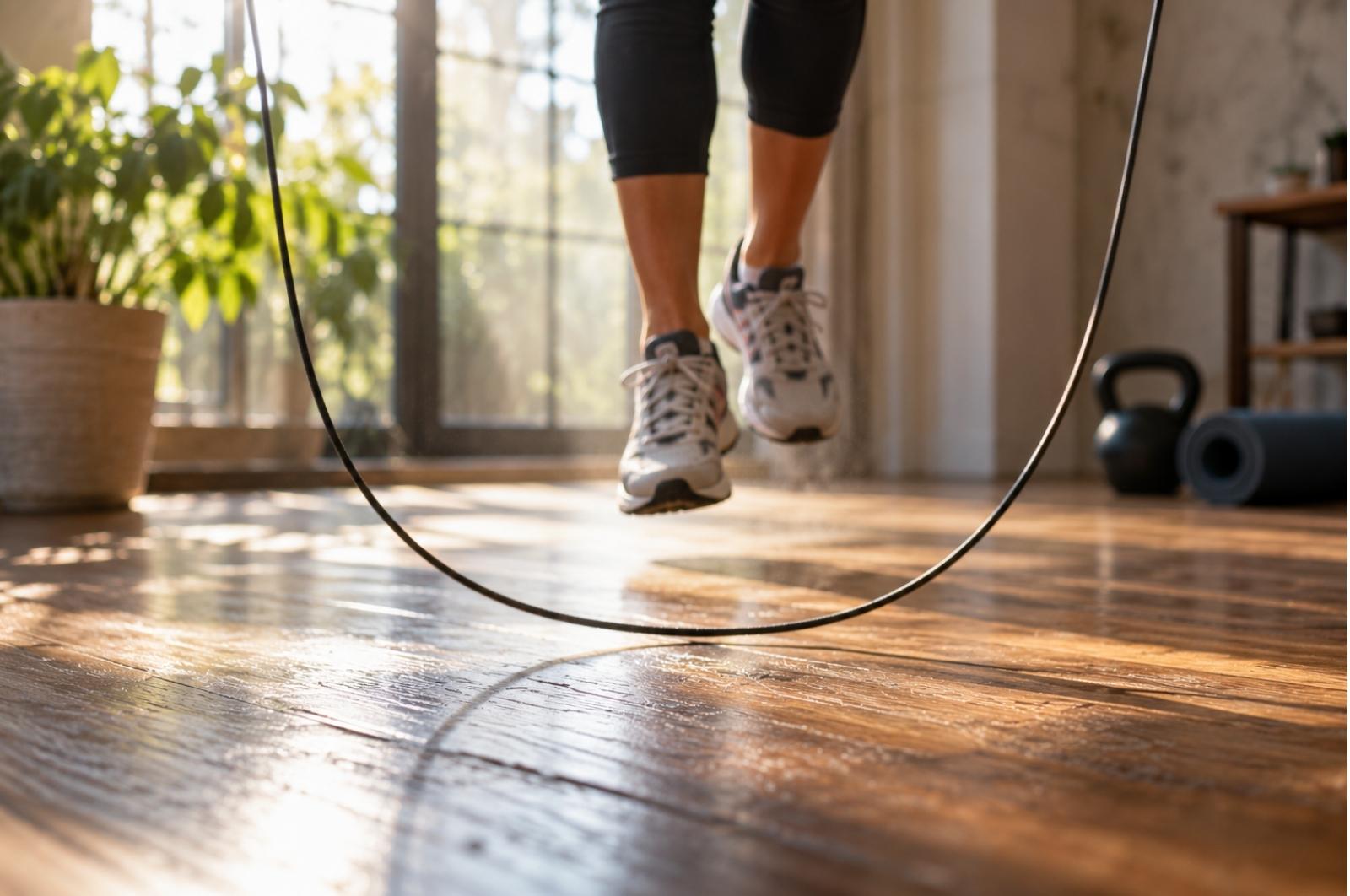
Jumping exercises, hopping, and skipping rope done 4 to 7 times per week at moderate to high intensity. The threshold for osteogenic effect is loads exceeding roughly twice body weight, applied progressively and in multiple directions.
Both interventions work through the same mechanism.
They apply high-magnitude mechanical strain to the skeleton, which is the specific stimulus bone remodeling responds to.
Low-force repetitive movement (walking, swimming, cycling itself) does almost nothing at the cellular level.
Dr. Stacy Sims has been particularly explicit about the impact-loading component for female cyclists.
Peri- and post-menopausal women lose bone mass at accelerated rates due to estrogen decline, and Sims's position is that the traditional "run more, ride more" advice actively fails this population.
Why Cyclists Refuse to Do Strength and Impact Work
The resistance to these interventions is cultural, not physiological. Cyclists are protective of their training time, and any hour spent lifting weights or jumping is an hour not spent on the bike.
There is also a body-composition concern. Riders worry that adding muscle mass will hurt their power-to-weight ratio, particularly climbers.
This concern is largely unfounded at the moderate loading required for BMD maintenance, but it persists.
The 6 to 10 rep protocol Sims recommends does not build significant hypertrophy.
It builds neuromuscular strength and mechanical loading capacity. Body weight changes from twice-weekly compound lifting are typically 1 to 2 kg over 6 months, and often accompanied by fat loss that offsets the muscle gain.
For a broader look at the bone density risks that cyclists face and the mechanisms behind them, our earlier piece on why cyclists get osteopenia and how to prevent it covers the physiology in more detail.
The Female Cyclist Multiplier
The bone-density problem is worse for women. Female cyclists face three compounding factors: lower baseline bone mass, hormonal declines through perimenopause and menopause, and lower body mass predisposing to nutritional deficits.
Elite female cyclists are also disproportionately affected by low energy availability (LEA), which further suppresses bone-forming hormones.
The combination of endurance training volume, cycling-specific non-loading, and inadequate energy intake produces bone-density losses that can approach 3 to 4 percent per year in the worst-affected riders.
For female cyclists over 45, the strength-training-plus-impact intervention is not optional. It is preventive medicine.
The Nutritional Layer That Matters
Mechanical loading is the primary intervention, but nutrition amplifies or blunts the response.
Calcium intake of 1,000 to 1,200 mg per day through diet (dairy, leafy greens, fortified foods) supports the bone-remodeling process. Supplements can fill gaps but food sources are consistently better absorbed.
Vitamin D at 1,000 to 2,000 IU per day (or from measured serum levels) is essential for calcium absorption. Deficiency is common in cyclists who train indoors during winter months or live at high latitudes.
Protein intake of 1.6 to 2.0 g per kg body weight supports both muscle and bone protein synthesis. Cyclists routinely under-consume protein because they prioritize carbohydrate for training.
Iron status matters especially for female cyclists, both for oxygen transport and for enzymes involved in bone collagen synthesis. Ferritin below 30 ng/mL is worth investigating.
The Fracture Risk Cyclists Never See Coming
The clinical relevance of low BMD only becomes obvious when a rider crashes.
A minor fall at 15 km/h that would leave a non-cyclist bruised and sore can produce a fracture in a cyclist with silent osteopenia.
Wrist, hip, and clavicle fractures are the common presentations.
Recovery from a mid-life fracture is significantly slower than recovery from the same fracture at 25, and repeat fractures become more likely as bone density continues to decline.
The compounding cost is real.
A rider who breaks a wrist at 45, spends 8 weeks off the bike, loses fitness, comes back cautiously, and adds another 4 weeks of low-intensity recovery has just spent a quarter of their year rebuilding what a stronger skeleton would have prevented.
Where This Guidance Falls Short
The bone-density picture is not universally grim. Some cyclists, particularly those who cross-train with running or resistance work already, maintain adequate BMD across decades of riding.
Cross-country skiers, who load the skeleton through poling and hill climbing, have consistently better bone mass than pure cyclists.
The evidence base for female masters cyclists specifically is thinner than for younger male populations.
Menopause-specific BMD trajectories in trained women are still an emerging area, and hormone replacement therapy interactions with training adaptation remain largely unstudied.
Individual response variability is significant. Some riders lose BMD faster than others on identical training and nutrition. Genetics accounts for a meaningful portion of the variance that no intervention will fully overcome.
What to Actually Do This Month
The strength-and-impact protocol is straightforward, and it does not require gym membership or specialized equipment.
Two sessions per week of compound resistance work. Bodyweight can substitute for barbell for the first 8 weeks (goblet squats, split squats, glute bridges, push-ups), then progress to weighted work as capacity builds.
Add 5 to 10 minutes of jumping-based impact work 3 to 4 times per week. Jumping rope, box jumps, hopping in place, or bounding drills all work. Progression is by height and complexity, not by duration.
Get a DEXA scan if you are over 40 and have never been screened. A baseline measurement lets you track whether interventions are working, and it identifies riders who need medical intervention beyond exercise.
Fix the nutritional basics. Calcium, vitamin D, adequate protein, iron for female riders. These are cheap to get right and expensive to get wrong.
The 84 percent osteopenia prevalence figure is not the ceiling. It is the current rate, driven largely by cyclists refusing to spend 45 minutes twice a week doing something that is not cycling.
The riders who do the strength and impact work protect their skeletons across decades. The riders who don't discover the problem the day they crash.