The Only 3 Rides Cyclists Actually Need
A 2024 systematic review of 14 studies found the same thing across cyclists, runners, and triathletes. Three ride types, arranged deliberately, out-performs six random sessions every time.
Some elite road cyclists carry the spine of a man decades older. The cause is not age, and the fix is not calcium.
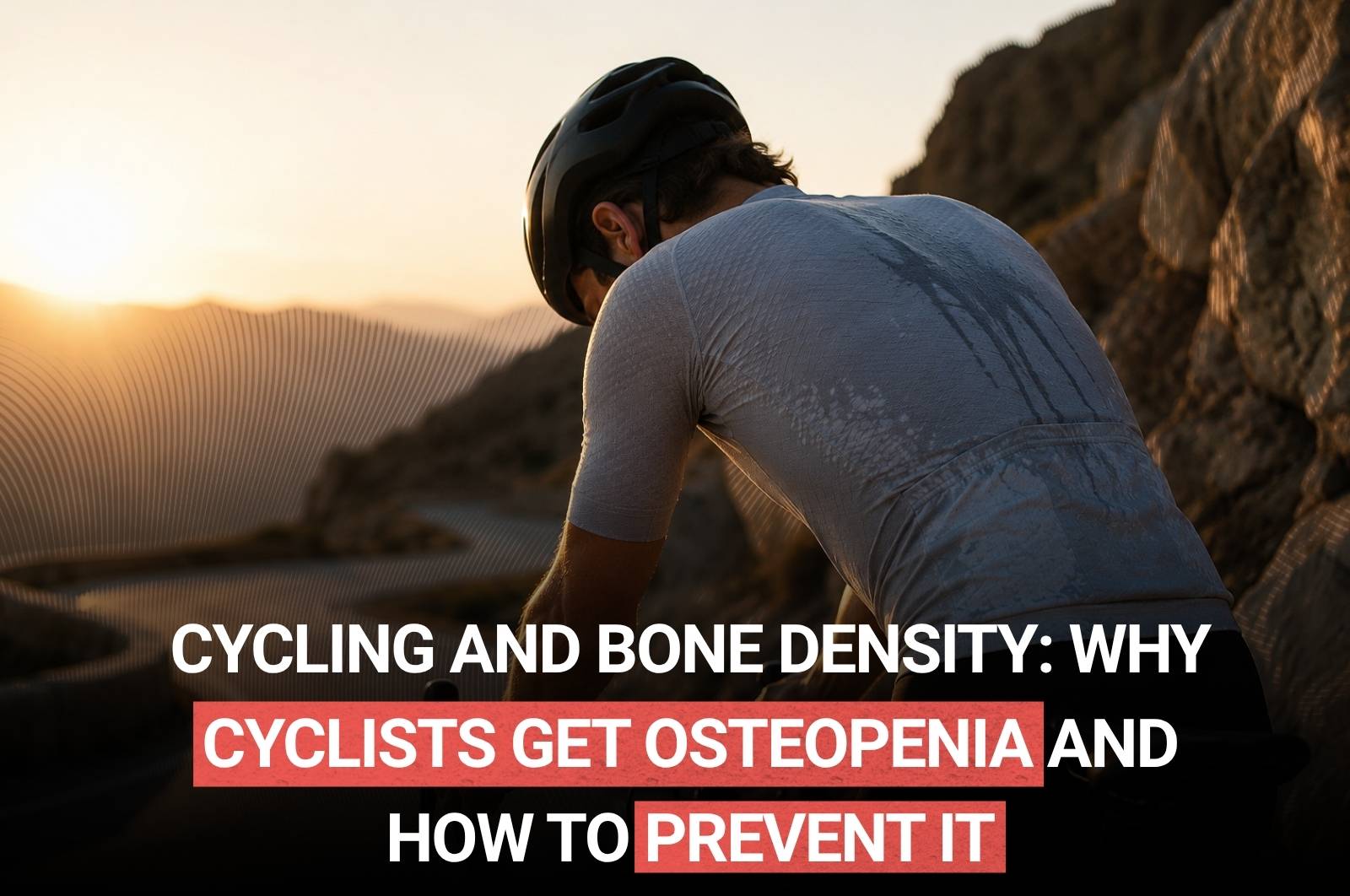
Here is an uncomfortable truth about the sport you love.
Cycling is one of the best things you can do for your heart, your lungs, and your waistline.
It may also be quietly weakening the one system almost no rider ever thinks about: your bones.
That sounds backwards. Exercise is supposed to make you stronger, top to bottom.
But bone does not care how fit you are. It responds to one thing above all, and cycling barely provides it.
Bone is living tissue. It gets denser when you load it with impact and strain, and it thins when you do not.
Running, jumping, and lifting all pound the skeleton and signal it to build. Cycling does almost none of that.
You sit. Your weight rests on the saddle and the pedals, not on your legs the way walking or running demands.
That is wonderful for your joints, which is exactly why so many riders are drawn to the bike in the first place.
We have written before about how cycling protects your knees and joints while other sports grind them down.
The catch is that the same gentleness that saves your joints starves your bones of the stimulus they need.
This is not a fringe theory. It is one of the more consistent findings in cycling physiology.
A major systematic review pulled together 31 separate studies on cycling and bone health.
The pattern was hard to ignore.
Adult road cyclists who train regularly showed low bone mineral density in key regions, especially the lumbar spine.
Athletes in weight bearing sports and ordinary non-athletes did not.
The review went further. It reported that roughly two thirds of professional and masters road cyclists could be classified as osteopenic, meaning their bone density had already dropped below normal.
Sit with that number for a second.
Two in three of the most dedicated riders, carrying bones weaker than they should be.
Other work has been blunter still.
Researchers have noted that some elite cyclists carry the kind of bone density you would expect to see in a man decades older, in a few cases comparable to a 70 year old.
Here is the part that stings. The problem tends to get worse the more you ride.
Longer careers and higher training volumes are linked to lower bone density, not higher.
The engine gets stronger while the frame it hangs on gets more fragile.
Luuk Hilkens, a researcher who has studied bone in elite cyclists, co-authored a viewpoint pointedly framed around the fragile bones of the professional peloton.
His message was not that cycling is bad.
It was that riders and teams need to take bone seriously, monitor it, and stop assuming that being fit protects them.
There is a second mechanism most riders never hear about, and it works against you on every long, hot day.
You lose calcium through sweat. On a big ride in the heat, that loss adds up quickly.
When blood calcium drops, the body pulls what it needs from the largest calcium store it owns. That store is your skeleton.
So a hard century in July is not only a fitness session.
It can be a small withdrawal from your bone bank, repeated ride after ride, season after season.

Now let us be precise, because the internet loves to turn a finding like this into a scare.
Most of the evidence is cross-sectional.
It photographs cyclists at one moment and compares them to others, which shows a strong association but cannot prove that pedaling alone caused every gram of bone loss.
The bulk of the research is also on men, often elite men.
Recreational riders who lift, run, or played impact sports when younger tend to look far healthier on a bone scan.
And low bone density is a risk factor, not a sentence.
It raises the odds of a fracture, particularly in a crash, yet plenty of riders with lower numbers never break anything.
The point is not to frighten you off the bike. It is to close a blind spot that pure endurance training leaves wide open.
The fix is refreshingly simple, and it does not involve giving up a single mile.
Your bones need load, and the bike will not give it to them. So you give it to them off the bike.
Resistance training is the single most effective tool here.
Heavy compound lifts like squats and deadlifts place real strain on the spine and hips, which is exactly the signal your skeleton has been missing.
This is one more reason strength work belongs in every serious rider's week, and not just for watts on the climbs.
If you are not sure where to begin, our guide to strength exercises that build real cycling power is a sensible starting point.
Add a little impact where you can. Short bouts of running, hopping, or even skipping give bone the jolt that smooth pedaling never will.
Then handle the inputs.
Get enough calcium and vitamin D, and just as importantly, do not chronically under fuel, because low energy availability attacks bone from a completely different direction.
If you have ridden hard for years, especially as a masters rider, a DEXA scan is worth a conversation with your doctor.
It is quick, and it turns a hidden risk into a number you can act on. You cannot manage what you never measure.
None of this is a reason to hang up the bike.
Cycling remains one of the finest gifts you can hand your heart, your head, and your future years.
But strong lungs and a thinning skeleton is a strange trade to make by accident. The riders who last are the ones who train the whole body, not just the motor.
Load your bones, fuel them, and check them.
Then go ride, knowing the frame will hold up as well as the engine does.
Perfect for the new riders!
No spam. Cancel anytime.