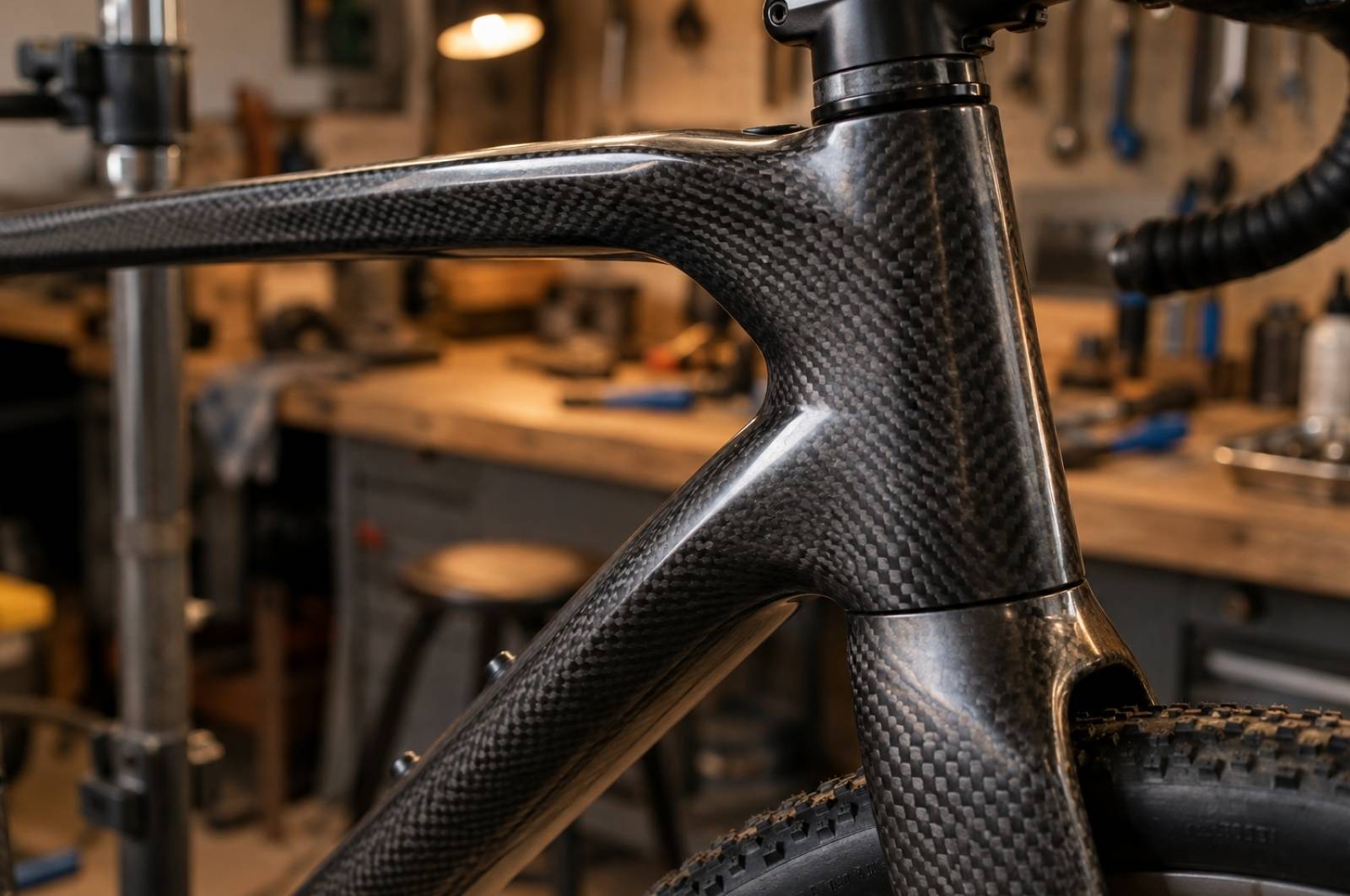
Canyon's LeBron James project exposed a truth the industry has been quiet about for years. When you scale a frame, the loads don't scale with it. And almost no production bike solves that.
Wolfgang Kohl did not set out to indict the cycling industry. He was just building LeBron James a gravel bike.
Kohl is the lead engineer for gravel at Canyon. When Canyon confirmed the one-off 3XL Grizl CF for James at the September 3 reveal, Kohl explained why the project took the shape it did.
"The geometry might land in the right place, but the loads don't scale the way the dimensions do," he told Velo.
"Everything needed to get re-engineered or the bike simply wouldn't function as a responsive system to the rider."
That is a mild, engineer-neutral statement. Read it twice and it becomes something more damning.
Every production frame in the taller size range is compromising on load engineering. And almost nobody is talking about it.
If you ride at 6'4", 6'6", or 6'8", you have felt this without having the language for it. The bike that "fits" you on the geometry chart still rides like it is fighting you.
The Fit Problem Nobody Wants to Solve
Bike geometry charts scale in a predictable way. Reach gets longer, stack goes taller, seat tube extends, head tube grows.
On paper, a 2XL frame looks like a natural extension of an XL. Which looks like a natural extension of a large.
The numbers scale. The physics doesn't.
A rider at 6'6" weighs, on average, about fifty pounds more than a rider at 5'10". They generate more torque through the pedals.
They put more lateral force through the bars during out-of-saddle efforts. They load the frame more aggressively in every direction.
The frame is longer, so bending moments increase. The wheelbase is longer, so twisting loads at the head tube get higher.
A frame that is 15% larger might be seeing 30% more load in some directions. Just making the tubes longer doesn't cut it.
You need thicker walls, different carbon layups, reinforced junctions, wider bearing standards. Almost no production frame does this.
Most brands take the XL mold, extend the dimensions, and ship it.
What Canyon Actually Had to Rebuild
For the LeBron project, Canyon didn't just stretch the Grizl. They rebuilt it.
Canyon's engineers developed a new carbon layup specifically designed to handle a 250-pound rider generating loads a standard Grizl was never engineered for. Off-the-shelf axles didn't meet the stress requirements.
So they CNC-machined custom thru-axles with boost spacing. They fabricated a custom seat clamp, because the production part wasn't rated for the seatpost length required.
Every one of those parts exists because a standard part failed the stress test. That is the tell.
When the world's third-largest carbon brand cannot use its own production components at 3XL scale, it means every 2XL and XL frame in the industry is riding closer to the load envelope than most riders realize. Not to failure or danger.
But to a place where flex, twist, and inefficiency start to show up in how the bike rides.
Why This Matters for the 6'3" Rider, Not Just the 6'9" One
LeBron James is an outlier. Almost nobody reading this is 6'9".
But the load engineering issue starts well before that. A rider at 6'3" and 210 pounds is putting substantially more force through the bike than the average XL frame was engineered around.
A rider at 6'6" and 230 pounds is well past it.
If you fit that description, some patterns you may have noticed suddenly have an explanation. The bike feels vague under hard cornering.
Out-of-saddle sprints feel like the frame is "wagging." Rough gravel transmits more shock than the geometry would suggest.
The bike descends nervously even after a professional fit. The rear end feels overwhelmed on chunky terrain.
Those are not fit problems in the traditional sense. Your saddle height is fine and your reach is dialed.
A proper bike fit protocol will not fix them. They are load-engineering symptoms, and they are baked into the frame before you ever throw a leg over it.
The Five Things Big Riders Should Actually Look For
If you are over 6'3", the spec sheet you should be reading is different from the one the marketing team wrote.
1. Frame stiffness at your size, not their base size. Ask the brand's engineering team (not the sales team) what changes between XL and 2XL.
If the answer is "we scale the tubes," walk away. If the answer includes "additional layers in the head tube junction" or "revised layup schedule," listen.
2. Wheel size relative to your inseam and riding style. The LeBron bike uses 32-inch wheels for a reason.
For riders over 6'3" on genuinely rough terrain, larger wheels reduce fatigue and improve rollover in ways that matter. It is not a gimmick.
3. Axle and bearing standards. Boost spacing, 12mm thru-axles, and oversized bottom bracket standards were designed for load capacity as much as tire clearance.
If a frame at your size is running road-spec axles, that is a red flag.
4. Handlebar width and stem length. A 42cm bar and 100mm stem look normal on paper.
On a 6'6" rider they can create a torque geometry that overwhelms a standard head tube. Wider bars, shorter stems, and a slacker head tube angle all reduce the lever arm your inputs apply to the frame.
5. Seatpost length and setback. A 400mm seatpost extension puts a very different load through the seat cluster than a 200mm extension.
Look for reinforced seat tube junctions, seatposts rated for the exposed length you actually need, and seat clamps designed for the seatpost diameter, not scaled down from the XL bill of materials.
Almost none of this shows up on a geometry chart. All of it shows up in how the bike rides.
Two things are happening at once. Both benefit tall riders.
The 32-Inch Wheel Push
Salsa, Mosaic, Rare Earth Cycle, and now Canyon are all publicly working on 32-inch platforms.
Some of that is chasing rollover physics for all riders. Some of it is quietly a fit story.
Salsa's Fargo 32 launched sized small through extra-large, targeting riders from 5'2" to 6'7". That is the first mainstream production bike to publicly acknowledge that fit range as a design goal.
The Custom Carbon Boom
Boutique builders like Dirty Sixer have been building 32-inch and 36-inch bikes for tall riders for over a decade.
The industry ignored them. Now the majors are starting to borrow their playbook.
Canyon's LeBron project is the most visible example. There are quieter versions of it happening at other brands.
The tell that this is real: engineering budgets are being allocated, not just marketing budgets. When a company like Canyon commits to a new carbon layup for one bike, that layup gets reused.
When the layup gets reused, the geometry that goes with it gets scaled. When the geometry gets scaled, tall riders finally get options.
Where the LeBron Project Falls Short (for the Rest of Us)
The uncomfortable part of this story is that the fix is not available to buy.
LeBron got the bike because he is a Canyon investor with a global platform. The engineering hours, the custom axles, the new carbon layup, the one-off wheels, none of it is going into production this year.
It might feed a future product. It might not.
For a 6'6" rider looking for a gravel bike right now, the options are limited. A 2XL production frame with the caveats above.
A custom titanium build from a specialist at $8,000-plus. Or wait.
Waiting is not a great plan, but it is not a terrible one either. The industry is moving.
Salsa is shipping this fall, Mosaic is shipping now, and Canyon has publicly committed R&D to the standard. Within eighteen months, a production 32-inch gravel bike from a top-five brand is likely.
If you cannot wait, the practical move is to spec for load first. A carbon fiber frame that runs a real 2XL layup, not a scaled XL.
Wider bars, and a slightly shorter stem. Wheels built for your weight, not for a 165-pound rider.
Tires with the volume you need for the terrain you actually ride. And a fit protocol that acknowledges the frame will flex more than a spec sheet suggests.
Final Thoughts
Wolfgang Kohl's line about load scaling is the most important sentence any bike engineer has said publicly this year. It is the quiet acknowledgment of a problem the industry has been designing around, not solving.
The LeBron project is a marketing win for Canyon. But the actual value is the R&D dataset it produced.
A validated carbon layup at 3XL scale. A new geometry file.
A proof point that the fit problem for tall riders is an engineering problem, not a customer problem.
The riders who benefit are not going to be the 6'9" ones. There is one of those in mainstream cycling.
The riders who benefit are the 6'3", 6'5", 6'6" cyclists who have quietly assumed their bike "feels weird" because they are too tall for the sport. They aren't.
The sport was too small for them. That is finally changing.
The custom bike went to LeBron. The engineering is going into everything Canyon builds next.