New peer-reviewed research on 10 cyclists says that framing was mostly wrong. What actually shifts is recovery capacity, not peak output
For most of the last decade, female cyclists have been told a specific story about their bodies.
The story went like this: estrogen and progesterone shift dramatically across a menstrual cycle. Therefore your hard sessions should be timed to your follicular phase.
Therefore you should back off in the luteal phase.
Therefore, if you are not periodizing your training around your cycle, you are leaving performance on the table.
This became known as cycle syncing. Coaches wrote programs around it. Apps built businesses on it.
Wellness influencers turned it into content.
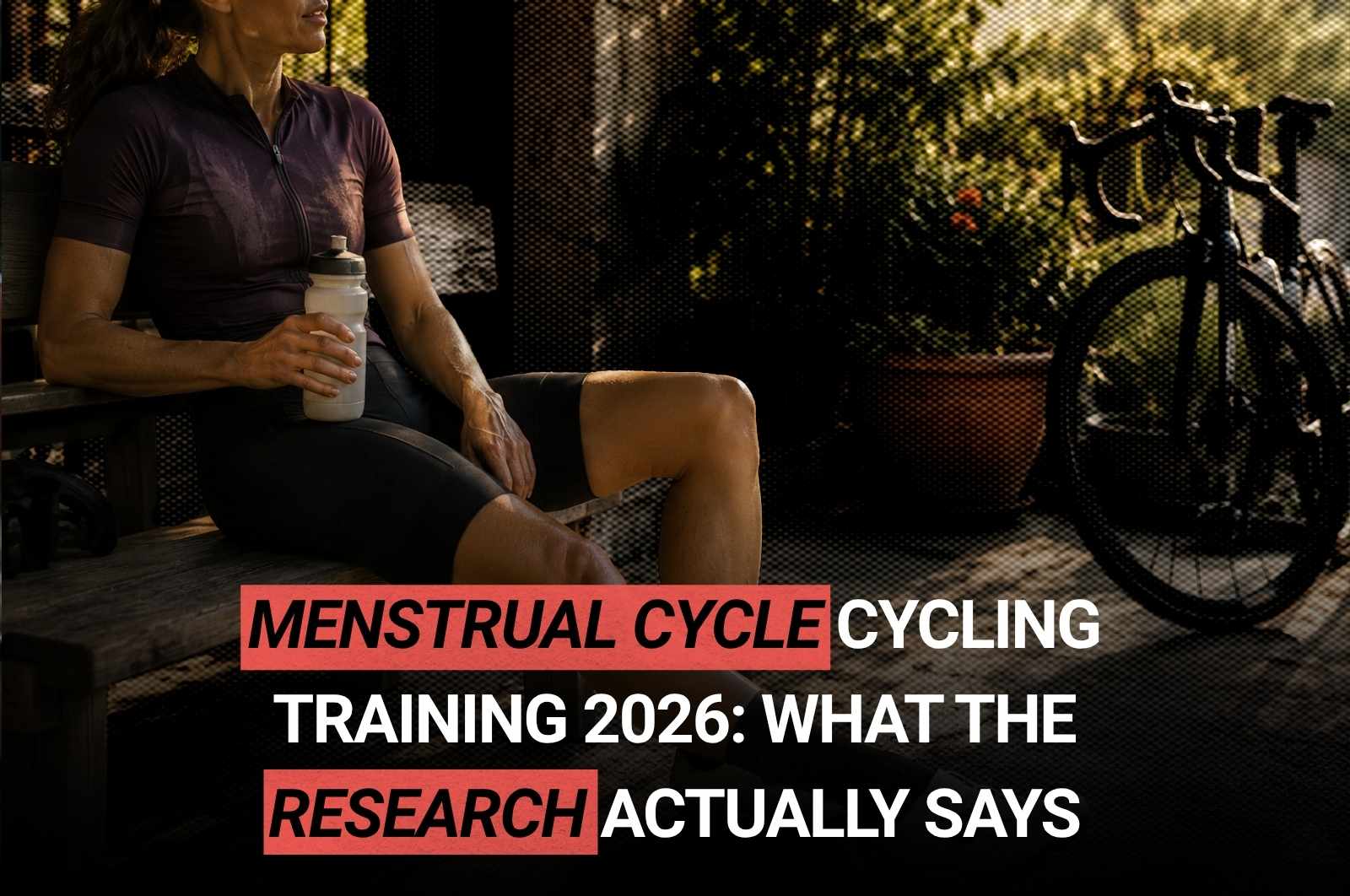
A new 2026 study published in International Journal of Sports Science and Coaching by researchers Isabella Righi and Renato Barroso looked at what the training data actually says.
The finding: the popular narrative was mostly wrong.
What the 2026 Study Actually Measured
The Righi and Barroso study tracked 10 eumenorrheic trained female cyclists across five laboratory visits.
The first visit happened during the early follicular phase, when participants were bleeding.
Participants completed an incremental test and familiarised themselves with high-intensity interval training.
The remaining four visits were split into two sets of consecutive-day sessions in either the late follicular phase (between the end of menstruation and ovulation) or the late luteal phase (about a week after ovulation).
On HIIT session days, participants answered a Total Quality of Recovery (TQR) questionnaire and a Well-Being questionnaire, then completed a 3-minute test before and after the HIIT block.
Rating of Perceived Exertion (RPE) was recorded throughout.
On time trial days, they performed a 20-kilometre time trial and answered the same TQR and Well-Being scales.
This was a well-designed study, closer to real-world training than most menstrual cycle research has managed.
The Finding Nobody Wanted to Hear
The actual performance metrics (power output, time trial time, HIIT session output) did not differ significantly between the late follicular phase and the late luteal phase.
In other words, the cyclists did not go slower when the syncing model says they should have.
What did change was how they felt. Perceived recovery scored lower in the late luteal phase.
Well-being scores dipped. RPE at a given output was higher.
The lead framing from the researchers: menstrual cycle phases affect recovery more than performance.
That is not the same message as "train hard in follicular, back off in luteal."
That is "you can still hit your numbers, you just may feel worse doing it, and you may need more recovery time between sessions."
Why This Matters for How Female Cyclists Should Train
There are two clear practical implications.
First, do not automatically back off hard sessions in the late luteal phase. If your legs are ready and your numbers are hitting, the performance is there.
Second, respect the recovery cost more than the performance cost.
If perceived exertion is higher at the same wattage, that is real training stress.
Two hard days in a row in a bad luteal-phase week may cost more than the same two days in the follicular phase, even if the power numbers look identical.
This maps directly to what elite female cyclists have said publicly. Interviewed for a PLOS One 2026 study on female cyclist experiences, one participant described elite sport as "highly result-oriented, with many unwilling to sacrifice short-term performance for longer-term wellbeing."
The new science suggests you may not have to. The performance often shows up.
The recovery load is what needs the extra respect.
Where the Broader Literature Actually Lands
The Righi and Barroso study does not exist in a vacuum. It aligns with a growing body of 2024 and 2025 systematic reviews and related bicycle ergometer research that keep landing on the same conclusion.
A 2025 Schlie, Krassowski, Schmidt review in the Journal of Applied Physiology found that when studies are held to high methodological standards, evidence for menstrual cycle-tailored training producing performance gains is limited.
A 2025 review by Mikkonen and Häkkinen in the Strength and Conditioning Journal was even more direct in its title:
"Evidence for Periodizing Strength and/or Endurance Training According to Menstrual Cycle Phases to Optimize Female Athlete Performance Is Lacking."
That is a lot of peer-reviewed science pointing in the same direction. Cycle syncing as a rigid framework was oversold.
Where Cycle Awareness Actually Does Help
This is where the honest picture matters.
Symptoms are real. In a 2026 PLOS One qualitative study of 20 competitive female cyclists, participants reported a wide range of symptoms that varied in severity and timing.
45 percent had experienced irregular menstrual cycles either currently or in the past, and many attributed those irregularities to low body weight or insufficient energy intake to support training.
That is the finding that should worry coaches, not the follicular versus luteal debate.
Under-fueling in female cyclists shows up as menstrual dysfunction long before it shows up as a bad power file.
It is one of the first red flags for Relative Energy Deficiency in Sport (RED-S), which is a well-documented syndrome with cardiovascular, bone health, and reproductive consequences.
The cycling calendar is brutal. Multi-day races, back-to-back interval blocks, and the pressure to stay lean can push female cyclists into chronic under-fueling.
A missing period is the body flagging a problem, not a badge of dedication.
Where the Research Still Falls Short
The Righi and Barroso study covered 10 cyclists. That is a small sample.
It also only covered eumenorrheic cyclists, meaning riders with regular natural cycles.
It did not cover riders on hormonal contraceptives, riders in perimenopause, or riders with irregular cycles, all of whom face genuinely different physiology.
The larger 120-cyclist IMPACT study at Karolinska Institute (Ekenros et al.) is currently running and will produce a much bigger dataset comparing follicular-phase-based training against luteal-phase-based training against control.
That study finishes in 2027 and 2028.
Until then, the honest read is: the current evidence base is small, but it is consistent, and it does not support the marketing hype.
What Actually Helps in the Meantime
Track your cycle, but for symptoms and recovery quality, not for scheduling hard sessions.
Fuel adequately, especially in high-training weeks.
Under-fueling shows up in menstrual dysfunction faster than most riders realize.
Believe the perceived exertion score. If a workout felt harder than the numbers suggest, respect that. The 2026 study specifically documented that RPE increases in the late luteal phase for the same output.
Sleep, hydration, and iron status matter more than cycle timing. The site has covered iron deeply in Iron Deficiency Is Quietly Crushing Your Cycling, which is especially relevant for female riders.
The peer-reviewed evidence keeps saying so. Female cyclists who trust the follicular-phase-good, luteal-phase-bad framing are training on a model that does not match the data.
What the science actually says: performance holds up across the cycle.
Recovery capacity does not. Perceived exertion increases in the late luteal phase even at the same output.
That is a more useful truth than the one that was being sold.
It means the female cyclist who was told to skip her hard interval day during the luteal phase was probably being told wrong.
It also means the one who was told her worse-feeling luteal-phase ride was in her head was being told wrong, too.
Both extremes were selling something.
The new data is quietly, unglamorously, in the middle.