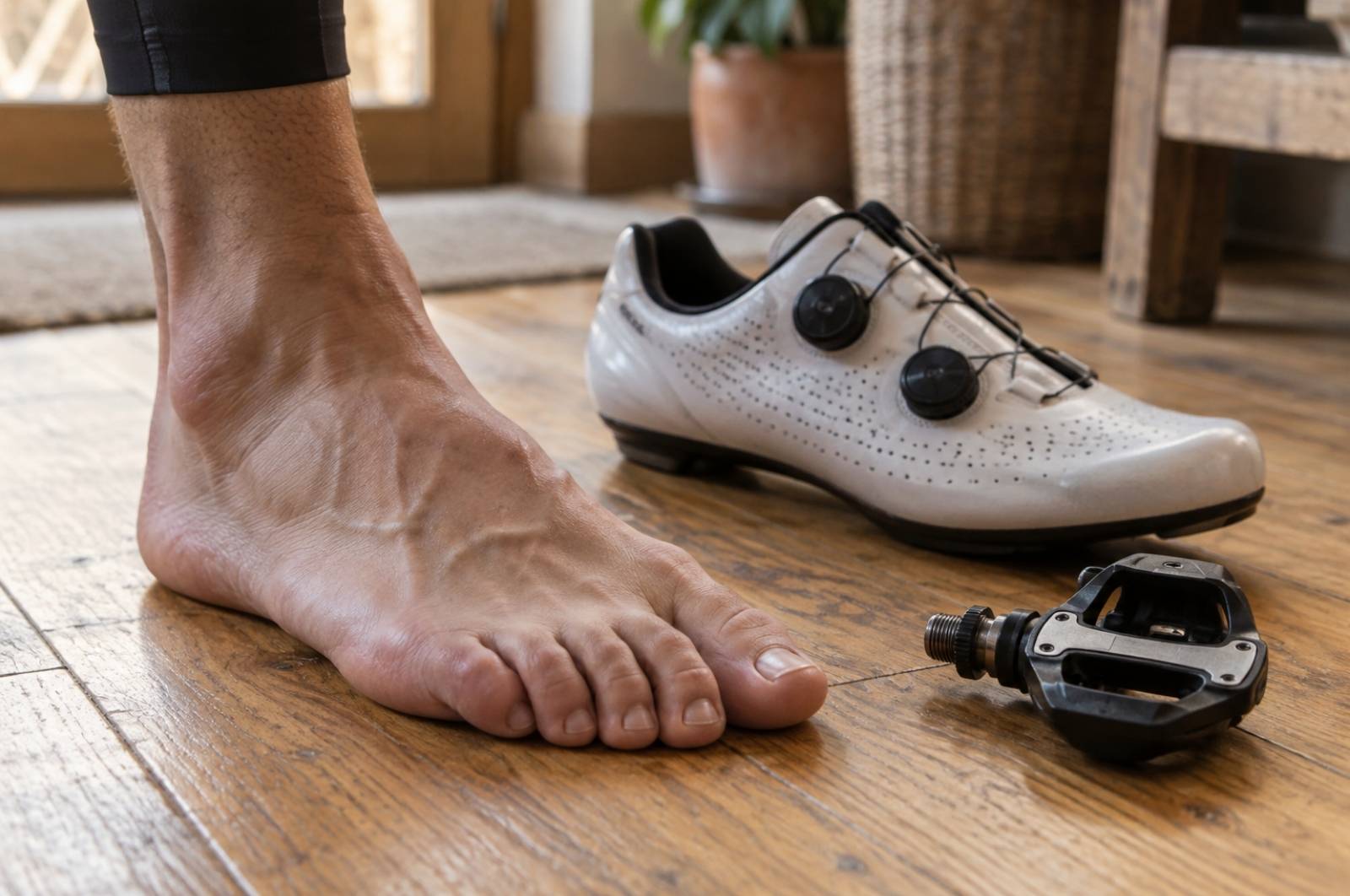
Running has spent 15 years arguing over minimalist shoes. Cycling has quietly gone the other way, chasing carbon-plate rigidity and tighter uppers, and there is a good biomechanical reason the barefoot movement has not crossed the aisle yet.
Walk into any running store in 2026 and the wall behind the counter tells the story.
Altra, Vivobarefoot, Xero, Merrell Bare Access, and a dozen other brands built entire businesses on the argument that thick heels, arch support, and structured uppers weakened the human foot.
Walk into a cycling shop the same day and the wall behind that counter tells the opposite story.
S-Works Ares, Fizik Tempo Overcurve, Shimano S-Phyre RC9, and now the new RC910 designed around SPD-SLR. Full carbon soles measured for bending stiffness in Newton-meters per radian.
Boa L6 dials with micro-adjust. Structural TPU heel cups.
Two sports. Two athlete populations. Two completely opposite philosophies about what a shoe should do.
The question is whether cycling ever swings back the other way.
What Barefoot Actually Means in a Sport Where You Do Not Touch the Ground
The barefoot movement in running rests on a specific mechanical claim.
The human foot has 26 bones, 33 joints, and roughly 100 muscles, tendons, and ligaments, and the argument is that a cushioned, arch-supported shoe overrides that entire system.
The intrinsic foot muscles atrophy, the forefoot cannot spread on landing, and the proprioceptive information the sole would normally send to the brain gets muffled.
For running, that argument has real evidence behind it.
Studies of habitually barefoot populations show measurably different foot strike patterns, better arch stiffness, and lower rates of certain overuse injuries.
None of that argument applies straightforwardly to cycling.
A cyclist's foot never absorbs impact. It never lands, splays, or push-offs against variable terrain.
It presses down against a rigid pedal spindle 80 to 100 times per minute for hours, in a controlled arc that never leaves a single plane.
The mechanical problem the barefoot movement was built to solve does not exist on a bicycle.
Why Cycling Went the Opposite Direction
The reason road cycling shoes got stiffer and stiffer for 30 years is not marketing. It is force transfer.
When you push on a bicycle pedal, some fraction of your effort deforms the shoe rather than turning the crank. A flexible shoe absorbs force through sole bending.
That energy does not disappear, but it does not go into forward motion either.
Research on cycling shoe outsole stiffness has been consistent about one thing: at sub-maximal intensities, stiffness does not measurably improve power output.
But at maximal and supramaximal sprint efforts, stiffer soles produce measurable sprint power improvements of up to 10 to 16% in controlled outdoor tests, compared to running shoes on flat pedals.
That number is real. It is also the number the industry has spent decades chasing.
The problem is that most amateur cyclists never spend meaningful time at sprint intensities.
And in that recreational and endurance range, the stiffness benefit disappears entirely.
The Case Barefoot Advocates Could Actually Make
There is a version of the minimalist argument that fits cycling. It just is not the version most people would guess.
The first claim would be about foot health off the bike.
Cyclists spend hours pressing against a rigid platform in a shoe that immobilizes the intrinsic foot muscles.
There is at least a plausible case that this contributes to weakened arches, reduced toe splay, and the surprisingly high rate of foot numbness and hot spot pain among long-distance riders.
The second claim would be about arch collapse and plantar pressure distribution.
A controlled crossover study published in Sensors looked at how in-shoe systems and hard insoles change plantar pressure distribution in cyclists, and found that the shoe-cleat interface causes medial longitudinal arch collapse, plantar fascia stretching, and subtalar joint pronation during sustained pedaling.
Those findings are not an argument for stiffer shoes. They are an argument for shoes that let the foot do more of its own work.
The third claim would be about cleat position and fit dogma.
The current industry standard puts the cleat directly under the first metatarsal head, and that position is calibrated for maximum leverage in a rigid shoe.
If shoe designs allowed the foot to flex naturally, that cleat position might not be optimal.
Those are the three arguments a serious minimalist cycling movement would have to make.
None of them are the running argument. All of them are internally consistent.
Where the Movement Is Already Quietly Happening
Look carefully at what pro riders and small brands are doing and you will see fragments of the minimalist argument being tested.
Tadej Pogačar wears lace-up cycling shoes, not because they are minimalist, but because the lace pattern lets his feet swell during long stages without cutting off blood flow.
That is a fit philosophy that is distinctly different from the tight, dial-and-cable Boa systems that dominate the peloton, and it hints at a broader instinct toward accommodating the foot rather than immobilizing it.
Lake Cycling has quietly built a business around wider lasts and more forgiving fit windows.
Their CX and MX lines run measurably wider in the forefoot than mainstream road shoes, which is a partial nod to the toe-splay argument even if the sole itself is still stiff.
Bont has built a cult following around heat-moldable carbon shoes that shape to the foot's own arch geometry rather than forcing the foot into a predetermined shell.
That is not barefoot cycling, but it is the same idea in a different vocabulary: let the foot lead, then support what it needs supporting.
And flat pedal riding has grown genuinely popular in gravel and bikepacking circles, with brands like Five Ten and Ride Concepts selling grippy flat-pedal shoes to cyclists who explicitly do not want to be locked in.
The building blocks are there. What is missing is a company willing to sell the full argument.
Why No One Has Made a Truly Minimalist Road Cycling Shoe Yet
The answer is depressingly simple. Sprint power.
Every major road brand markets its top shoe on measurable stiffness numbers because the World Tour peloton demands it.
Sprinters and time trialists ride bikes at power outputs where the sole bending question actually matters, and every recreational road cyclist buying a shoe is essentially aspiring to the same equipment as the pros.
A brand that launched a minimalist road cycling shoe would have to argue against the entire aspirational marketing pipeline the industry has built for 40 years.
And they would have to do it without the natural constituency the running minimalist movement had.
Running had Christopher McDougall's Born to Run in 2009 and a rich ancestral-health narrative behind it.
Cycling has no equivalent story: the bicycle is a modern invention, and nobody rode barefoot for a million years.
The audience for a minimalist cycling shoe would have to be built from scratch, and no brand has decided the audience is large enough to justify the marketing investment.
What a Serious Minimalist Cycling Shoe Would Look Like
If a brand did decide to build one, the specification is not hard to imagine.
Flat, wide toe box with genuine forefoot spread room, not the tapered points that current road shoes use.
This would let the intrinsic foot muscles do actual work during the pedal stroke.
Moderate sole stiffness, not the maximum-stiffness carbon plates of current top-tier shoes, but stiff enough for meaningful power transfer at endurance intensities.
The research suggests the useful stiffness threshold sits around 200 to 300 Newton-meters per radian, well below what current pro-level shoes offer.
Thinner insole and lower stack height, letting the foot sit closer to the pedal and increasing proprioceptive information about the pedal stroke.
Adjustable or user-selectable cleat placement window that goes further back toward the arch than current standards, since cleat placement further back has been shown to reduce calf muscle activation and let the foot's arch structure do more of the work.
Flexible, breathable upper with lace or minimal-hardware closure, letting the foot swell and move during long rides.
None of this is radical. All of it exists in fragments across the industry. Somebody just has to combine it into a shoe and sell it.
The Honest Prediction
The barefoot movement will not come to cycling as a wholesale replacement of clipless pedals and stiff soles.
That version of the argument does not survive contact with the physics of pedal-driven power transfer.
But a partial, biomechanically-honest version has a real chance of showing up over the next five years.
The push will not come from road cycling. It will come from gravel and ultra-endurance riders who spend 10 to 14 hours a day on the bike, and who are already asking questions about foot health, numbness, and hot spot pain that the current shoe designs are not answering well.
Watch for a small, opinionated brand to release a wide-toe, moderate-stiffness, low-stack ultra-endurance shoe and market it explicitly on foot health rather than sprint watts.
When that happens, the mainstream road brands will pay attention within a season.
The bigger road brands will not lead this.
They cannot, because their marketing infrastructure is built on the opposite claim. But they will follow, because they always do.
What This Means For You Right Now
You probably do not need to buy a minimalist cycling shoe. Nobody makes a good one yet.
What you can do is stop assuming that maximum stiffness equals maximum performance for your use case.
If you are not sprinting for finish lines, the top-tier carbon-plate shoe on the wall is not built for you.
A mid-range shoe with a slightly more forgiving fit and a slightly wider toe box will feel better on long rides and will not cost you measurable power at the intensities you actually ride.
Do foot mobility work off the bike. Walk barefoot at home, and do calf raises and toe splay drills.
The intrinsic foot muscles that current cycling shoes immobilize get weaker with disuse, and that weakness shows up as foot pain on long rides.
If you want a broader framework for how off-the-bike work supports on-the-bike performance, our piece on 4 cycling drills that work at any age covers the connection between mobility, cadence, and pedaling economy. And if you are curious about the underlying research on shoe-pedal interfaces and plantar pressure, the peer-reviewed evidence is more nuanced than the industry marketing would suggest.
The Bigger Question
The barefoot movement in running was really an argument about whether modern shoe design had gotten disconnected from what the human foot actually needs.
That question is worth asking about cycling shoes too, even if the answer looks different.
The modern road cycling shoe is a highly-evolved instrument, optimized for a specific narrow use case at the top of the sport. For that use case, it works beautifully.
For the recreational and endurance rider using the same shoe for a completely different set of demands, some of the design choices are not obviously right.
Sprint stiffness does not help you at 220 watts. Aggressive tapered toe boxes do not help your feet during a 6-hour gravel ride.
Maximum sole rigidity does not help your intrinsic foot muscles stay strong.
The question is not whether cycling needs a barefoot movement.
It is whether the industry is willing to build a shoe for the rider who is not chasing sprint wattage numbers.
That shoe does not exist yet.
It probably should.