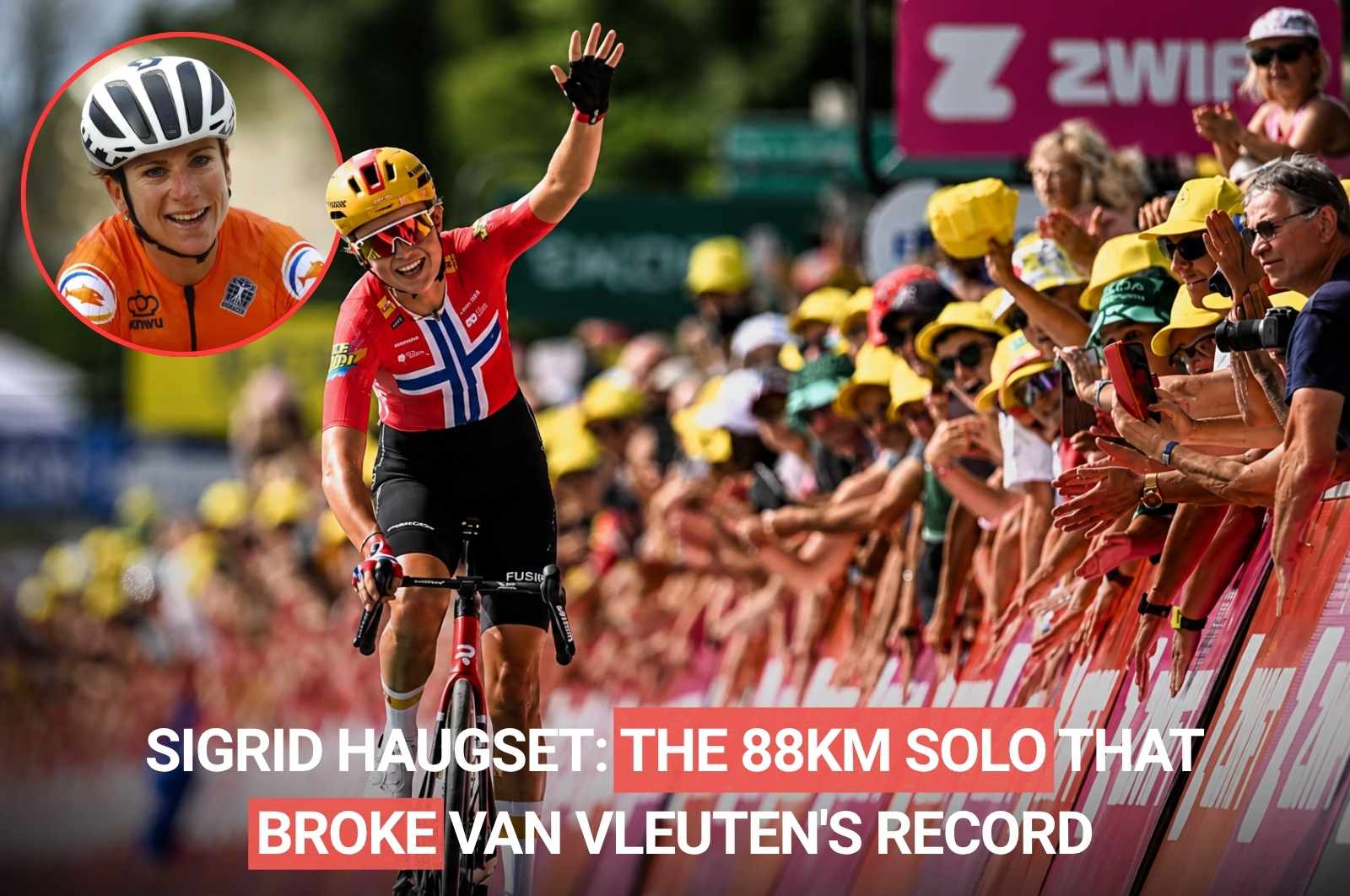
The 27 year old Norwegian was picked to shepherd Katrine Aalerud through the mountains. Instead she launched an 88.5 km attack, held Lotte Kopecky at 1 minute 24 seconds, and turned an opening week into history.
Annemiek van Vleuten (Image: Bettini Photo), Sigrid Ytterhus (Image: Getty Images)
The plan was simple. Uno-X Mobility brought Sigrid Haugset to the Tour de France Femmes to fetch bottles, chase gaps, and shield Katrine Aalerud on the climbs.
By Monday evening in Poligny, she was wearing yellow.
The 27 year old Norwegian attacked on the third climb of Stage 3, went clear at kilometre 68, and never came back. She held the peloton, the chase, and Lotte Kopecky at arm's length for the next 88.5 km. That is the longest solo winning breakaway in the history of the modern Tour de France Femmes.
It broke Annemiek van Vleuten's 62 km record, set on the road to Le Markstein in 2022.
It also broke a lot of assumptions about how this race would unfold.
The Attack Nobody Rated
Haugset went clear on the Côte de la Savine, a category 2 climb roughly halfway through the 156.5 km stage from Geneva to Poligny.
An 11 rider move had gone up the road earlier and been reeled in. When it collapsed, most riders sat up. Haugset did not. She pressed on alone across the Col de la Faucille region and into the rolling terrain of the Jura, building a gap that eventually stretched close to five minutes on the peloton.
The GC favourites did not chase seriously. Kim Le Court Pienaar attacked several times but could not build a cooperative group. Demi Vollering watched. Pauline Ferrand Prevot watched. Everyone assumed she would come back.
She did not.
The Chase That Nearly Worked
Kopecky was the only rider who tried to make the maths work. The Belgian, a multiple world champion and one of the most versatile riders in the peloton, launched a long solo pursuit inside the final 30 km.
With 12 km left, she had cut the gap to 15 seconds.
Haugset later admitted she was cramping. She said she was dizzy at the end and could not lift her arms off the bars. But when Kopecky was almost in sight, she stood up, drove another effort, and pulled the gap back out.
She crossed the line 1 minute 24 seconds ahead.
The Domestique Detail Everybody Missed
Haugset spent four seasons at Team Coop Repsol before stepping up to Uno-X Mobility for 2026. She entered the Tour de France Femmes with zero UCI wins on her palmares.
The team roster brief was clear. Aalerud was the leader, targeting a top 10 on GC. Haugset was late climbing support with, and this is the phrase teams use, permission to try for a stage if the situation offered.
The situation offered. She took it.
There is a smaller detail worth naming. Haugset raced Paris Roubaix earlier this year with a fractured hip. She finished. She kept racing through the spring. That kind of pain tolerance does not show up in a power file, but it shows up in a 88 km solo when your legs are screaming and a world champion is riding through you.
What This Does to the GC
Haugset now leads the general classification by 2 minutes 2 seconds over Le Court Pienaar. Vollering sits third at 2:06.
That is a significant buffer heading into the Stage 4 individual time trial in Dijon, and it changes the tactical texture of the whole race. Movistar and Marlen Reusser still have the ITT firepower to reset the standings. The FDJ Suez climbers still have Mont Ventoux on Friday. But Uno-X now has a jersey to defend, and every attack from a GC favourite has to reckon with a race leader who has already proven she will suffer alone for 88 km.
The team has not lost a Grand Tour yellow jersey in one summer before. Their men's squad wore it briefly through Torstein Traeen at the men's Tour de France just weeks ago. They have both jerseys now, in the same year.
The Norwegian Line
Haugset is the first Norwegian woman ever to wear yellow at the Tour de France Femmes.
The men's side has three names on that list. Thor Hushovd, Alexander Kristoff, and Traeen. She joins that lineage in her first opportunity, on a stage nobody expected her to win, in a race she was not selected to lead.
That is the kind of story cycling tends to remember.
What Comes Next
Stage 4 is a 21 km time trial from Gevrey Chambertin to Dijon. It is a course that suits pure specialists like Reusser and Zoe Backstedt. Haugset is a solid time triallist, third at the Norwegian ITT championships this year, but she is not a world class TT specialist.
The realistic expectation is that she loses time on Stage 4. The question is how much.
If she surrenders the jersey to a Reusser or a Vollering, that is the story. If she holds it into the Massif Central, the Uno-X plan for 2026 gets rewritten in real time. And if she is still in yellow when the race reaches Bedoin on Friday, the first ever women's summit finish on Mont Ventoux becomes a coronation stage, not a general classification test.
The Statement This Race Just Made
The Tour de France Femmes has now produced a genuine record breaking solo, a first ever Norwegian yellow jersey, and its most tactically wide open opening week yet. And there is still an entire mountain phase to come.
You do not get moments like this in cycling often. When they arrive, it is worth stopping the scroll for.