The first Sunday of April is only a few days away, which means that the Ronde van Vlaanderen is just around the corner. We’ve already seen many Flemish cobbled classics this season, however the Tour of Flanders is a different beast. It combines all the cobbled climbs and sectors from each race, making it one of the toughest days for the riders in the saddle. It is a race that every cycling fan should watch from start to the finish, since the race could kick off at any moment.
The fight for the breakaway is a long and attritional one, meanwhile the threat of echelons forces everybody to stay alert, which usually causes a lot of crashes even before the riders reach the first difficulties of the day. Speaking of difficulties, there are quite a few you have to get through if you want a chance at victory. Climbs such as the Koppenberg, Paterberg, Taainberg and the Oude Kwaremont are probably the deadliest in all of cycling.
Many iconic rivalries have been created at this race. We all remember the battles between Fabian Cancellara and Tom Boonen in the early 2010s or the nail biting finish between Mathieu Van der Poel and Wout van Aert in 2020. However, next to the superstars, some underdogs have also succeeded at this race in the past, Kasper Asgreen and Alberto Bettiol being the most recent ones. But as many races nowadays, this race has also been dominated by one rider in the recent years. Of course, I’m talking about Tadej Pogacar.
The Slovenian has turned this race completely upside down with his aggressive style of racing, and it has paid off for him a couple of times already. Could anybody stop him this year from getting his third win, which would make him the tied record holder? I’ll take you through all the possible scenarios the race could end in, introduce you the Slovenian’s biggest challengers, while also giving you a deep-dive into the route itself. As you can see, there’s plenty to discuss, so let’s get straight into it.
Previous editions
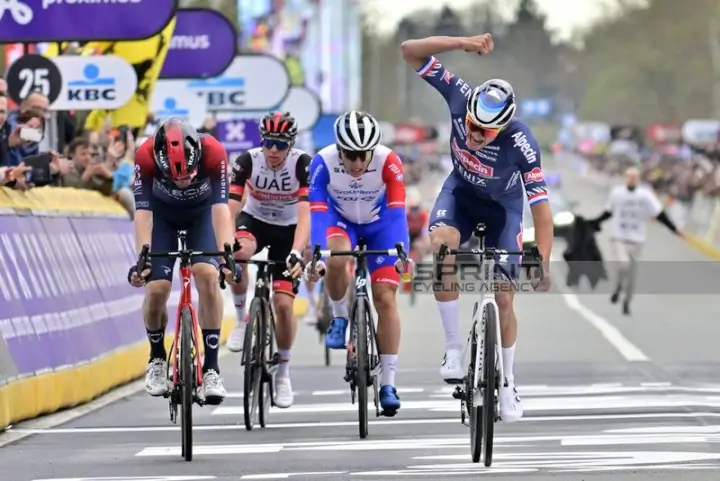
But when was the first time Pogacar took part at this race? It was in 2022, and he already came very close to the final triumph, even though he was tackling the Flandrien cobbles for the first time. As expected before the race, he attacked wherever he could and after the last repetition of the Paterberg only Van der Poel was the one who could keep up with his constant accelerations. After the climb the two started to work together so no one could come back, however with 1km to go the Slovenian refused to takeover the lead, which resulted in a stair-contest.
As a consequence, Dylan Van Baarle and Valentin Madouas caught the two just before the final sprint, which meant that the win would be decided in a four-men showdown. The presence of Madouas and Van Baarle disrupted the Slovenian, so in the end Mathieu Van der Poel won by multiple bike lengths. Pogacar was boxed in during the sprint, so he ended up finishing in 4th place.
However, the way he distanced everybody except the Dutchman on the climbs was definitely a sign that with a little bit of improvement he could eventually become victorious. And that’s what he exactly did in the following year.
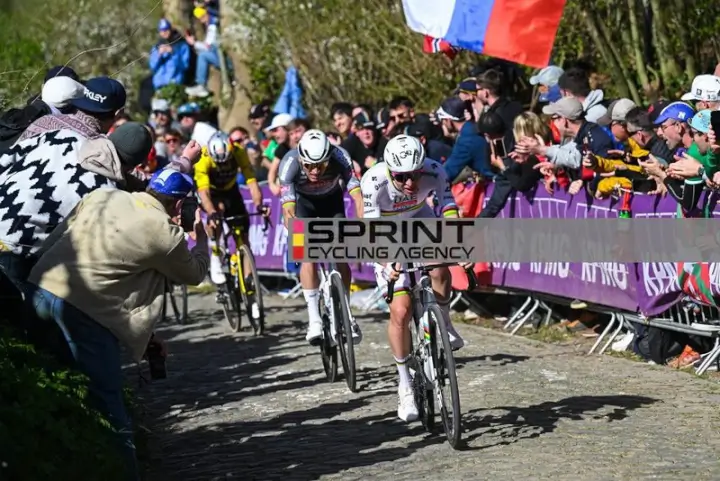
Just like in 2022, Tadej attacked countless times, but this time no one could follow him on the penultimate climb, on the infamous Oude Kwaremont. At the top of the Paterberg he had around 15-20 seconds on Van der Poel who tried everything in his powers to catch the Slovenian, unsuccessfully. Tadej’s win changed the race forever. It made everybody realize that this race has now become his playground where not even teams with numerical advantage could stop him.
However, in 2024 he decided fully focus on winning the Tour de France again, where he was beaten by Vingegaard in the previous two years. People hoped that without him on the startline the race would come down to the wire again. But unfortunately for the believers, the exact opposite happened. Mathieu Van der Poel put on a exhibition and won in emphatic fashion after a 45km long solo. He made his decisive move on the Koppenberg in the rain, where we saw multiple riders having to run up the climb because of the weather conditions.
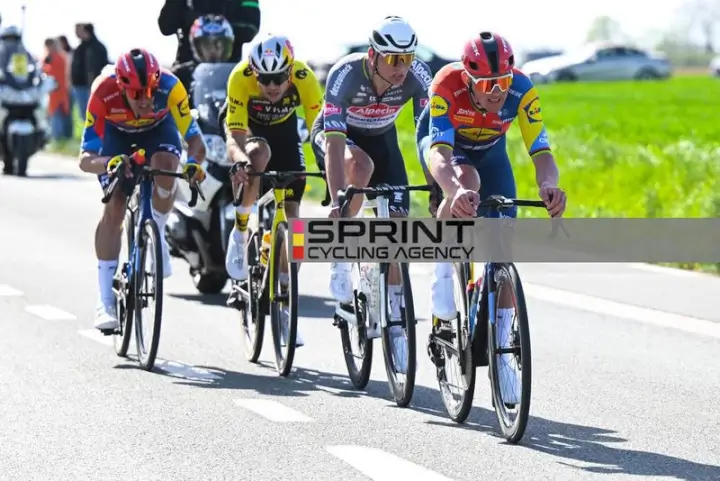
So entering 2025, people were hoping that after such a dominant win Mathieu would be able to go head-to-head with Pogacar, who meanwhile successfully reconquered the Tour de France. The Slovenian stuck to his aggressive style of racing, he was attacking wherever he could. However, entering the last repetition of the Oude Kwaremont we still had Jasper Stuyven, Wout van Aert and Mad Pedersen with the two pre-race favorites.
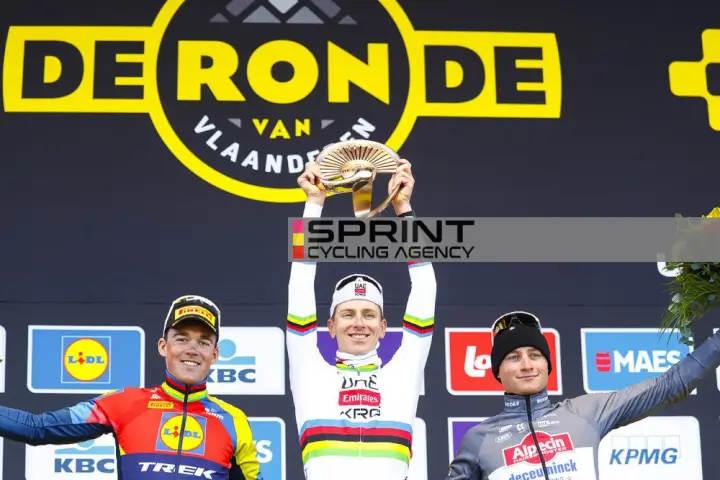
But that’s where the inevetible finally happened. Van Aert tried to anticipate Tadej’s attack right before the climb, but not even that could stop him from dropping all his rivals and riding off into the Belgian sunset. In the end he won by over a minute ahead of Mads Pedersen, who was able outsprint Van der Poel.
So, what did we learn from these particular editions? Well, Pogacar is clearly a level above everybody else when it comes to the cobbled climbs. We also know that a multi-leader strategy is useless against him, as neither Visma in 2023 nor Lidl-Trek last year had a shot using that tactic. So is there a way anybody can stop him from getting his third Tour of Flanders on Sunday. Before we take a look at that, let’s dive into the parkour more deeply!
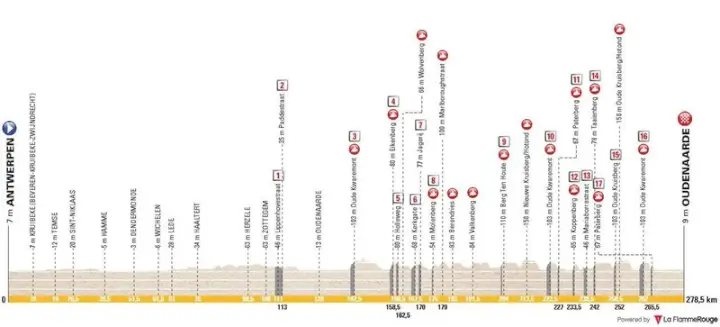
Bruges and Antwerp now alternate hosting duties for the Tour of Flanders. This year, it’s the turn of Antwerp, Flanders’ biggest city, to welcome the men’s peloton. The first 140 kilometers are relatively easy, however there are many things that could still happen in this phase of the race. Firstly, breakaway formation always takes a long time and I’m sure that this year will be no different. Almost every team will try to get into the day’s breakaway in order to have an advantage before Pogacar launches his first attack.
Secondly, the wind could also be a key factor, as there have been many occasions in the past when echelons happened. But even only the threat of the wind could create some unnecessary nervousness in the bunch, which could result in crashes. What happened in 2023 is a perfect example for that. On that day the weather was horrible, so as a consequence every team wanted to be at the front. But unluckily for them Bahrain’s Filip Maciejuk decided to come back from the sidewalks in a dangerous manner, which caused a huge crash in the peloton.
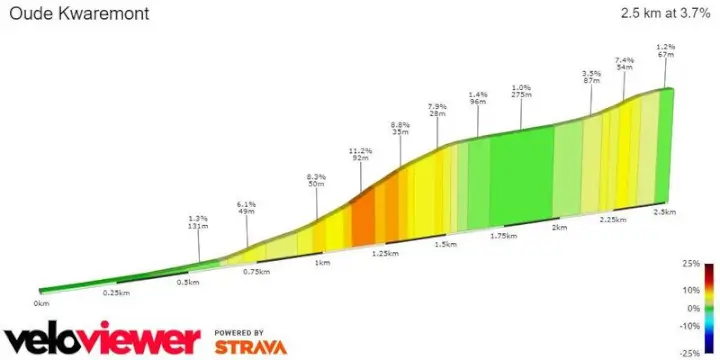
The Polish rider got disqualified, but that was no mercy to the likes of Wellens, Turner, Girmay and Mohoric who all had to abandon the race because of his stupid actions. All in all, a lot of things could happen even in this so called “boring” part of the race, so it’s important to stay alert and focused. So after 140 kilometers of stress and nervousness the riders finally hit the first difficulty of the day, the Oude Kwaremont (2.5km-3.7%).
It is a climb of two parts. After a short flat section at the beginning it suddenly kicks up and reaches its maximum gradient, which is 11.2%. This steep part is about 750m long which is followed by an almost fully flat section. Right before the end though it kicks up again with a 7% section just before the top. This is the only climb in the race that is tackled three times, that’s why many believe that it is the most decisive. But on the first repetition with a 140km to go the peloton should still be mostly intecked. After the top the riders have about 20 kilometers to recover before the real race begins.
Between 120 and 90km to go the climbs come one after the other. The Eikenberg, the Wolvenberg, the Molenberg and the Berendries all feature in this phase of the race. This is where we usually see the first anticipation moves take place. And if you want to get ahead of the favorites, then probably this the last place where you can do so, since after the top of the Berendries the climbs suddenly disappear.
The terrain stays quite rolling though, so if you have a gap you can definitely increase it if the cooperation is good enough in the group you’re in. This phase of the race is about 30km long and serves as a perfect appetizer before the final part, as the final 50km might just be the hardest in all of cycling. It starts with the second ascent of the Oude Kwaremont, which is followed by the Paterberg (0.4km-13.5%).
As you can see from the gradients, this climb is a true monster. However, the suffering doesn’t end there with the Koppenberg (0.6km-8.7%) as the next obstacle. This trio of climbs is where we usually see the first of Tadej’s attacks take place. But even if you could follow him on all three, I have some bad news for you, because the Kwaremont-Paterberg duo features again just before the finish.
Before that comes the Mariaborrestraat, which is a cobbled sector, followed by the Taaienberg (0.6km-6,7%) and the Oude Kruisberg (2.6km-4.2%). The Taaienberg is the climb where Tom Boonen used to make his decisive attacks, hence why many Belgians call it the “Boonenberg”. And now it’s finally time for the “final act”, the Kwaremont-Paterberg combination for one last time. This is the last place where you can realistically drop your rivals, if you don’t want to sprint for the victory in Oudenaarde, as the final 14km are completely flat.
But even if you’re alone atop the Paterberg, it is still possible that group catches you, since you could be riding into a headwind in this part of the course. So now that we know where the key points are in the race, let’s take a look at who could be the key figures and how can each of them come out on top.
The favorites
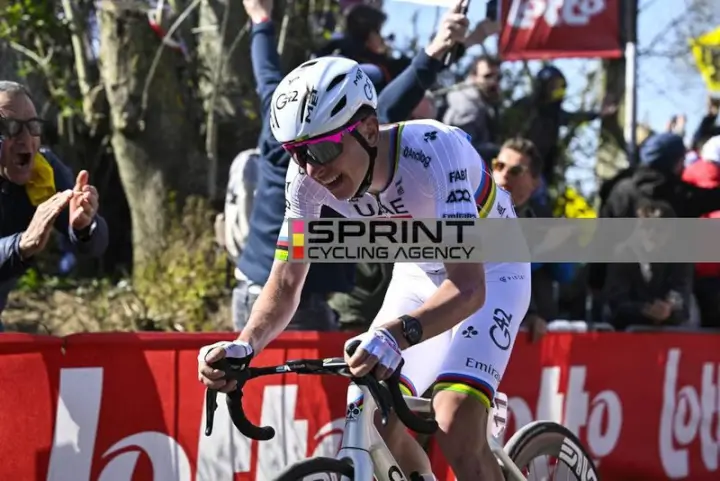
Tadej Pogacar - As you would expect, the number one favorite is the 2-time reigning world champion, Tadej Pogacar. As I’ve already said, he is looking to become the 6th rider in history to win the Tour of Flanders for the 3rd time. But what does he has to do to achieve this incredible feat? Well, he is the odds-on favorite for a reason.
The last two times he won he showed that no one is on his level when it comes to climbing. Therefore he has only one job: stay clear of the incidents in the earlier parts of the race, and then just drop a bomb on either the Kwaremont-Paterberg duo or on the Koppenberg. However, he has to be careful with his attacks. If you’re Pogacar, you don’t want a repeat of last year’s Amstel Gold Race, where he went solo from far out, but eventually got caught by Evenepoel and Skjelmose and lost the sprint to the Dane. So it actually might be smarter to keep some of his competitors with him after the Koppenberg so he is not alone until the final two climbs, where he could probably also drop everybody.
What I’m trying to say is that it is way riskier to do a 50km solo, when he could win in a 18km solo as well, because at the end of the day, if he stays on the bike then probably no one can challenge him. Unfortunately for his rivals, the Slovenian also has a super strong supporting cast. It includes the likes of Morgado, Politt, Rui Oliveira, Bjerg and Florian Vermeersch, who has been on fire this season.
The Belgian finished 3rd in both Omloop and E3 and he was also the last rider who could follow Van der Poel and Van Aert on the Kemmelberg at In Flanders Fields (formerly known as Gent-Wevelgem). One thing is for certain, Pogacar is the strongest and he also has a team around him that is good enough to launch him. So is there anybody who could come close to Tadej? Well, there might just be one.
Mathieu van der Poel - And that rider is none other than Alpecin’s talisman, Van der Poel. He is tied for the most wins at this race with 3, however against Pogacar he has already lost two times while only beating him once, which was in 2022. So the question is: how can he repeat that this year? Before we get into that, we have to be honest for a second. On pure strength, he has no chance against the Slovenian, so he has to beat him strategically.
Firstly, he shouldn’t relay with him if they’re together in a group at the front of the race. I know that Mathieu is a champion and champions never refuse to cooperate, but if he wants to win then he has to put his values aside. Secondly, he should race as passively as he can, because the more riders are with Tadej and him the more complicated the situation becomes, and that’s where the group dynamics and tactics come into play. He is likely to beat Pogacar in a sprint, so he is not the one who should be calling the shots.
And finally, Alpecin need to make sure that they put as much pressure on UAE as possible. They shouldn’t help them control the breakaway and they need to make sure that their leader is not isolated in the final. Riders like Planckaert and Sénéchal should try to anticipate in the first hillzone, while Dillier and the others should try to get into the early breakaway. Both Mathieu and Alpecin will have to be on their A-game if they want to retake the crown of Flanders.
The Dutchman’s shape has also been questioned by the public following his crash at Milan-Sanremo. However, after his win on Friday at E3 he posted his power files on Strava, which said that he averaged 446 watts for 90 minutes during his solo effort.
On Sunday he also had Van Aert on the ropes on the last Kemmelberg, which suggests that he is clearly a level above everybody else except Pogacar. But can he do the impossible and defeat his fellow rival? And is there another rider or a team that could get involved in the fight for the win? Let’s go over them!
The podium candidates
Wout van Aert/Visma-Lease a bike - After the two main favorites there’s clearly a drop down in terms of individual strength, however there are quite a few strong teams that could make the race complicated. One of these teams is Visma. Their main leader is Wout van Aert, however it’s the depth of their team what makes the true contenders, but firstly let’s discuss how Wout has looked so far.
He started his season off on the white roads of Tuscany, getting a respectable 10th place at Strade Bianche. He also raced Tirreno-Adriatico, where he was also quite lively during the race, however the results were worse than what he had hoped for before the race. Then came the first Monument of the year. He didn’t even try to follow Pogacar’s attack on the Cipressa, but in hindsight it was the right decision. He was definitely one of the strongest rider in the chasing group and in the last 2 kilometers he was able to distance them and cross the finish line in 3rd place.
And in the last couple of cobbled races he also showed some promise. At In Flanders Fields he was the only one who could follow Van der Poel in the hillzone, but the two just got caught with 2 kilometers to go. On Wednesday though he found himself riding solo towards glory at Dwars door Vlandeeren. He was still leading with a kilometer to go, but Ineos’ Filippo Ganna passed him in the final straight to take the biggest win of his career (excluding TTs).
Yes, it would’ve been better if he had won, but more importantly his form looks to be the best it has ever been since 2022, and with such a strong team around him he definitely has a chance to at least get onto the podium on Sunday. Speaking of his team, it is stacked.
Christophe Laporte is performing at his best again after a couple of difficult years, while Per Strand Hagenes is having a career year. Matthew Brennan could also have a key role in the team, although his form has looked a little bit shaky recently. Meanwhile, Affini and Zingle are valuable domestiques and they will be ready to work their ass off for their leaders.
Visma are always on point tactics wise, and I’m sure they have a detailed plan on how they can get the best result possible. All in all, they might not have a rider of Pogacar’s quality in their team, but with good teamwork, smart tactics and a little bit of luck the “Yellow Bees” might have a chance at achieving something unexpected.
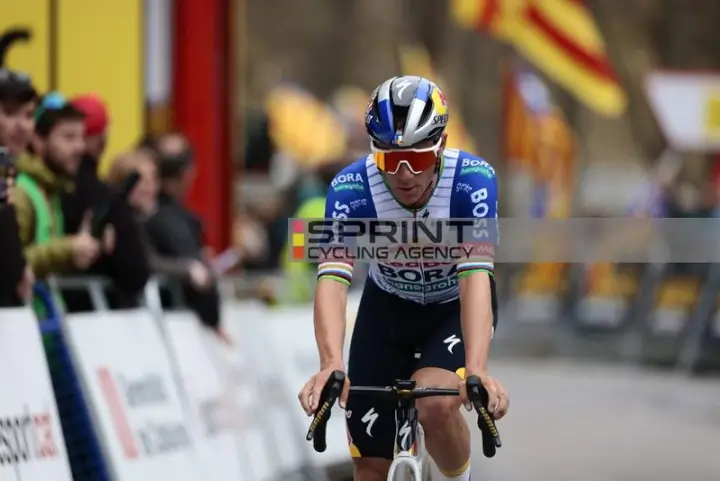
Remco Evenepoel/Red Bull-Bora - The Tour of Flanders is the race of surprises and unexpected events, but what happened on Wednesday was something that even the most prepared ones didn’t see coming. On the morning, Red Bull announced that their Remco Evenepoel will be at the startline on Sunday. It was a huge shock for everybody, but what are the consequences of his decision.
Well, the bookmakers instantly made him the 4th favorite, which is quite surprising considering he has never ridden a cobbled race professionally before. He is a extremely talented one-day racer with probably the second best punch behind Tadej Pogacar, but Flanders is not just about that. You need to be in position at the start of every single climb, while conserving as much energy as possible, which is hard for everybody and you can imagine how hard it is for the inexperienced ones. Can Remco compensate this inexperience with his extraordinaery talent, or will he crumble under the pressure of the Belgian public?
Luckily for him, he is in a team that can help him take some of that pressure off his shoulders. The likes of Mick van Dijke and Jan Tratnik are incredible at positioning, while Pithie, Gianni Vermeersch and Tim van Dijke have all showed tremendous strength during the classics season. It was especially Tim who had stepped up his level from last year and performed incredibly well at races such as Omloop, Paris-Nice and E3.
So even if this Evenepoel experiment fails, they still have quite a few cards to play. But could Remco succeed? He definitely has a team that can match Pogacar’s or MVDP’s, but does he have the form. At the UAE Tour and the Volta Catalunya his climbing performances were disappointing, but earlier in the year at the one-day races he looked like a different rider, dominating from start to finish.
And at the end of the day, the Tour of Flanders is a one-day race not a Grand Tour with long ascents. One thing is for sure, he is a rider who you can’t let ride away, because if he is solo then even Pogacar might struggle to catch him. Either way it goes, I can’t wait to see what he can do on the cobbles of Flanders on Sunday.
Mads Pedersen/Lidl-Trek - The final rider who I would like to mention in this category is last year’s runner-up, Mads Pedersen. In 2025 he was in the shape of his life, hence why he could beat Van der Poel and Van Aert in the sprint for 2nd place. However, his 2026 season didn’t start the way he had hoped for.
Right on his first race day at the Volta a Valenciana he crashed and broke his left wrist and his right collarbone. That was six weeks ago, and back then no one expected the Dane to recover in such a short amount of time. But somehow he was already at the startline of the first Monument of the year, just a month after his accident. He finished 4th there, which was a very impressive result considering the circumstances. Then he made his cobbled season debut at E3, where he missed the race-defying move due to poor positioning, which resulted in a 9th place finish.
Unfortunately two days later he couldn’t even attempt to defend his In Flanders Fields title due to sickness. However, by Wednesday he was ready to go at the Dwars door Vlandeeren. He was very active and aggressive at the beginning of the race, maybe a little too much so, because he couldn’t follow Wout van Aert’s attack on the Eikenberg. From there on he was always one step behind his rivals and ended up finishing in 10th. So, what are the conclusions from his season so far?
He is clearly not at his best in terms of form, but that doesn’t exclude him from the podium contenders on Sunday. He could still get a good result, however Lild-Trek will have to make sure that he doesn’t spend his bullets to early in the race. Next to Mads, the German team has quite a few options as well. Mathias Vacek, Kragh Andersen and Jakob Soderqvist could all finish in the Top10, if they play their cards right.
Watch out also for their young super talent, Pedersen countryman, Albert Withen Philipsen. The young Dane hasn’t quite had the start to this season people had expected from him, but with the raw talent he possesses, a Top10 could be realistic goal for him too. Last year they had Stuyven and Pedersen in a group of five riders after the Koppenberg. I doubt that they can replicate that this year, but they are definitely a team to watch out for.
Now that we have gone over the most important riders, let’s look at some other teams and riders who could be involved at the front on Sunday. Bahrain’s Alec Segaert has been having a very successful classics season so far, topped by a win at the “mini Paris-Roubaix”, Grand Prix de Denain. He will have an experienced veteran in Mohoric by his side. Both of them will likely race aggressively, which could pay off if they are strong enough.
Decathlon has been the surprise team of the 2026 season so far, but they don’t have a out-and-out leader on their roster. Still, the Bissegger, Bol, Naesen, Hoole quartet should be capable to at least be involved in the anticipating part of the race.
EF will have a former winner in Kasper Asgreen in their team. The Dane is far from his 2021 shape, but as a former winner he should not be underestimated. If the race is ridden passively, then his American teammate, Luke Lamperti could also get a good result in a small group sprint.
Other fast men such as Samuel Watson, Biniam Girmay, Arnaud De Lie, Paul Magnier, Soren Warenskjold, Luca Mozzato and Lukas Kubis would also benefit from a situation like that. FDJ are have two very intriguing riders in their team in Grégoire and Thibaud Gruel. Both of them are in great shape, so they might just be the best French finishers.
Speaking of riders in great shape, the likes of Trentin, Abrahamsen, Aimé De Gendt and Astana’s Bettiol-Teunissen-Ballerini trio are all good candidates for a Top10 finish. The last two teams that have riders who could have an influence on the race are Ineos and Soudal Quick-Step.
The Brits are coming into this race on a high note, after Ganna’s win midweek at the Dwars door Vlandeeren. However, the Italian won’t be at the startline, as he wants to fully focus on Paris-Roubaix. Even though the Italian’s absence, the Tarling-Turner-Sheffield trio seems like a competitive one. Meanwhile, the feelings at Soudal are quite different before their home race.
During the offseason they put a lot of emphasis on trying to rebuild their classics team, but so far they’ve been having a miserable classics campaign. Dylan van Baarle has been very disappointing so far, while their young sprinter, Paul Magnier has had more mechanicals then Top10s. Jasper Stuyven, who was their other marquee signing next to Van Baarle, is the only one who’s been performing on a desirable level.
What would make their classics season even worse is if Evenepoel finds a way to win. At that point, the owners might as well just sell the team. Jokes aside, a good Quick-Step would only make the race more exciting, so let’s hope that the Belgians find a way to be competitive.
What do you think, can Pogacar be beaten on Sunday or will it be a Slovenian show on the Belgian cobbles again? And which riders do you think could surprise us? Let me know in the comments!