A chaotic first week sets up a decisive second week in the Giro, with a time trial, puncheur stages, a brutal Alpine battle and a likely sprint finale in Milan.
What a first week we have had! An incredible Grande Partenza in Bulgaria was followed by some very close stages in Italy. Many stages came down to the wire, and we also saw the Maglia Rosa change shoulders multiple times. Meanwhile in the GC things are still relatively close, although it still looks like that Vingegaard is a level above the rest.
However, the gaps will surely get bigger in the 2nd week. We’ll see a time-trial and we’ll also have a multi-mountain Alpine stage later in the week. On paper the other stages are not hard enough to create significant gaps, but as we have already seen this week, in the Giro anything can happen. The sprinters will also have an opportunity on stage 15 in Milan, and the way the sprints have gone so far, it will definitely be an exciting finale. So without further ado, let’s get into each stage individually.
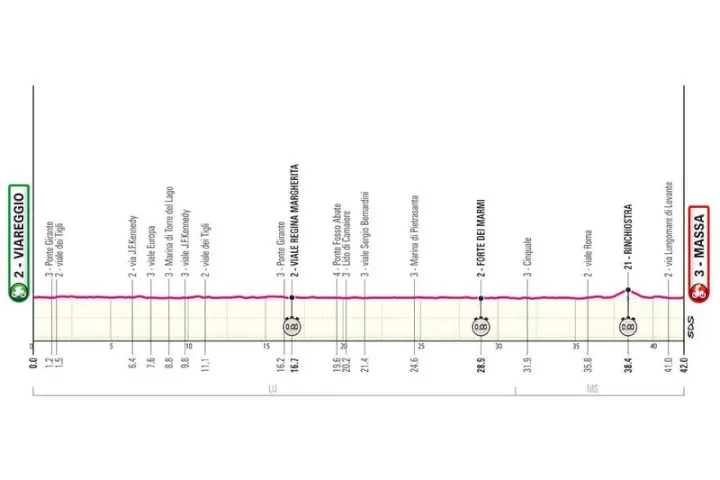
Following a very demanding last few days, the 2nd week starts off in style, with the first and only time-trial of the entire race. It is almost entirely flat and it has only couple of U-turns to navigate, making it a non-technical course. This is a huge advantage for the time-trial specialists, such as Ganna.
Speaking of the Italian, he will undoubtedly be the favorite to win this stage. The former world champion’s track record in the individual efforts at the Corsa Rosa has been exceptional in his entire career. In total he has 6 time trial wins, which shows how dominant he’s been on the TT bike in recent years. Other TT specialists such as Alec Segaert, Rémi Cavagna or even his teammate Magnus Sheffield are well suited to a parkour like this, however it’s highly unlikely that they can beat the Italian powerhouse.
Next to the fight for the stage win, there will be another affair we are going have to keep our eye on. Off, course, I’m talking about the fight between the GC riders. Jonas Vingegaard is by far the best time-trialist out of the favorites, so he should finish ahead of his rivals by a significant margin.
However, behind him anything can happen, as the rest are very closely matched in regards to time-trials. Arensman might be the one exception, as he has already had some impressive individual efforts in the past. You definitely won’t want to miss this stage, since it will probably influence the GC quite a bit.
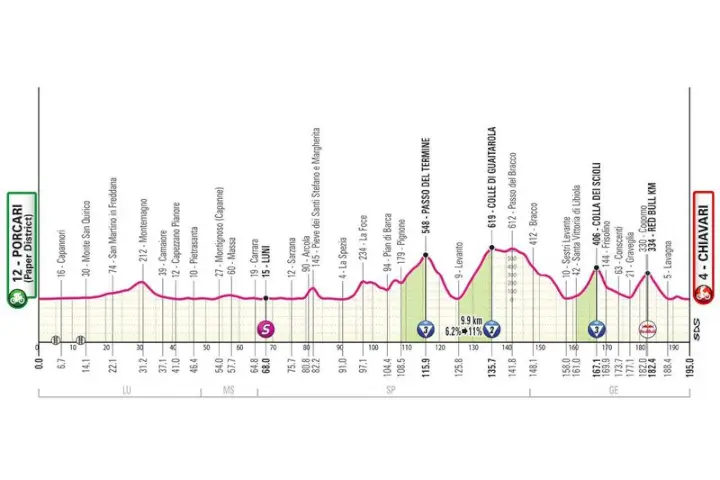
The first road stage in the 2nd week promises to be a banger one. On paper it looks like a puncheur’s paradise, and if we look at the numbers, this statement becomes even more true. Overall this stage has almost 3000m in elevation gain, most of which comes after the first 100km, making it a very demanding last couple of hours for the riders.
The first couple of categorized climbs are the Passo del Termine (7.4km-4.9%) and Colle di Guaitarola (9.9km-6.2%). The first serves as more of a warm up climb, while the second one is lot harder than what the numbers tell. It is a very irregular climb, with multiple sections over 8% and a maximum gradient of 11%. If someone wants to go from a long way out, this will be their place to do it.
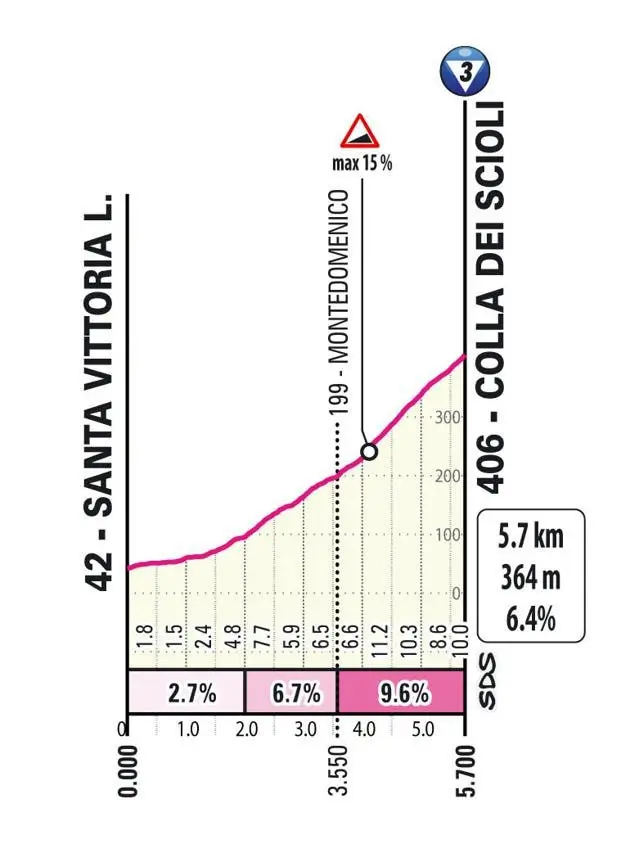
Following the two ascents, we have a long, very gradual descent into Sestri Levante, where will have 40km left to the finish. And that’s where the stage will really start to take shape. After Sestri Levante, two short and steep climbs (Colla dei Scioli and Cogorno) lead into the final part towards Chiavari. The Colla dei Scioli (5.7km-6.4%) is only a 3rd category climb, but just like the previous one, this is also much harder than what the numbers suggest.
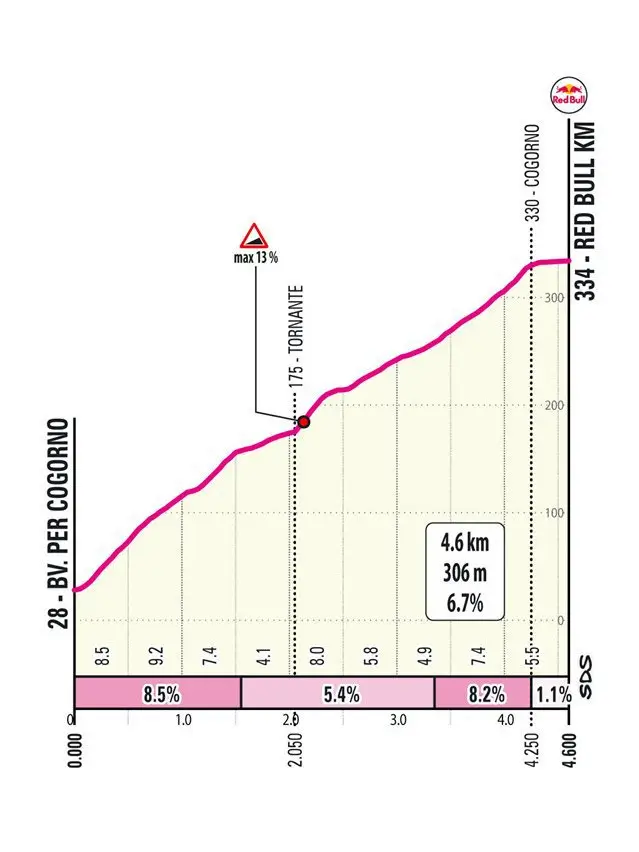
It starts very gently and gets harder as we get further into the ascent. The last couple of kilometers are especially hard, as they average over 10%. It is also a climb that has never been used before in any professional race, so it will be very intriguing to see how the riders and teams approach it without any previous data. After the top, the riders will have a 10km long descent, where they will need to recover, because the stage is far from over yet. And that’s because we have another short, but punchy hill left, the Cogorno (4.6km-6.7%).
It is slightly shorter and shallower than the previous one, however it still has a couple of sections that average more than 8%. At the top there will be a Red Bull KM too, which makes this climb even more important. Following the sprint on top, there will be only 13km left to ride, which can be divided into two parts: a 6km descent followed by a 7km long flat section.
Under the 5km banner there is a short climb, where a late attacker could get away before the finish in the centre of Chiavari. Speaking of the finish, it has a few 90 degree corners, but the last km is almost entirely straight. The last time a Giro stage finished in Chiavari was back in 1958, when the Italian Silvano Ciampi proved to be the strongest. So, after almost 70 years, who could be the Italian’s successor.
Well, personally I think this stage could go two ways: either we get a breakaway fight or a battle between the puncheurs/GC riders. Usually we have at least a couple of stages in the 2nd weeks of Grand Tours, that are won by the breakaway, and I think this has a good chance to be one. The second part of the stage is tailor made for the baroudeurs, however it might take the break a long time to form, since the first 100km are mostly flat, which could derail their chances.
And that’s where the peloton comes into the picture. Lidl-Trek with Ciccone, UAE with either Narváez or Christen or even Astana for their puncheurs could control this stage. But if I were them, I would hedge my bets and send some riders into the breakaway too. Either way it goes, this stage is promises to be a very exciting one with a lot of uncertainty regarding the outcome of the stage.
The 12th stage might be the only sprint stage in the entire second week, although a breakaway winner is not out of the question either. And why is that? Well, the first 100km of the day are flat, but what comes after could definitely trouble the fast men. Two climbs follow each other in quick succession, the first one being the Colle Giovo (11.4km-4.2%), followed by the Bric Berton (5.5km-5.9%).
We might see a similar scenario that happened on stage 4, where Movistar lit up the peloton on the main ascent of the day to drop the pure sprinters and put their fast man into prime position for the stage win. On that day Aular wasn’t able to reward his teammates’ work with a victory, so I’m sure he will be even more eager to give them something back, and this stage could be perfect for that.
Could any of the pure sprinters survive though? Based on stage 4, Groenewegen, Milan and Magnier have zero chance at surviving this stage in the bunch. Lund Andresen might have a small chance, but I think it might be a little too hard for him too. Out of the versatile sprinters Ben Turner will definitely be in the mix at the finish. Narváez, who won on stage 4, is another name that will be up there on the results page too.
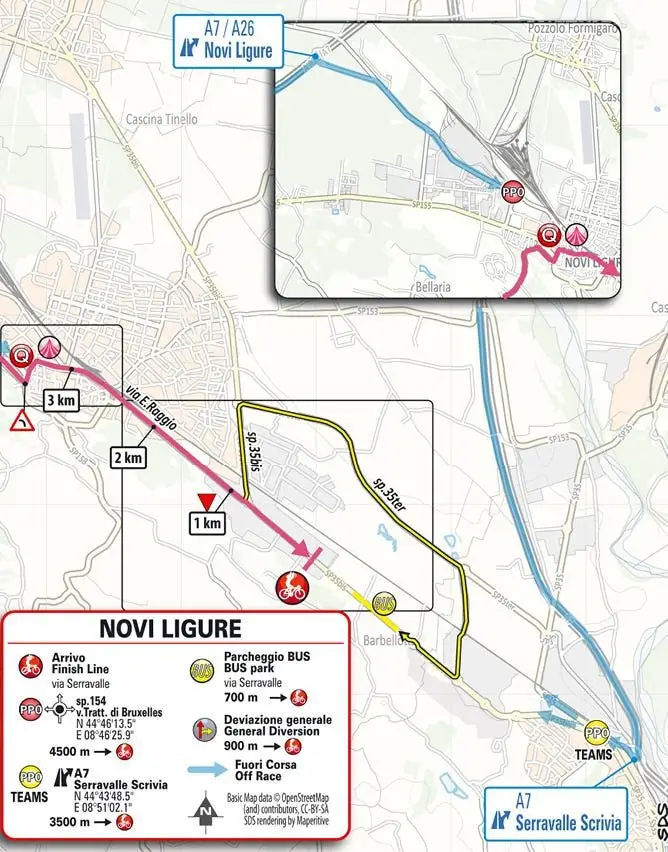
And what about the breakaway? Before we take a look at their chances, let’s discuss the stage finish. After the 2nd climb the riders descent down into the Po valley, from where a series of short ups and downs lead to our finishing town, Novi Ligure.
As you can see on the map, the last 3km are virtually straight. The final corner comes at 3000 m from the finish, so the teams will have plenty of time and space to position their man for the stage in the outskirts of Novi Ligure. Speaking of the finishing town, the last time the Corsa Rosa finished there was back in 2019, when Caleb Ewan won on a “pancake flat” stage. On that day the break had no chance at making it to the finish, however this year they might have a realistic shot.
Since the pure sprinters’ teams probably won’t control the stage, the break’s faith lies in the hands of teams such as Movistar, Astana, UAE and Ineos. All these four teams have one thing in common, which is that they have a rider on their roster who can climb relatively well and also has some speed to win a reduced group sprint. However, just like on the previous stage, they could just decide to send one rider into the break and compete for the stage win that way.
If that’s the case, then we will have a very exciting breakaway battle on our hands. On the other hand, they can also decide to control this stage collectively, in which case we will probably see a sprint between the climby sprinters. A late attacker might also have a chance, since there are not many teams that will have the firepower to control the aggressors following the two climbs. One stage, many possible endings, that’s why we love the Giro, right?
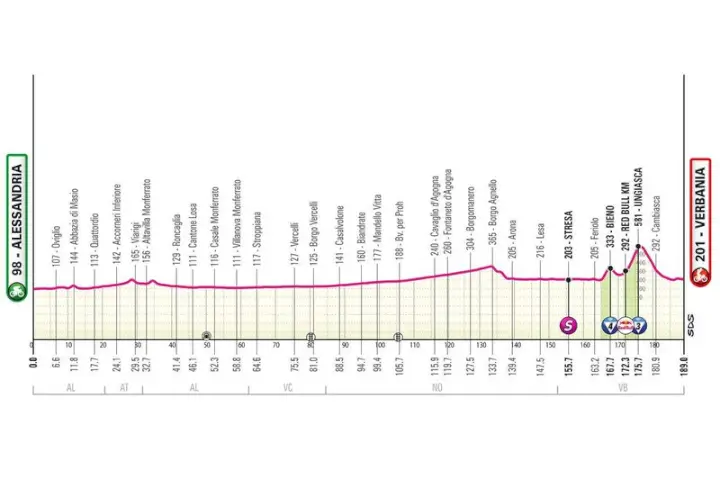
The next stage is very similar to the last one, in the sense that it also looks like a paradise for the versatile sprinters. Flat course for 160 km, becoming suddenly more demanding in the final 30 km, which contain all the elevation gain. Sounds perfect for the likes of Aular, Turner and Narváez, right?
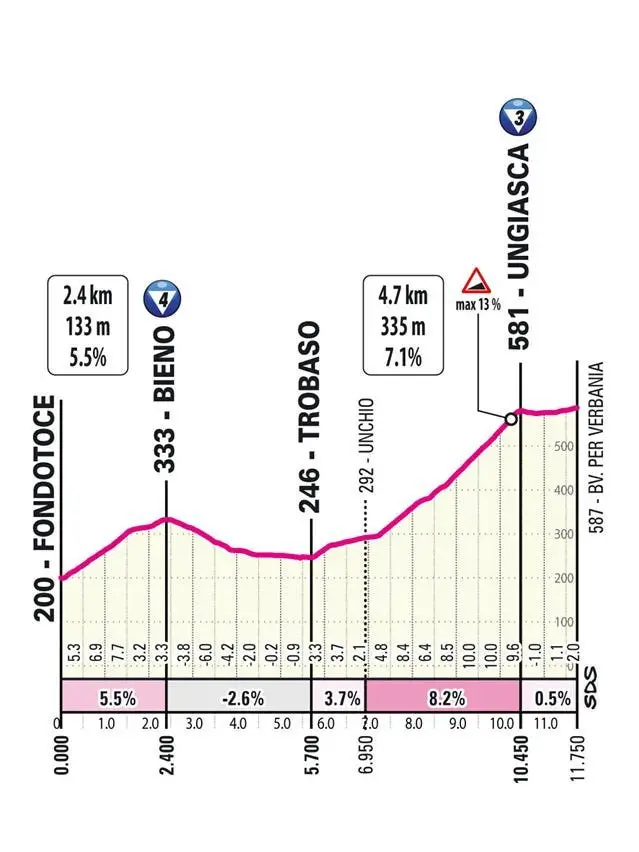
And if we take a look at those last 30km more closely, this statement becomes even more certain. There are 2 categorized climbs in the final hour of the stage, the second one being especially demanding. Before that though, the riders will still have to get through the Bieno (2.4km-5.5%). It has manageable gradients, unlike the climb that follows, which is the Ungiasca (4.7km-7.1%).
It is a very similar ascent to the one we saw at the end of the 2nd stage in Bulgaria. Just like the Lyaskovets Monastery Pass, this climb has also some double digit sections, where on paper the an attacker could get away. But there will be still 15km left until the finish from the top, half of which is downhill, so regrouping will likely happen, just like it did on stage 2. And who won on that day? Thomas Guillermo Silva, a versatile sprinter. What makes this stage even more suited to them is the flat finish, since top-end speed matters a lot more in those.
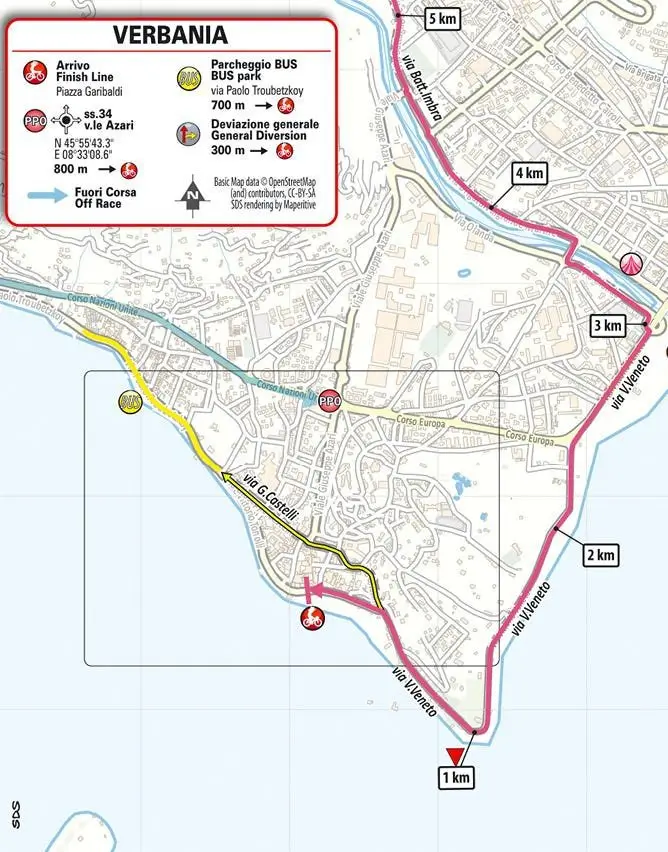
Speaking of the final, it won’t be the most technical one and it will be also easier, since the final group will likely be less than 30-40 riders. The last 3 km run along the lake. First on a wide, almost straight road, then following the shoreline with some bends and a slight narrowing of the carriageway. The most important corner is under the flamme rouge, but from there on it is pretty much straight. There is a slight bend at around 300m to go, which as we saw in the previous stages, could cause some nervousness in the final sprint. Let’s just hope that everybody will stay upright.
It won’t be the first time the Giro finishes in Verbania either. In 2015, Belgian legend Phillipe Gilbert won after an emphatic solo ride. This stage could also see another rider arrive solo at the finish, although a small group sprint is a lot more likely. And with knowing what awaits for the riders on the next day, I’m sure most of them would be a fine a calm day ending in a sprint.
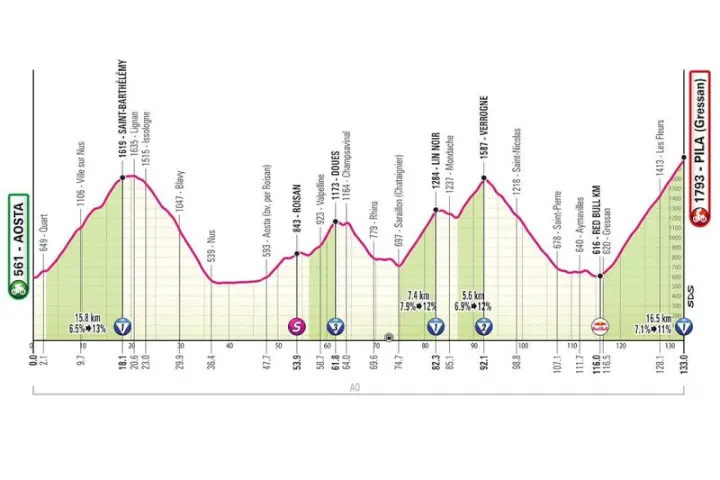
Up next is major Alpine mountain stage made up of a continuous sequence of climbs and descents, with virtually no recovery sections in between. Right from the gun, the route climbs the long ascent to Saint-Barthélémy (15.8km-6.1%), followed by a wide and fast descent of almost 20 km.
The climb itself is also harder than the numbers suggests. It has 3 descending parts in it, which lowers the average gradient quite considerably. Because the climb starts right from neutral, we could see many scenarios play out. For sure there will be riders jumping left right and center to get into the breakaway.
However, what also has to be noted is the length of the course. With it being a very short stage (133km), the GC teams might actually be interested in winning the stage, since it would be quite easy to control. Speaking of the GC teams, they also have to be careful, as a rival could easily sneak into one of the breakaway moves, which would create a very unpleasant situation for the main favorite’s team, in this case Visma. But we should get our questions answered by the top of the climb.
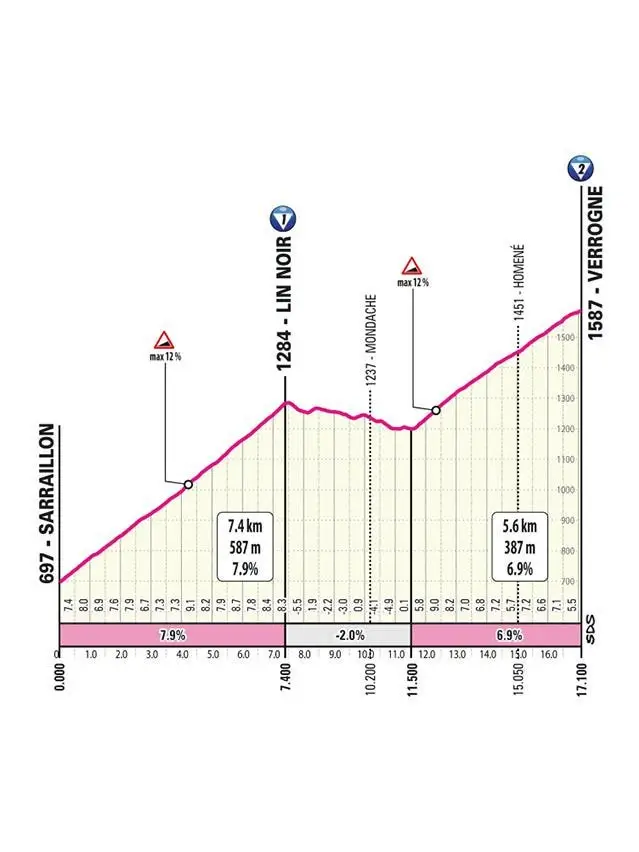
After the quick descent the race calms down a bit as we have a 20km long valley before the next categorized climb, which is only a 3rd category, so on paper it shouldn’t cause any difficulty for the favorites. However, what should definitely make riders suffer is the following sequences of climbs. With around 60km to go the riders start the Lin Noir-Verrogne duo.
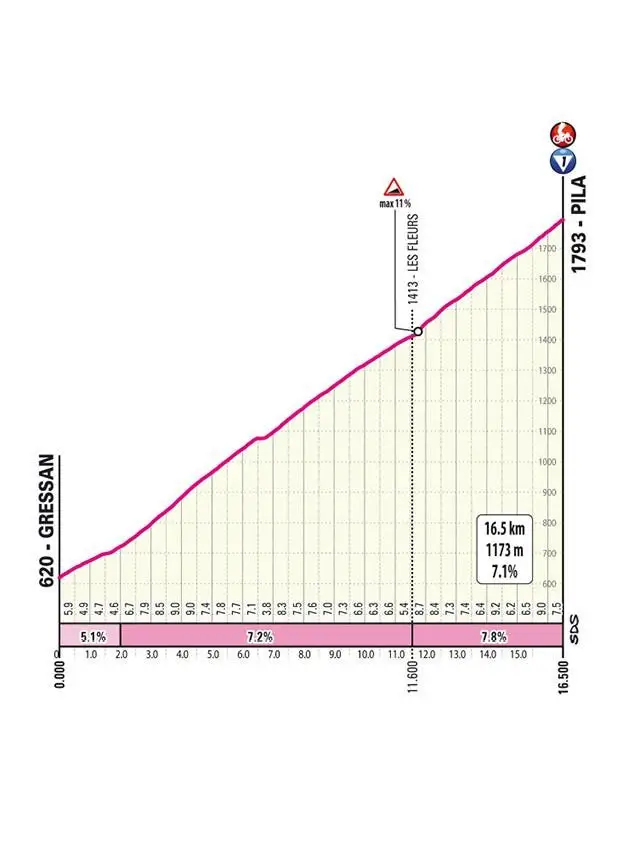
The first one is the harder, as it is 7.4km long and averages almost 8%. Then a 3km long false flat descent follows, before the riders take on the Verrogne (5.6km-6.9%). Based purely on the numbers, it is a relatively easy climb, but don’t forget that this ascent comes just minutes after they finished the last one. This combination of climbs is perfect to build up fatigue in the legs, and put your rivals on the limit, before the main difficulty of the day. And that is none other than the ascent up to Pila (16.5km-7.1%).
You won’t be able to hide on this climb anymore, if you are weak than you will get dropped, simple as that. Overall it is a very steady climb, as it averages around 7% the entire way. So if someone wants to attack early, they definitely have to opportunity to do so. However, you also don’t want to go into the red to early on such a long climb, as that could result in a detrimental collapse.
At this Giro we have already seen many mountains that have almost never been used before. This one was actually used on a couple of occasions, but a very long time ago, the last one being in 1992 to be exact. Back then we a saw a breakaway rider win, but what stood out the most is how big the gaps were between the favorites. What will also make the gaps larger than usual is all the accumulated climbing before the final ascent. This will be by far the most important stage in the 2nd week, so you definitely won’t want to miss it.
You would think that on Sunday we would have a mountain stage. But unfortunately, this time we’ll have a pancake flat day that will likely end in a sprint. And when I say “pancake flat”, I’m not lying to you. Overall it has 612 vertical meters, which is very low, even for a Grand Tour sprint stage. But I guess you have to reward the sprinters after the consecutive hard days.
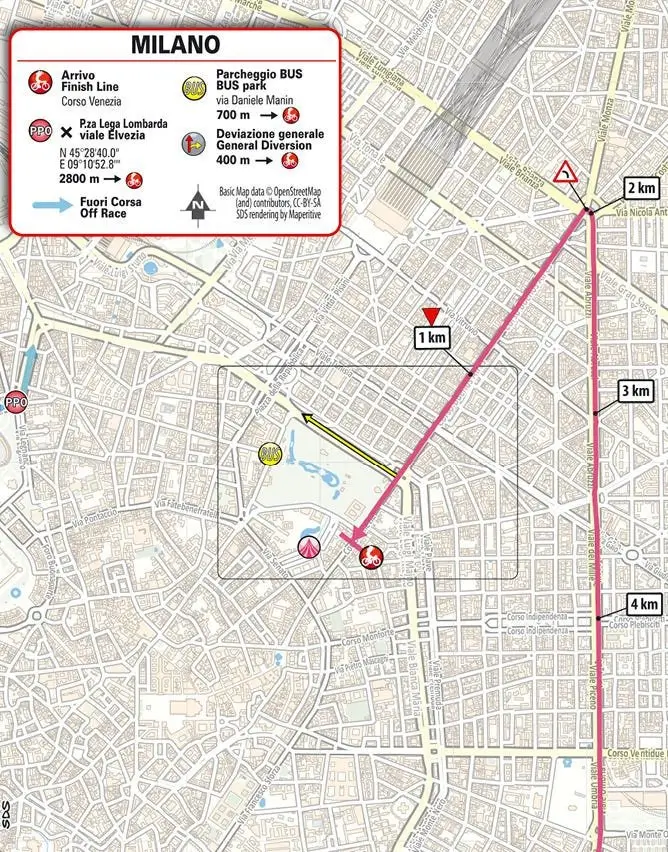
And with this most likely being the only “pure” sprint in the entire 2nd week, I’m sure that we’ll see a super tight fight between the fast men in the “fashion capital of the world”. Speaking of our finishing town, as you would expect it has hosted a Giro finish many times in the past. However, for the last road stage held in the city we have to go back all the way until 2017, when it was actually the final stage.
Beforehand everybody expected it to end in a bunch sprint, since that’s how these Champs-Elysées style stages usually conclude. But back then things turned out differently. The duo of Iljo Keisse and Luke Durbridge were brave enough to attack and go against the odds, which paid off. The Belgian ended up beating the Australian in a two up sprint, which is a very rare sight on the final sprint stages.
This year though, I think this scenario is even more unlikely than in 2017. There are just simply too many sprinters that have not won a stage yet, like Milan and Groenewegen. Both of teams came here with ambitions of victory, and honestly they won’t have many opportunities following this stage, if we exclude the finish in Rome. With that in mind, this could make or break a team’s entire race. The lead outs will have to do a perfect job if they want to actually give their sprinter a real shot at victory.
Speaking of the lead outs, they won’t have a hard time regarding the technicality of the course, as the race finishes on a circuit. The 16.3 km circuit is entirely flat and laid out on wide boulevards with very few corners, the last of which comes at approximately 2 km from the finish. The finishing straight is flat, on 8 m wide asphalt, well suited to a high-speed bunch sprint.
So following a couple of very messy sprint finishes in Napoli and back in Bulgaria, we should on paper finally get a sprint where all the big guns can go head-to head. But who are the big guns? Well, purely based on size and power it is undoubtedly Milan, however the Italian is still yet to win a stage at this year’s race, so the pressure we’ll be extremely high on him and his team to finally deliver a victory for Italy.
The riders that have a chance at destroying his dreams will most likely be either Groenewegen or already two-time stage winner, Paul Magnier. The Frenchman has already showed that he is one of the fastest in the bunch and is also exceptionally good in positioning. Meanwhile, Groenewegen has arguably the best lead out train in the entire race. Just take a look at how dominant the lead out of the Rockets was at the end of the Naples stage.
And on paper, the Dutchman is still one if not the fastest sprinter in the entire field. If anybody else wins other than these three, than that would be a massive surprise. So even if you won’t watch the full stage, be sure to tune in for the last 20km, since the last half an hour will be electric.
And this is where the 2nd week concludes. Overall, I expect a very breakaway heavy week, with not a lot of GC action. But we should get enough of that in the TT following the rest day and on the brutal Alpine stage on Saturday. It’s a real shame that we won’t have a GC day on Sunday, but maybe the sprint will make up for it.
The gaps however in the overall classification should get a lot bigger, which could very well set up a incredible last week, where will have plenty of mountain stages to enjoy. The preview of that will also come later during the 2nd week. Be sure to check that out as well.
Which stage are you the most hyped about in the 2nd week?