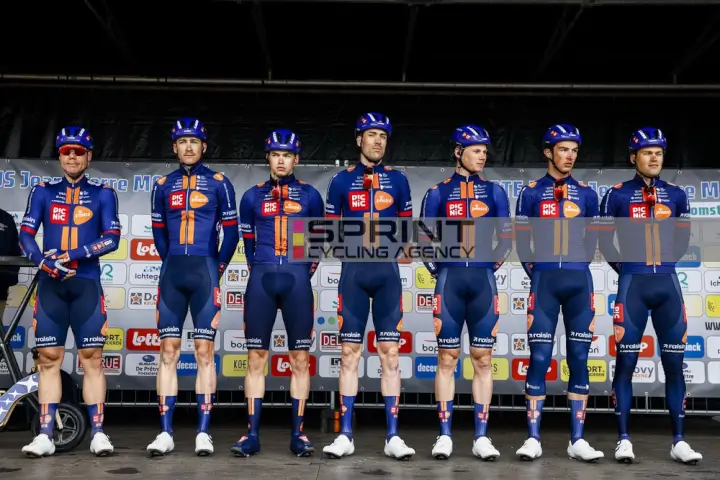
Team Picnic PostNL are winless, sinking in UCI points, and staring down a potential 2028 WorldTour exit. Here’s how a talent-factory team fell into a historic slump and why their development pipeline may still save them.
Over the past few years we’ve witnessed many terrible seasons by certain World Tour teams. Teams like Astana, Cofidis, Arkéa and Intermarché-Wanty have all had their fair share of struggles during the last 3 year cycle in the UCI Rankings. However, what Team Picnic Post-NL have shown so far is historically bad.
They haven’t won a race yet and points scoring wise they are on pace to have the worst ever season by a WT team in recent history. And it’s not like that they have a supertalent, such as Paul Seixas, who could get them out of this gigantic hole either. Yes, they have some great young talents on their roster and with time they might become established World Tour riders, but time is exactly what the Dutch team doesn’t have.
If they continue like this for another month or two, then they can wave goodbye to their World Tour licence at the end of 2028. And who knows what will happen after that. They might be able to consolidate and rebuild or they could go bankrupt and find themselves without a title sponsor, just like Arkéa did last year after their relegation.
But how did a team that once had the likes of Hindley, Hirschi and Matthews riding for them got to this point? Well, that’s what I will try to answer today. We’ll take a look at their transfer strategy, their team building philosophy and we’ll compare their season to the worst ones in the history of cycling. So, without further talking, let’s jump into it!
The “DSM years” (2021-2023)
Firstly, let’s take a look at how did they look before Picnic became their title sponsor. They were called Team Sunweb form 2017 all the way until 2020, in those years they had the likes of Tom Dumoulin and Matthews on their roster. However, at the end of 2020 the German company stepped down and in came the Dutch multinational corporation called DSM, and that’s when their story really begins.
With Sunweb stepping down, some of their valuable riders also decided to leave the team, such as Matthews and Kelderman. However, with the new sponsor coming they clearly wanted to have a new franchise rider they could build around, hence why they brought in Romain Bardet. Back then the Frenchman was still only 29 years old and seemed like the perfect successor to Tom Dumoulin, who left the team at the end of 2019.
Next to Bardet, they also signed quite a few young talents from all over the world. They either came from their own development team or from other highly-regarded youth structures. This “investing in the youth” philosophy is something that we will see in the upcoming seasons as well.
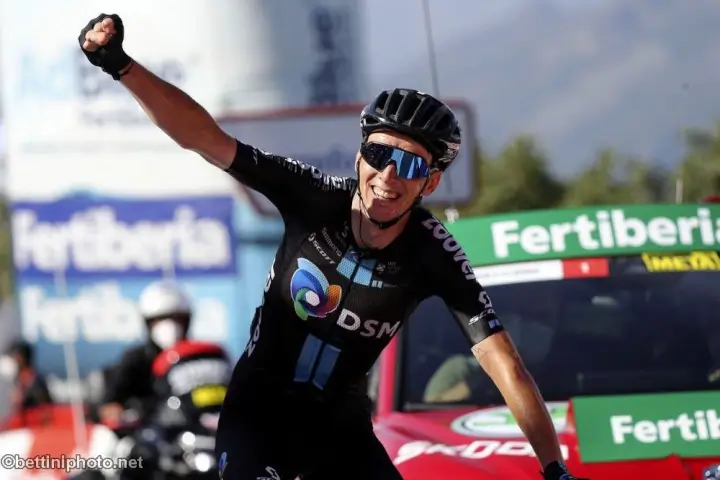
Their first year as a Dutch team was quite average. Bardet definitely underperformed compared to the expectations the team had when they signed him, however he still found a way to win a stage at the Vuelta.
Next to the Frenchman, Michael Storer also won a couple of stages at the Spanish Grand Tour, while their other GC rider, Jai Hindley still delivered some valuable results. They were always more of a GC team, so it isn’t really a surprise that they didn’t achieve a lot in the classics. Overall, they were competitive during all year, but the huge result was missing.
And following the sponsor changes just like in the previous year, a lot of their leaders decided to move on. Hindley, Hirschi, Benoot, Gall, Kanter, Storer and Van Wilder were all riders who could get results in the World Tour on a consistent basis. So now they had to find a way to replace all this talent, and they decided to do that by bringing in “the youth”. Casper Van Uden, Bittner and Mayrhofer were all signed in this transfer window.
Next to the young talents, they also signed an experienced classics leader in John Degenkolb, while picking up free agent Sam Welsford. All these signings were very sensible from a financial perspective, but because most of their recruits were neo-pros, a step back was on the horizon. But they were probably thinking that this investment into the youth and development would pay off in the long run.
So, how did their results look like in 2022? They won a couple of Grand Tour stages at the Giro and at the Vuelta, while Bardet had a bounce back year capped off by a 6th place in the GC at the Tour. But most importantly, the young riders they had signed in the previous years were all improving. Thymen Arensman, Andreas Leknessund and Pavel Bittner all head breakout performances that year. It seemed like that their transfer strategy was working.
So in the next year they continued to let the “veterans” leave and sign even more talents. However, next to Soren Kragh Andersen, Nico Denz and Cees Bol there was another departure, and he wasn’t a veteran. Thymen Arensman has also decided to leave the team and join the British giants, Ineos Grenadiers.
It was a clear sign of things to come. They were not able to retain the best of their young talents due to financial reasons, and constantly finding and developing new riders instead of keeping the proven ones seemed very risky, especially as 2023 was the first year of the new points cycle. But they had no choice, they had to continue, and that’s what they did. Oscar Onley, Max Poole and Tobias Lund Andresen were the next candidates to replace the departing riders. And they did.
Onley and the Dane both had incredible neo-pro years, meanwhile others like Dainese, Welsford and Bittner kept their upwards trajectory. They ended the year with 10 wins, including 3 at Grand Tours. However, the exodus of their best riders continued. Dainese, Welsford, Leknessund, Mayrhofer and Brenner all left the team. And there weren’t just roster changes, as a new co-sponsor also came in the following year.
The “Picnic-PostNL years” (2024-2025)
So in 2024 it was a new start again, but this time on multiple fronts. As per usual, most of their leaders left the team, but their title sponsor (DSM) also stepped aside, which left the team without a sponsor. However, they were still an appealing team to support financially, since they were still a World Tour team back then. And that’s why PostNL stepped in and became their new title sponsor.
As their name suggest, they are a Dutch company, which meant that they wanted to increase the Dutch presence within the team. Hence why 7 of their new recruits were from the Netherlands, one of them being sprinting-superstar Fabio Jakobsen.
His 2023 season wasn’t the best he’s ever had, but he was still considered as a Top5 sprinter. And with Bardet starting to get older, they needed a new “franchise rider” who they could build around. But unfortunately for them, his season wasn’t as successful as they had hoped for beforehand. He only scored one win, which was at the Tour of Turkey, while also being uncompetitive in the bigger races, such as the Tour de France.
However, the others stepped up and performed really well, which was a positive surprise. Bardet had his best season while riding for the team, as he finished 2nd at Liége-Bastogne-Liége and also won the first stage of the Tour, which meant that he was the first one to wear the infamous Maillot Jaune. It was a huge achievement for both him and his team, since the 2024 Tour was the last one he rode.
Onley and Andresen continued to lead the team in both scoring UCI points and winning races, meanwhile the likes of Casper Van Uden, Max Poole and Kevin Vermaerke also improved drastically. They ended the year with 22 wins, which was the most since 2014, when the team was called Giant-Shimano. You could argue that only 3 out of the 22 wins were achieved at the World Tour level, but a win is a win. It also seemed like that their leaders were happy to stay, as for the first time in many years none of their main riders have left.
So entering 2025, everyone thought that the only way for them was up. They just needed their young riders to develop, which they’ve done many times in the past, while also having a better Fabio Jakobsen. However, his bad luck continued. His 2025 season was severely impacted by injuries, primarily stemming from surgery in April for flow limitations in his iliac arteries. He later suffered a broken collarbone at the Renewi Tour and was sidelined for most of the year.
This meant that they had to rely even more on the likes of Onley and Andresen to elevate their performances up a level. Luckily for them, they both did, as without those two, they would’ve probably got relegated to the Pro Teams, but I will tell you about the points in more details later. The Brit had a career year with multiple Top5s in World Tour one-week races, highlighted by a 4th place in the GC at the Tour de France.
Meanwhile, Andresen also showed that he is a sprinter who can be a team’s primary option when it comes to the flat finishes. But this is where the story took a huge turn. At the end of 2025 both of the left the team. Tobias was signed by Decathlon, a team that had and still has aspirations of becoming a new super team.
In the meantime, they couldn’t find a way to keep Onley on board, even though he still had a contract for another year with the team. British giants, Ineos stepped in and bought himself out of his existing deal. At least they didn’t lose him for free. Financially, the team was on the brink of collapsing, so in a way Onley’s departure actually helped them. Thanks to those two, they kept their World Tour license for the next three year cycle, however the UCI only guaranteed the first year, because of the financial difficulties they had. Next to them Vermaerke also left, while Bardet retired mid-season.
But what about the incomings? Well, they signed quite a few riders, however most of them were riding for Continental Teams. Every sign pointed towards one thing, that the are going to have a long and tough 2026. But even the most pessimistic didn’t think that it would look like this.
A Horrific start (2026)
This year has been a horrible year for the Dutch outfit so far. They are still winless, and this bad streak doesn’t really seem like to end anytime soon. Just for a bit of context, even some development teams (Red-Bull Rookies, Visma) have more wins then they do. Overall, they only scored 10 Top10s this year, which is exactly the same amount of wins as Red-Bull have got so far.
UCI points wise they are looking even worse. They have never been a true powerhouse when it comes to points scoring, as they usually focused on the World Tour races, while putting less emphasis on the minor ones, where it is generally easier to score points. They finished 17th in 2023, 16th in 2024 and 17th again last year, which is pretty decent considering that they didn’t optimize their rider scheduling for scoring as many points as they could.
However as of me writing this article they sit in 26th place, approximately 1400 points behind the next best World Tour team, which is FDJ, and only a fraction ahead of Thai Continental Team Roojai Insurance Wingspace. Pavel Bittner is the only one who can achieve great results and score points on a consistent basis. Even though Jakobsen is healthy again, he is yet to have any significant result, and it seems like that he might never reach his peak level again.
Next to the Dutch sprinter, none of their other veteran leaders, like Degenkolb and Barguil are on a good enough level at the moment. The rest of team is also extremely young and inexperienced, which doesn’t help either. But how does this terrible start to their season fair in cycling history. Is it the worst or did another team have an even worse one? Let’s find out!
Historical comparisons
An important thing to note is that I only took the last 3-year UCI cycle (2023-2025) plus this current year into consideration, when making these comparisons. The calendar was a lot different beforehand, so it wouldn’t show us a realistic result. Firstly, let’s look at the wins.
The longest early season win drought in this period was actually set this year by EF. It took the American team 66 days to get their first win. In the previous 3 years it was Wanty, Cofidis and Arkéa who had this negative record. For all of them it took about 60 days to get their maiden win of the season. As of now, we are already almost 90 days into the season and Picnic are still without a win. What makes this negative streak even worse, is that the calendar is expanding year by year, which means that there are a lot more races you can to win. But when could this streak come to an end realistically?
In the upcoming couple of weeks, there are mostly only World Tour races in the calendar, such as the cobbled classics and the Itzulia Basque Country. They are unlikely to get a win in any of those races. The next “smaller race” on the team’s schedule is the Tour of Turkey, which starts on the 26th of April. In my opinion, that’s the closest race they could actually win a stage in, however it is still a month away. And even though it is a smaller race, a win isn’t not a guarantee. Anyway we look at it, it seems like that they are on course to set a record that won’t be broken anytime soon.
But what about the total wins? In 2023 it was AG2R with 9, a year later it was another French team in Cofidis with 5, while last year it was Intermarché-Wanty with 4 wins that had the least successful season victories wise. Picnic could definitely get 4 wins, but the longer they sit at zero, the more pressure they’ll have. And is it possible that they end the year with no wins?
Well, personally I think that the chances for that are pretty low. Even in 2020, in a season which was shortened due to the pandemic, Movistar and Cofidis still found a way to win a couple of races. But who knows, in cycling anything can happen. Finally, let’s look at the UCI points.
As I’ve already mentioned, they are 26th in the Rankings with only about 700 points next to their name. We are about a quarter into the season, but most of the racing days are still left, with the 3 Grand Tours upcoming. But even with that in mind, they are on pace to score less than 5000 UCI points. In the last cycle, it was Intermarché-Wanty that had the worst season, with a mere 6309 points in 2025.
Last year even some individuals, like Del Toro, Vingegaard and Pedersen scored more than 5000 points. And with a season like they’re just having, relegation is inevitable at the end of 2028. So with that said, what are the positives they can build on when they get relegated? Is their a way back for them? Let’s take a look!
Their future
Relegation from the World Tour can have different effects on each team. Without a good enough financial backing, you can easily go bankrupt, just like Arkéa did last year. Or you can keep fighting, in the hopes of getting that World Tour status back 3 years later.
That’s what Cofidis is trying to do now, and they’ve been pretty successful at it so far. They are currently the 2nd best Pro team in the rankings, only trailing Pinarello Q36.5 by about a 100 points. They are also ahead of World Tour teams such as Quick-Step, Alpecin and Lidl-Trek. But which way could our Dutch team go at the start of the next cycle, in 2029.
It’s hard to predict how they’ll look in such a long time, but as of now I’m quite optimistic. But why am I so positive, since financially they are clearly behind even some pro teams like Tudor and Pinarello. Well, they are already used to signing lesser known riders and developing them. Next to that, some of the young riders they have right now could also improve significantly in 3 years time. Riders like Juan Guillermo Martínez and Bjoern Koerdt have already showed some flashes during their time at the team.
Meanwhile, their recruits from the Continental level also look like promising additions. Dillon Corkery, Frits Bisterbos and former Zwift Academy finalist Mattia Gaffuri all look like riders that could have a long term future in the pro peloton. And if some of their more established riders, such as Poole and Van Uden make a step forward, we could be looking at a team that has all the tools necessary to be competitive at the start of 2029. And I haven’t even mentioned the part of their team that has the most promise. Of course, I’m talking about their development structure.
The reason for optimism - Development Team Picnic PostNL
When people think about the best development structures in the world, the first ones that come to everybody’s mind are Visma’s, UAE’s, Lidl-Trek’s and Red-Bull’s. All of these teams have the financial muscle to sign the very best juniors, while Picnic are definitely one of the poorest team in the World Tour.
However, even despite their financial disadvantage, they are still able to produce young riders throughout their development team. In the last five years (2020-2021) 19 riders became professionals from their development teams. Stars like Onley, Lund Andresen, Bittner, Poole, Mayrhofer, Garofoli and Max Poole were all once wearing the colors of the Picnic Development Team. What makes this even more impressive is that none of the riders I just mentioned were considered as super-talents when they got picked up by the Dutch team.
They know how to transform an average junior into a professional who can consistently get great results at the World Tour level. And that’s the reason why I think they can stay alive and bounce back even after the relegation.
As of now, there are also some nice talents in their ranks too. Jurgen Zommermand, Pavel Sumpík, Matteo Vanhuffel, Matthew Peace and Jacob Bush are all riders that will probably ride for a World Tour team in the near future. However, Picnic have to make sure that most of them sign for them. If they can do that, then their team might be full of future superstars in a couple of years.