A bold Giro d’Italia first week starts in Bulgaria and quickly turns explosive, mixing sprint chances, punishing hills and two big mountain finishes that could shake up the GC early.
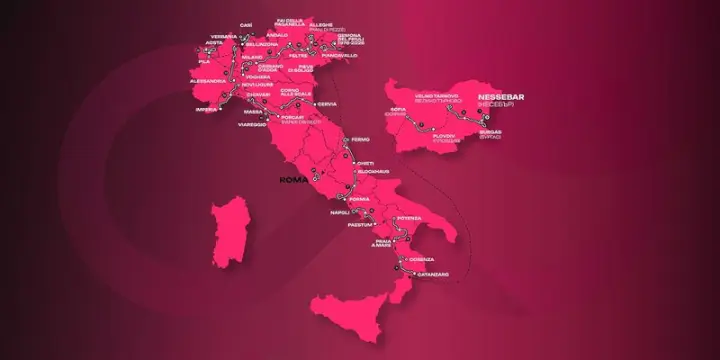
May is here, the weather is becoming nicer and hotter and the classics have now officially came to an end, which means it’s time for the first Grand Tour of the year, the Giro d’Italia. And just like last year, the Grande Partenza is going to be held abroad, this time in Bulgaria. It will be the 16th foreign start in the history of the race and the second in a row.
After the start in Bulgaria, the riders take a ferry across the Adriatic Sea and continue the racing in Southern Italy. The first week is not a traditional one, as there are numerous hilly and mountain stages across the first nine days. Week two is a typical transitional week, with only a stage or two that could be important for the GC, including the only time-trial in the entire race coming on stage 10.
But just like in previous years, the third week is brutal with multiple mountain stages to conquer. The bad weather that is usually in the Alps by the end of May will also make things a lot more intriguing and dramatic. Overall, the riders will have 48764 meters in elevation to get through, which is almost 4000 meters less than last year. Still, at the end of the day it will be the riders who make the race exciting.
Don’t forget that in 2023 we had an a super hard third week with multiple stages over 5000 meters of altitude gain, however due to the passive racing by the likes of Geraint Thomas, Primoz Roglic and Joao Almeida it turned out to be a very disappointing last week with little to no action, except for the final showdown on the Monte Lussari, where the Slovenian came out on top by producing one of if not the best performances of his life.
Last year we only had one super hard stage in the final week, and that turned out to be a banger, where Simon Yates managed to turn things around on the mighty Colle delle Finestre. So with knowing all this, it doesn’t really matter how many hard stages we have or how they are distributed across the three weeks. It all starts in Bulgaria, so let’s look into the first week’s parkour deeply and analyze how each stage could turn out.
As I’ve already mentioned, the first week is quite a non-traditional one, with overall only 4 sprint stages, and even those are not easy, as many of them have climb in the middle of it. There are also a quartet of hilly stages, where the puncheurs will have a chance to shine, while the GC riders will be trying to stay out of trouble and maybe gain a some valuable time on each other.
And even though it is only the first week, we are going to have a demanding mountain stage, which ends on the infamous Blockhaus. On paper we should already have some differences between the favorites by the end of the first week, which might make riders race more aggressively in the second week. But let’s not get too ahead of ourselves, instead here is the break down of the Bulgarian Grande Partenza, followed by the remaining 6 stages of the first week.
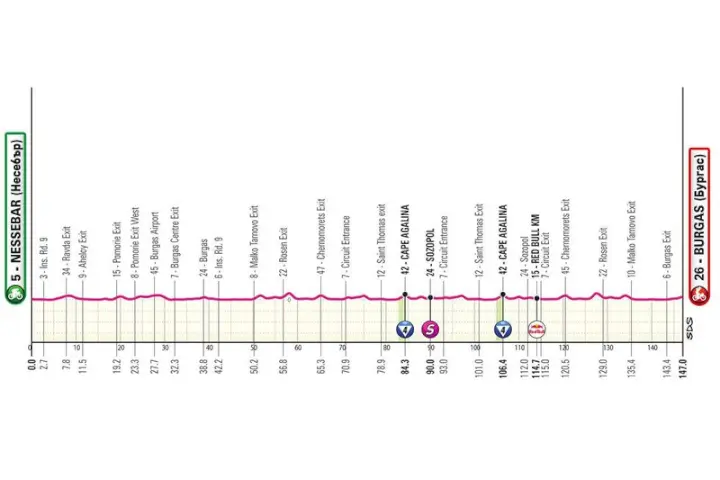
The 109th edition of the Corsa Rosa kicks off with a sprint stage, with no serious difficulty during the stage. It is almost entirely flat with a couple of very short rises concentrated in a 22km circuit that is covered twice around mid-stage. Some of the local teams like Polti, Bardiani or even the Unibet Rose Rockets, who will make their Grand Tour debut here, will probably try to get the first Maglia Azzura of the race.
With about 33km to go, we’ll have the so called Red Bull KM, where riders will be able to get some bonus seconds that count towards the GC. So, watch out for it on every stage, as the GC riders will definitely go for it, which could create some chaotic situations. Following this special intermediate sprint, the riders will exit the circuit and will start to make their way towards the finish line in Burgas.
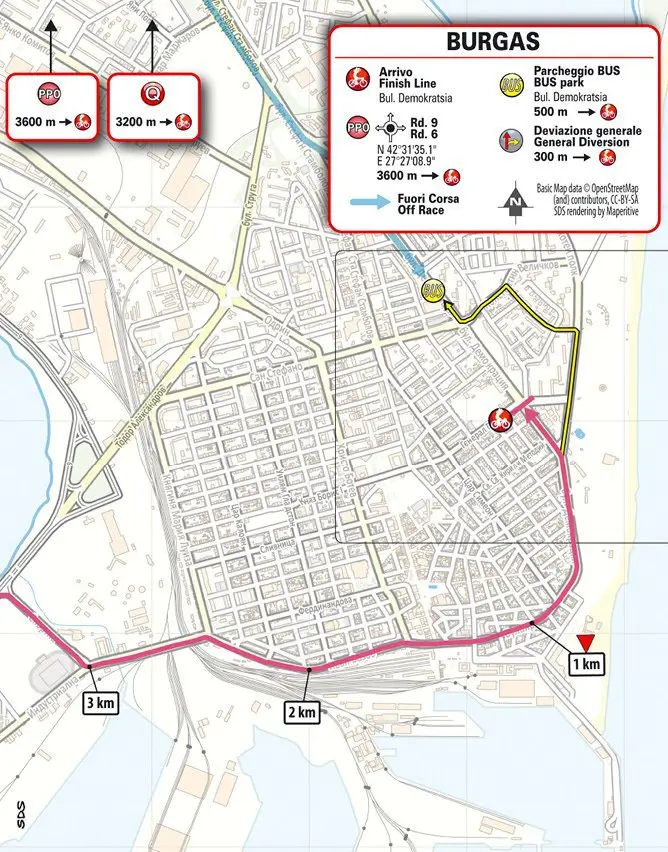
The finish is located in the city centre, which makes it quite a technical one. The roads are mostly straight, however there are a few bends to navigate. With a kilometer to go there’s a long left hander followed by the last corner with 300m to go. Whoever is the first coming out of this turn will also likely win the stage. Therefore, the lead out trains will play a crucial role in the final part of this stage.
Next to that, everybody will still be fresh and motivated, which will make the peloton nervous and could cause some crashes. It is not a rarity to see GC riders already on the floor on the opening stages, just look at last year’s first stage in Albania, after which Mikel Landa was forced to abandon the race, following a high speed crash on the final descent.
And as we saw last year, the road surface can be quite poor in this part of Europe, so that’s another thing the riders will have to keep in mind during the stage. If everything goes as expected, then we should have the pink jersey on one of the fast man’s shoulder by the end of the day, but anything can happen on the first stage of a Grand Tour. Expect a nervous stage, with a lot of fight for positioning and a fast finish with maybe some unexpected events.
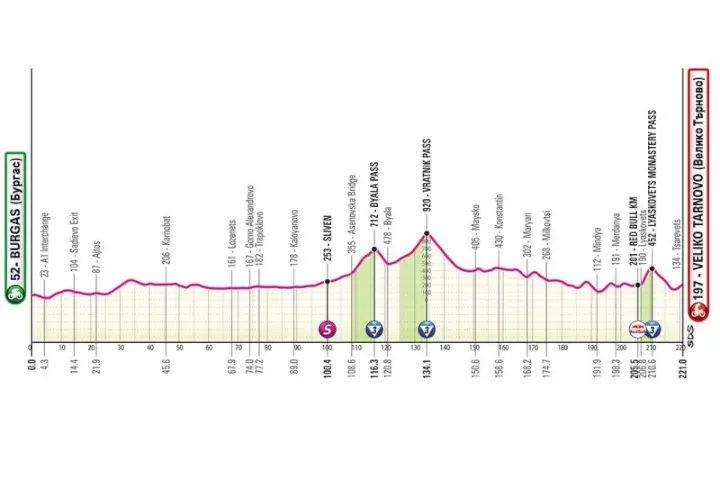
Following the sprint on stage one, we’ll already have some hills to navigate on the second stage. At 221km in length, it is one of the longest stages in the entire race, and with its rolling terrain across the Balkan valleys, we could already see a fight between the GC favorites.
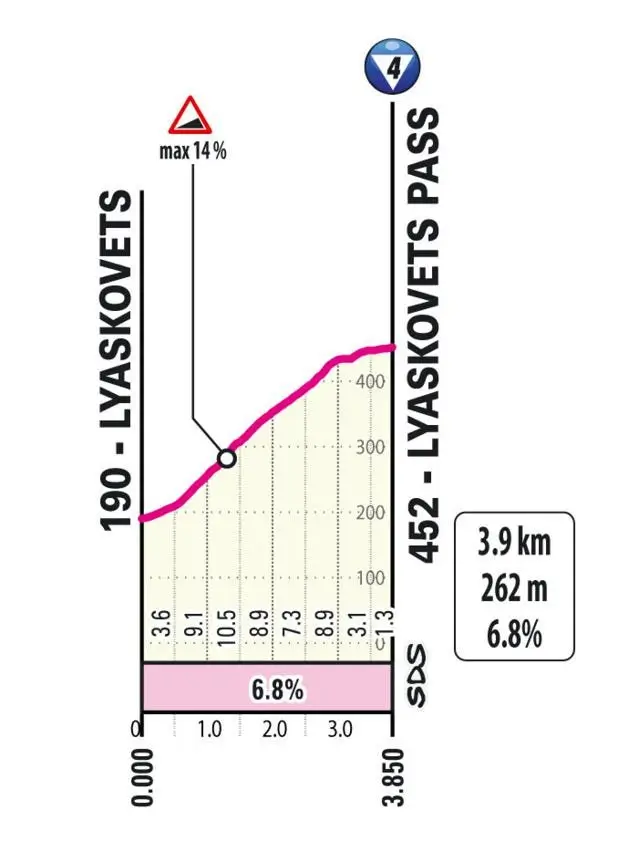
After a flat start, the stage becomes more demanding in the middle part, with a couple of 3rd category climbs located at the halfway point, followed by a long descent and a flat run in into the decisive part of the stage, marked by the Lyaskovets Monastery Pass (3.9km-6.8%).
It is quite an irregular climb, with the middle 2km averaging around 8%, with a maximum gradient of 14%. On paper, the pure sprinters like Milan and Groenewegen will have no chance at survival, but on the other hand it might not be hard enough for the GC riders to create meaningful gaps. However, at the top there will be only 11km left, so attacks are an inevitability, even though the final is more complicated than it seems to be, as the final kilometers are still challenging after the descent.
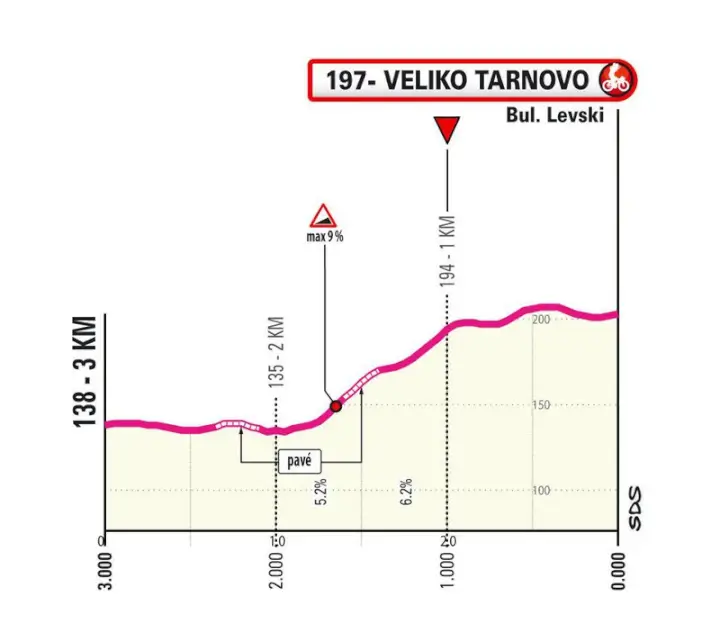
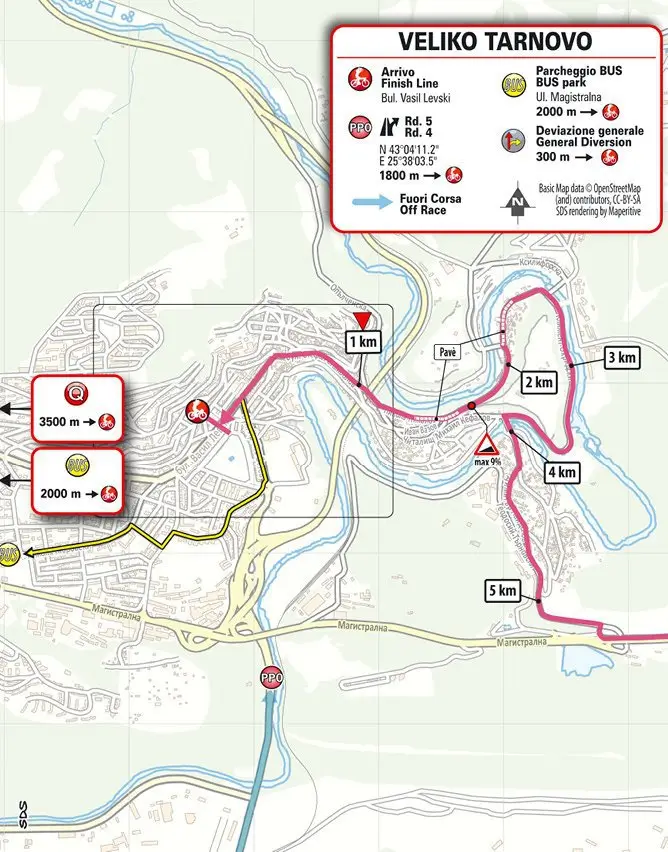
The final 3km are mixed. The first kilometer is mostly flat, however there will be a short cobbled section to navigate before the road heads uphill. With about 1500m to go there will be another cobbled section, with gradients up to 9%. From there on there will be a few hundred meters left to climb before the flat final kilometer. The last corner comes with 500m to go, and the final couple of hundred meters will be slightly uphill.
After such a hard climb so close to the finish, the last couple of kilometers will definitely make some riders’ legs heavy. On paper the GC riders won’t be able to drop each other on a finish like this, as it’s not hard enough. That’s why it’s a perfect stage for the versatile sprinters. Last year we had a very similar finish in Matera on the 5th stage, which was won by Mads Pedersen ahead of Zambanini and Pidcock, so expect similar type of riders compete for the stage win. Don’t forget that the Maglia Rosa will probably be up for grabs too, as the sprinters will likely get dropped on the last climb.
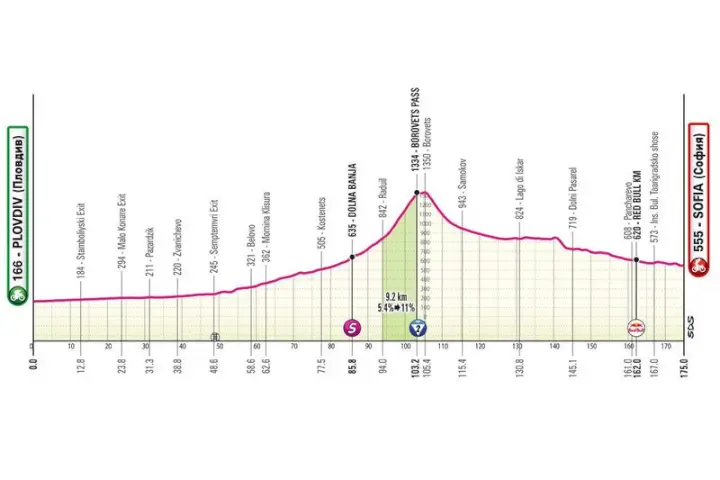
The next stage should be another one for the fast men. However, as I’ve said in the week 1 overview, even the sprint stages are not straightforward, and this one is no exception either. This stage can be divided into two parts: the first is a steady false flat uphill and ends at the Borovets ski resort, while the second is a steady false flat downhill all the way to the finish in Sofia.
The climb up to the ski resort is the main difficulty in the stage, it is 9.2km long and averages 5.4% with some 11% pinches halfway through it. The versatile sprinters’ teams will probably try to drop more of the pure sprinters, but after the top there’s still 75km to the finish, so even if you get dropped, there’s a good chance that you can catch back up in the descent.
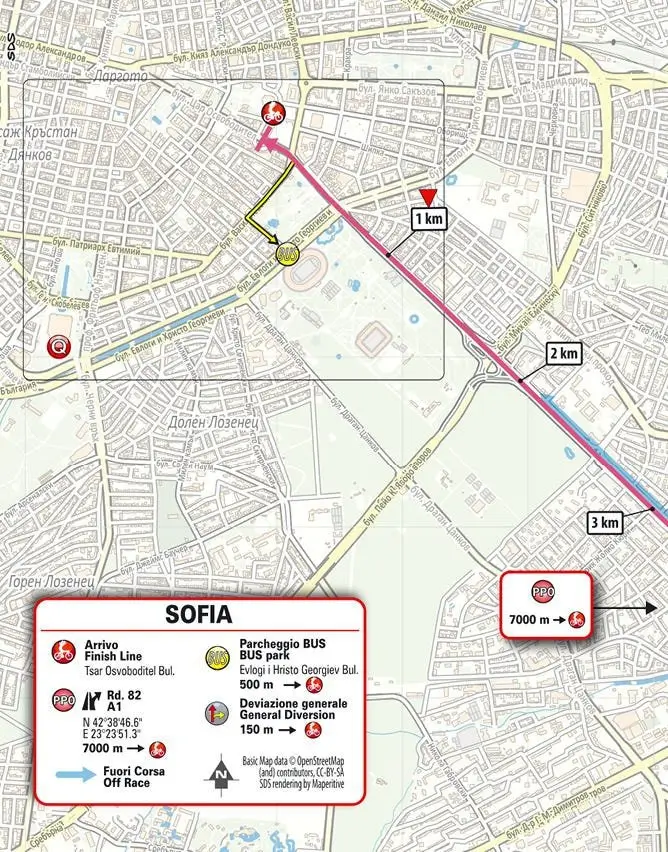
As oppose to the first stage, the finish of this stage is a lot less complicated, as the final 8km are completely straight. The roads will be 8m wide, so expect a UAE Tour like sprint. Due to the simplicity of the finale, not everything is over if you’re not in position under the flamme rouge. It will be a high speed sprint where power and aerodynamics will play a crucial part.
On paper Jonathan Milan will be the odds on favorite, however as we all know his position isn’t the most aero on the bike, so some of the smaller sprinters could have a shot if the “Italian Beast” has to launch early. So, this is the end of the Bulgarian Grande Partenza, as the riders will continue racing in Southern Italy after a short ferry across the sea during the rest day.
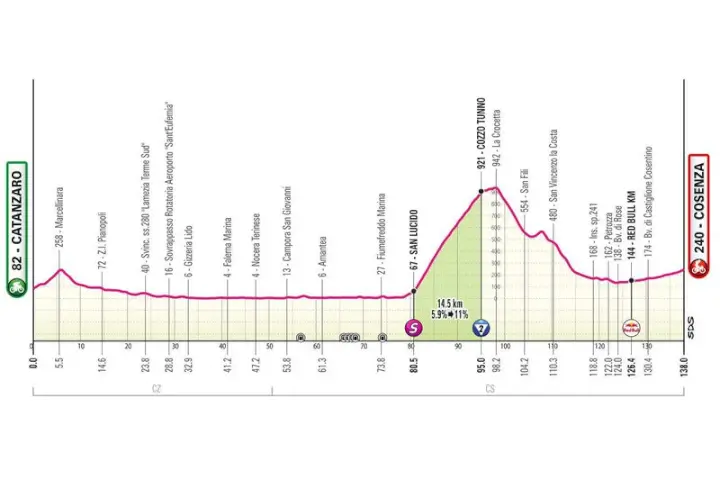
The first stage in the race’s home country is almost identical to the last one in Bulgaria. The opening 80km are almost completely flat, before the riders take on the only categorized climb of the stage, which is the Cozzo Tunno (14.5km-5.9%). It is slightly longer than the one in the previous stage, however due to its regularity it shouldn’t cause a lot of trouble for the sprinters. From the top there will be about 50km left to ride, 30 of which are downhill, where regrouping is a possibility.
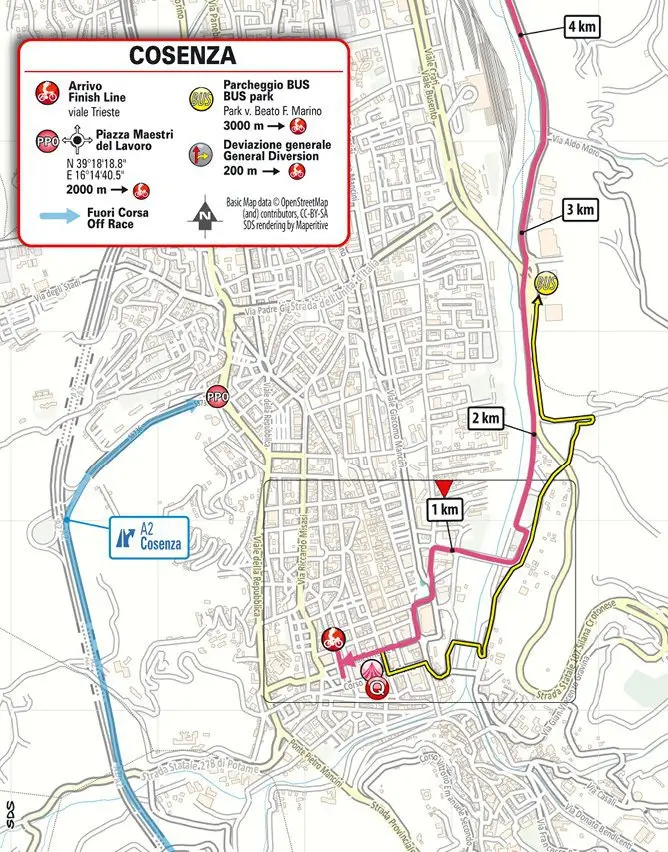
The finish in Cosenza is very simple, up until the last 1500m, where there will be turns coming after turns. All in all, there are 6 ninety degree turns in the last mile, with the final one coming at just 450m to go. What makes this last section even more intriguing is that the last straight is far from flat, as it averages 3.7%.
The last time we had a stage finish in Cosenza was back in 1989 on also the 4th stage, which was won by Rolf Jarmann after he attacked with 4km to go. Due to the technical finish, a solo rider might have a chance to replicate what the Swiss did. But on paper it should be a sprint finish, where the lead outs will play a very important part, because you will have to be in the first five riders after the last turn if you want to have a chance at victory.
It will also be crucial to time your sprint perfectly, as the uphill finish could make things a lot more unpredictable, compared if it was a traditional sprint. Expect chaos and a huge fight for positioning, where the smartest rider will be the one who raises their hands in the air for the first time on Italian soil.
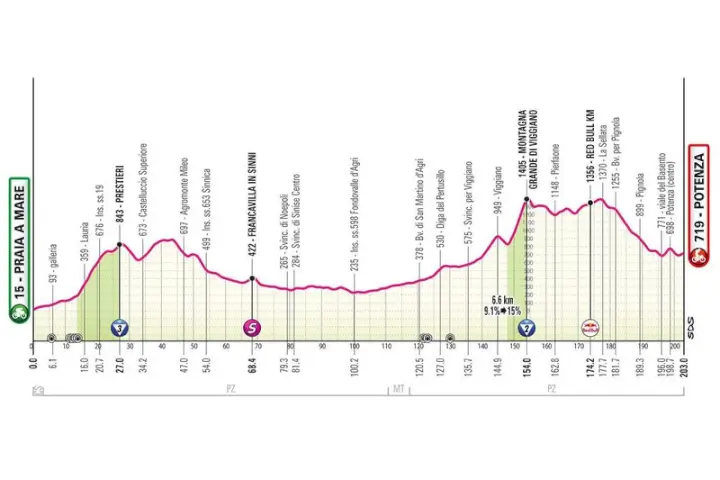
The following stage is one which could be their for the taking for the breakaway. It starts right next to the sea in Praia a Mare and we have a climb almost right at the start that goes up to Prestieri (13km-4.6%). It is the perfect climb for a large break to form with many strong riders in it. After the climb, we have a long valley section where the gap can be increased, especially if no teams will control behind.
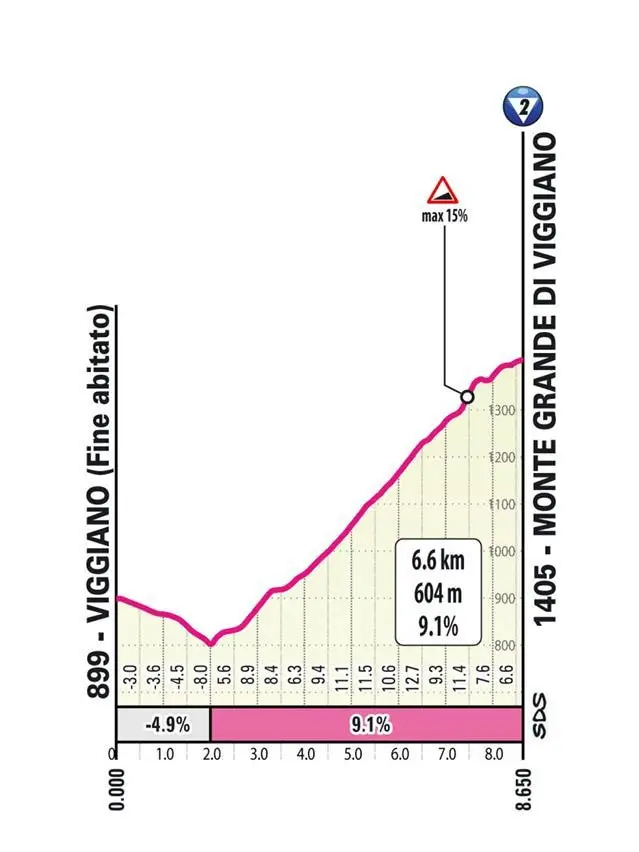
And why would any of the favorites’ teams control this stage? On paper it isn’t hard enough to create significant gaps in the GC, so they will likely save themselves for the upcoming stages. This means that next to the stage win the pink jersey might also be up for grabs for the breakaway riders. After the long valley comes the main difficulty of the stage, which is the Montagna Grande di Viggiano (6.6km-9.1%).
It is one of the hardest climbs in the entirety of the first week, with a couple of kilometers in the middle of it that average double digits. It is the perfect place to make the decisive move, if you are looking to be in pink by the end of the day. Following the top, there’s a 20km long rolling terrain before the descent into Potenza.
This stage is very similar to last year’s stage 8, which ended in Castelraimondo. On that day a big breakaway went up the road with the peloton letting the gap out behind, which meant that the pink jersey was up for grabs. On the main climb of the day (Sassotetto), which was located in the middle of the stage, a small group formed including the likes of Plapp, Ulissi and Kelderman.
After the climb it was the Australian who got away on the undulating terrain and claimed the stage following a 45.5km solo effort. However, it wasn’t him who took the Maglia Rosa, instead it was Astana’s veteran who became the leader of the race, for the first time in his illustrious career. I expect a very similar scenario to happen in this stage, since the final in Potenza is quite straightforward.
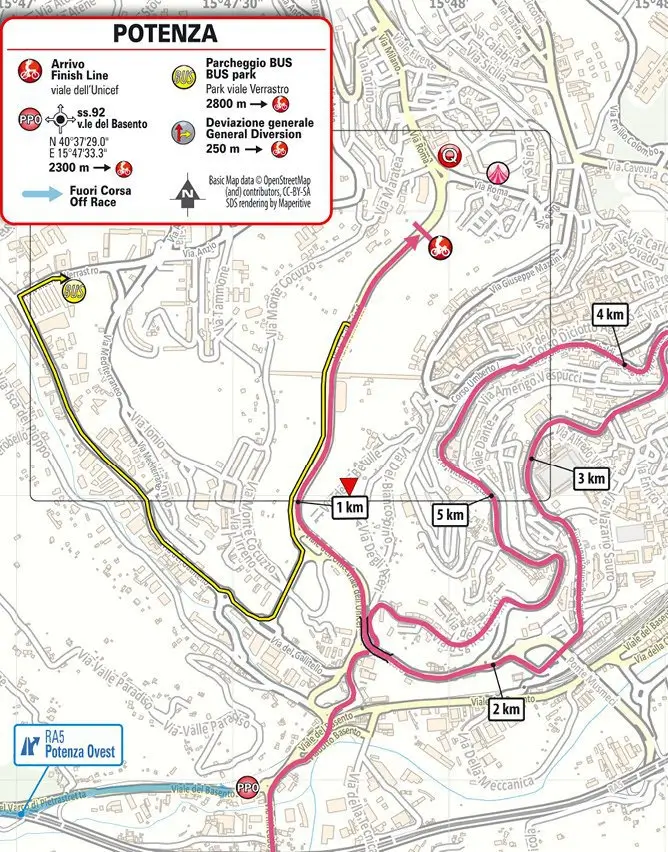
Speaking of Potenza, the last time the Giro finished here was on stage 7 four years ago, which also included the Montagna Grande di Viggiano and was won by Visma’s Koen Bouwman in a small group sprint. This year’s finish is nearly identical to the one in 2022, as the final 700m are straight and trend slightly uphill (around 2–5%). A breakaway fight is the most likely outcome, however that doesn’t mean that the favorites will just sit in the peloton and cruise into the finish for a number of reasons.
Firstly, this a perfect stage for some of the lesser known GC riders to slip into the breakaway and take time on their rivals. Ben O’Connor did just that in the 2024 Vuelta, which helped him finish in 2nd place at the end of the 3rd week. Secondly, the main climb is also very hard on paper, where differences can be made if someone has a bad day. So expect a very eventful stage with action both in the breakaway and in the peloton.
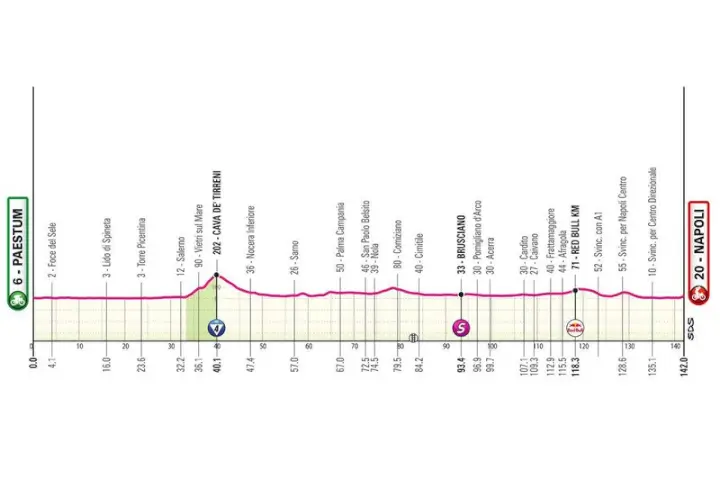
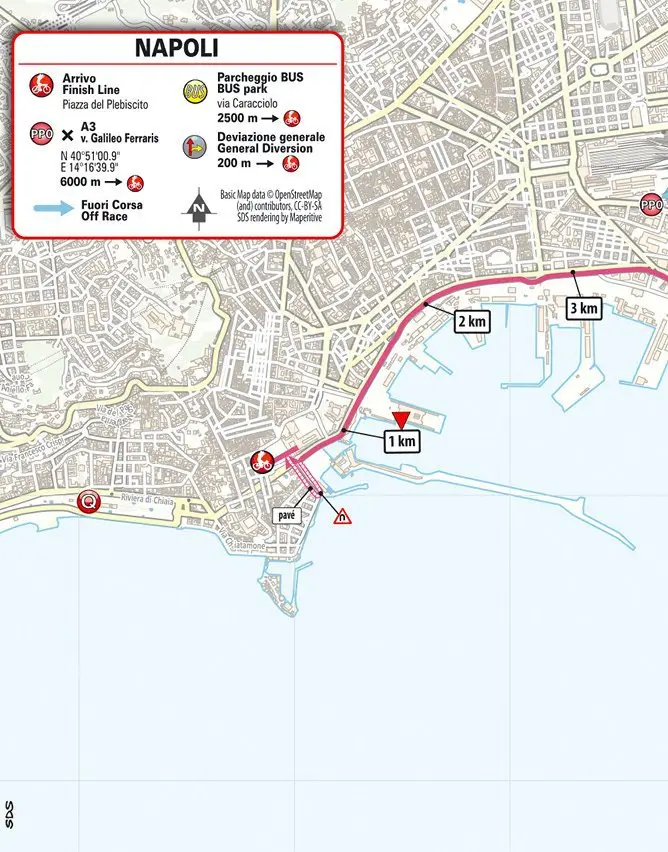
A finish in Naples can only mean one thing: it’s time for a sprint again. Overall it might be the easiest stage in the whole race, as it is only 142km and only has one 4th category climb, which comes with 100km to go. There is a Red Bull KM with about 25km before the finish in Naples, that the GC riders might be able to contest, depending on whether the breakaway is caught or not. But just like most of the sprint stages so far in this Giro, this one also has a catch.
Similarly to stage 4, the finish is pretty simple all the way until the flamme rouge. But the big difference is that next to the technical turns the riders will also have to navigate through some pave sections, which are uphill. The first turn comes with 650m to go, it’s a left hander that leads into the slight uphill (4%) with stone slabs. At 400m, two right-hand bends lead onto the final straight on 8 m wide cobbles.
This we’ll be 4th year in a row that Naples features as a finishing town in the Corsa Rosa, and on all three of the previous occasions we’ve had a sprint finish. In 2023 Mads Pedersen won ahead of a certain Italian up-and coming sprinter called Jonathan Milan. That was the year the “Italian Beast” really made a name for himself, but interestingly he hasn’t been able to win yet in the “City of the Sun”, as Visma’s Olav Kooij won in the following year, while Alpecin’s Kaden Groves took the “crown of Partenope” last year.
So the main question is simple: can he finally win in the city, where all the Italian greats, such as Cipollini and Moser have won in the past? Well, he might have to wait another year, since the uphill nature of this finish is definitely a disadvantage for him. On the other hand, Lidl-Trek’s lead out train will probably be one of the strongest, so if they can put him into the prime position after the final couple of right handers, then he still has a good shot.
Also he’s one of the heavier sprinters, so pushing the power on the cobbles should not be a problem for him. However, due to the complicated final, a late attacker could also succeed, if they time their move perfectly. Overall the stage will probably be quite uneventful for the first few hours, but the we should see a finale that hopefully makes up for all the waiting.
In this decade we’ve seen a major shift in how mountain stages are distributed across the three weeks. In the 2010s it was quite rare to have a mountain stage in the first week, but that approach changed in the 2020s. In the last few years we had many mountain-top finishes early in the race: last year it was the Tagliacozzo, the year before that it was Oropa on the 2nd stage followed by Prati di Tivo later in the week, while in 2023 it was the Gran Sasso d’Italia.
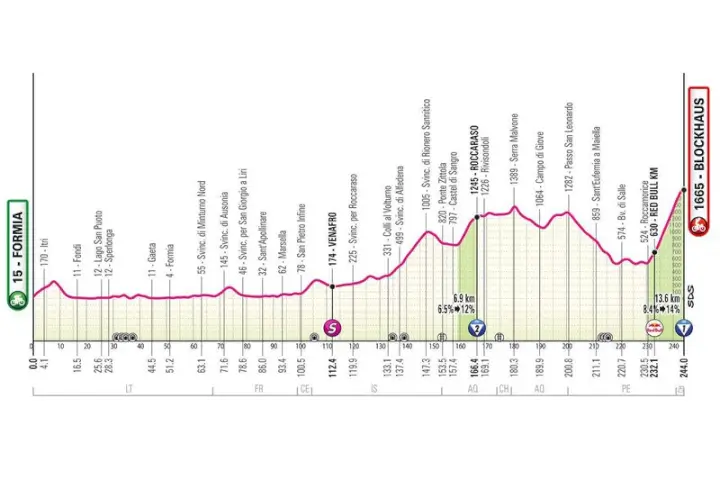
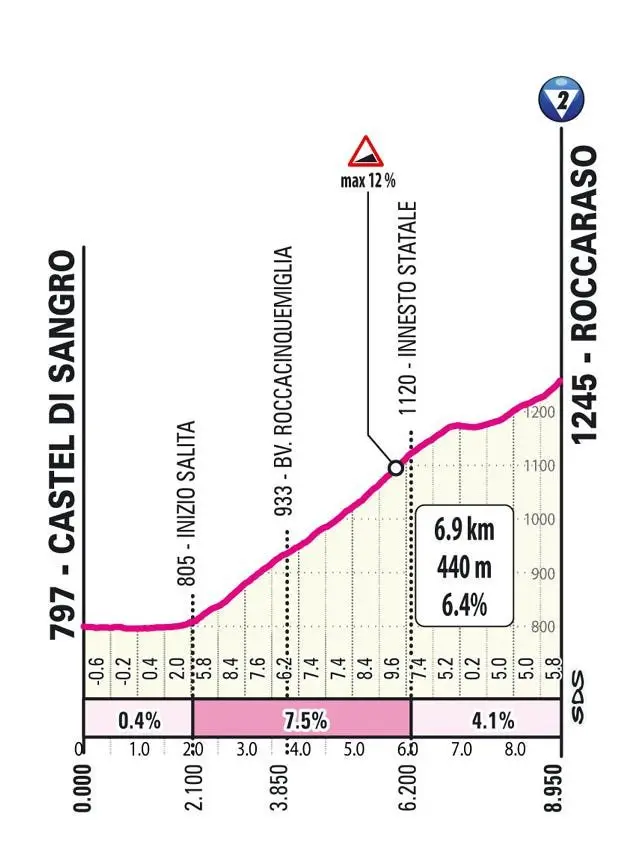
All these stages I’ve just mentioned were hard but they are a step below what awaits for the riders this year. After 2022, the mighty Blockhaus is finally back. Just like 4 years ago, it is also going to be a super long stage, the longest to be exact. Elevation gain wise it will be slightly less, however it will still be a banger of a stage where gaps can be created. The first part of the stage is relatively easy, as it runs along the Southern Lazio coast before heading North into the Apennines. That’s where the first categorized climb is located, which is the Roccaraso (6.9km-6.5%).
It is not the hardest climb into the world, however it’s still tough enough to hurt your rivals, especially if you have plans of attacking on the final climb. After Roccaraso a long rolling terrain follows before the descent leading to Roccamorice, where the final climb begins. Speaking of the final climb, it’s a true icon.
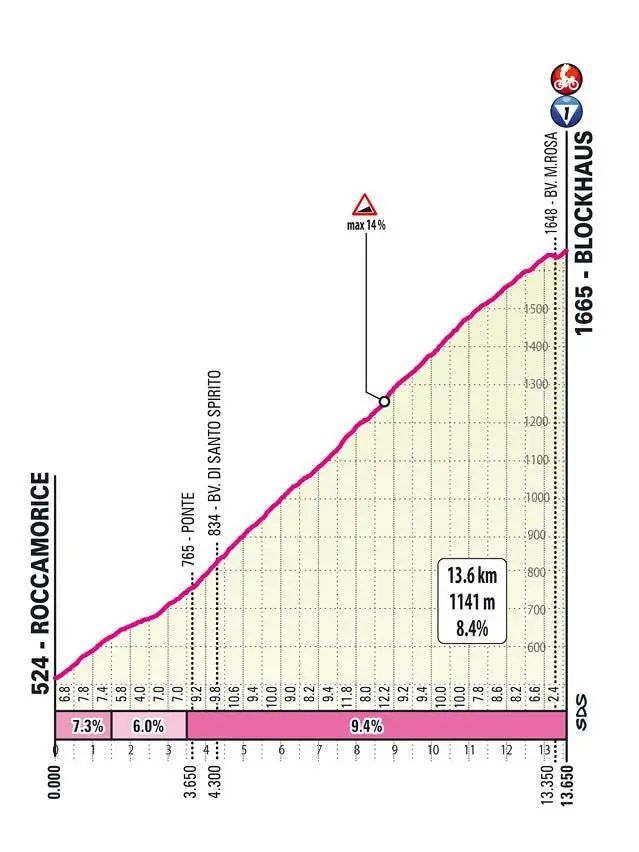
The Blockhaus is 13.6km long and averages 8.4%, with the final 10km averaging 9.4%. The hardest part of the climb is under the 5km banner, where the gradients reach 14%. If you intend to drop your rivals, then that’s the last place where you can attack, as the road flattens out around the flamme rouge before it kicks up again for the final 200m.
The last time we had a stage finish on the Blockhaus was in 2022, when Jai Hindley won in a 6-men group sprint. Before that in 2017 the gaps were a lot bigger, as Nairo Quintana was able to put time into all his rivals with an attack on the steepest section. But how did we have a group sprint on such a hard climb 4 years ago, you could ask? Well, the middle part of the ascent is very exposed to the wind, and in that year it was mostly headwind, which made attacks a lot less effective and reduced the difference in strength between the contenders.
Hindley will be present at this year’s race too, and I’m sure he will try to replicate what he did in 2022. However, with Vingegaard on the start line, a Quintana like dominant win is also in the realms of possibilities. We’ll definitely have an intriguing stage, since this will be the first time we’ll see the favorites on a major climb going head to head.
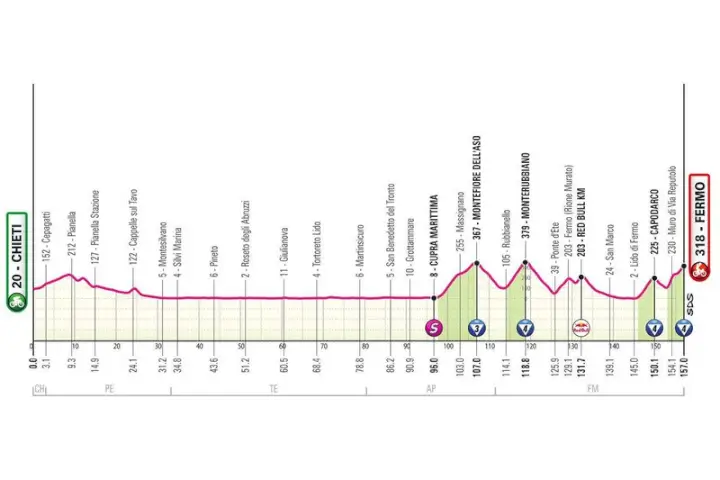
You’d think that after such a hard mountain-top finish an easier stage would follow, but the Corsa Rosa isn’t a simple race, it has difficulty after difficulty, hence why many people view this as the hardest Grand Tour out of the three. The first 100km are almost fully flat, however after that the succession of ups and downs begins, with several steep walls located near the finish.
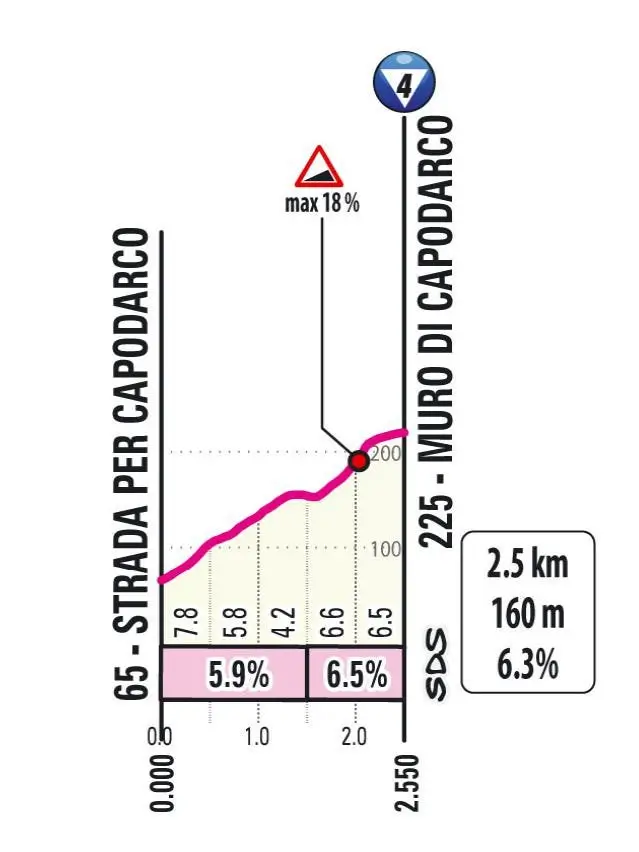
The first of these ups and downs is the Montefiore dell’Aso (9.9km-3.6%), followed by the Monterubbiano (4.7km-5.7%). They are far from the hardest ones, but perfect to build up fatigue in the legs before the riders reach the finishing town, Fermo for the first time. That’s where the riders will take on the “wall” of Via Cardarelli, on top of which the Red Bull KM is located, so the GC riders might already be on the move at this point in the race, with about 25km to go. After the climb a descent is up next followed by the run in towards the final categorized climb of the day, the Capodarco (2.5km-6.3%).
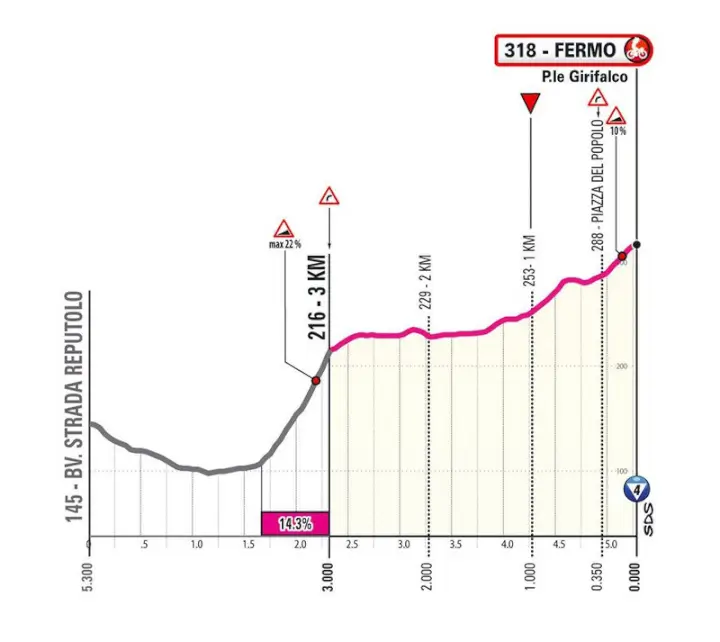
Purely based on the numbers, it isn’t the hardest climb in the world, however it still has a section where the gradients reach double digits. What is even more important, is that after the top there will only be 7km left to ride, 4 of which are downhill followed by the Fermo-Reputolo climb, which is uncategorized.
So, the final kilometers are essentially all uphill, starting with the Reputolo climb, which leads into the town of Fermo, and has gradients up to 22%. The route continues climbing to 750m to go, where a short descent will give the riders a short breather, before the final ramp to the finish at around 10% in Fermo. Next to the climbing, the riders will also face multiple sharp turns in the last couple of kilometers, which makes the finish even more tactical.
Speaking of the finish, it has been previously used in the Tirreno-Adriatico on a couple of occasions. On the first one back in 2017 Peter Sagan came out as the victorious, beating Thibaut Pinot and Primoz Roglic in an uphill sprint. Meanwhile, in 2022 it was Arkéa’s Warren Barguil who won at the end of a impressive breakaway adventure.
What has to be noted, is that both times the favorites group had less than 10 riders, which indicates that it is a finish where differences can be made. And knowing how hard the previous stage was, I think it’s a certainty that someone loses their GC aspirations on this stage.
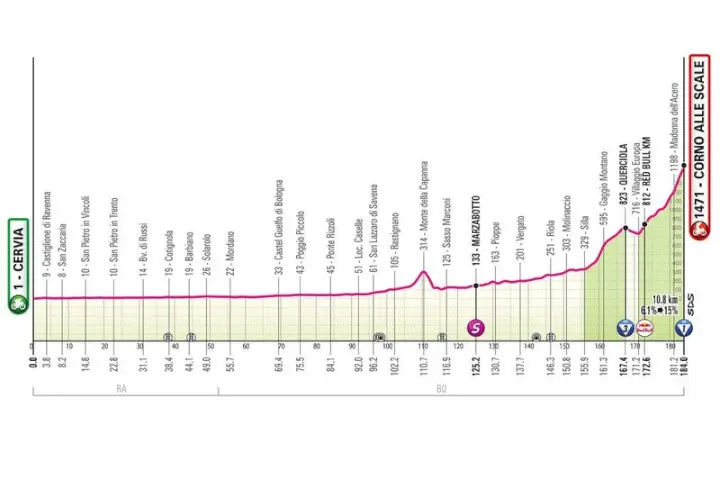
The first week ends in style, with the second mountain-top finish of the race, following 2 consecutive GC stages. Fatigue will surely be trough the roof for most riders, but Monday is a rest day, so there will be definitely some action. Speaking of action, hardly any will be found in the first 155km, as most of its is flat.
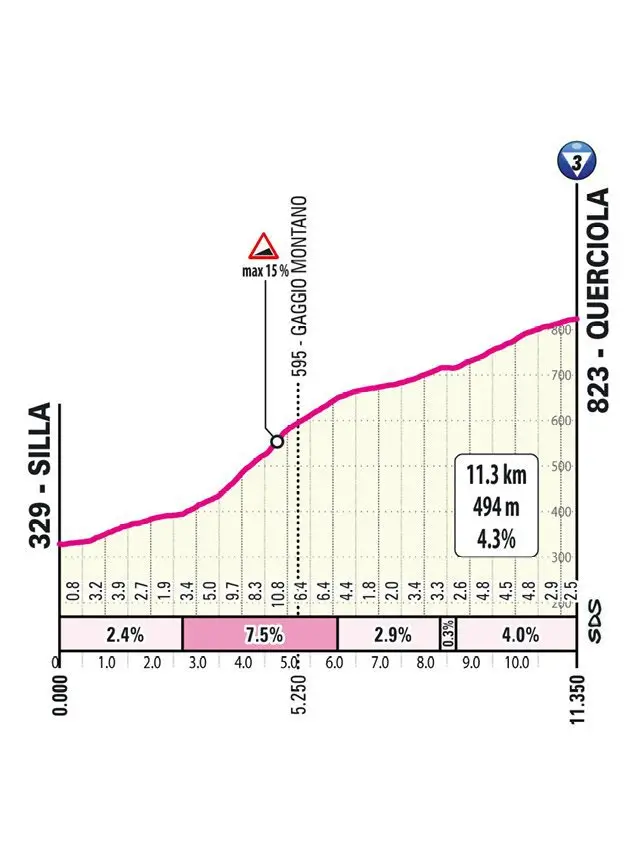
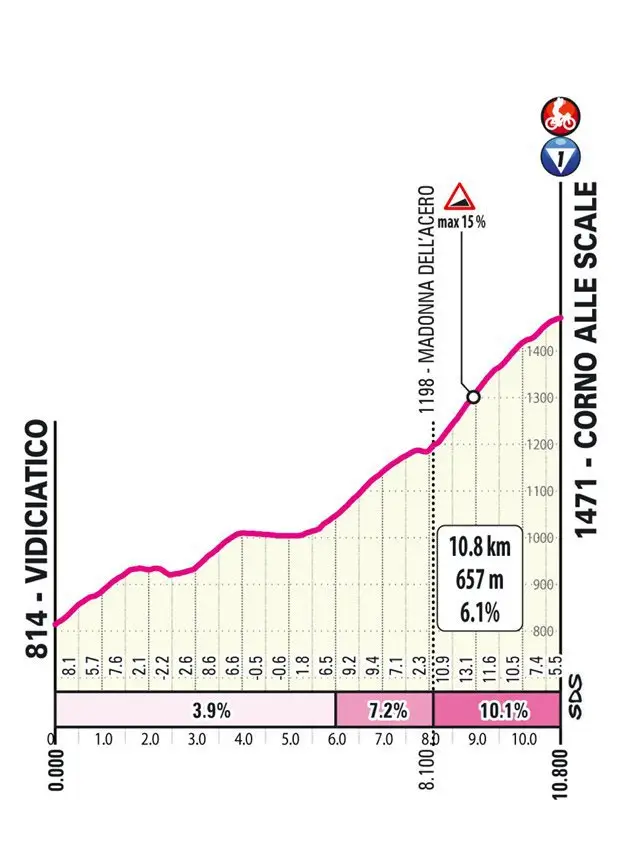
However, the last 30km are going to be as exciting as they could possibly get. There are two categorized climbs in the final part of the race, effectively forming a single ascent, separated only by a very short descent. The first one of the “duo” is the Querciola (11.3km-4.3%), which has never been used in any professional race before.
It is a climb of three parts. It starts smoothly, as the first 6km average around 4%, however what comes after that is pure hell. There is a short transition period of around 2km at 7.2%, before we get to the final and hardest part of the climb. In the final 3 km, gradients remain above 10%, with peaks up to 15%, before easing slightly in the final straight, where the gradients are “only” 7%.
It is a climb that we’ve almost never seen, as it has only been used once before. On that occasion, we had a home winner in Simoni Gilberto, with the lead up to the climb also including the ascent up to Querciola. Due to this being the 6th consecutive stage (there’s a rest day on Monday following the Grande Partenza in Bulgaria) and the 3rd quote-unquote “GC day”, it is hard to predict how this stage will unfold.
If a rider, such as Vingegaard has already taken time on the previous two stages, then Visma might give this stage to the riders in the breakaway. On the other hand, they might view this as an opportunity to take even more time on the others, and solidify their position in the race lead.
However, one thing we all know is that anything can happen in the first week of a Grand Tour. Favorites might crash out, or lose time unexpectedly, while some underdogs might emerge as contenders for the eventual win.
Overall, it’s a first week that has everything to be entertaining. From an intriguing start in a foreign county, sprint stages that could be chaotic and a day for the breakaway in middle of the week to the last 3 days, where there will be non-stop GC action, it’s almost a perfect start to a Grand Tour. Only a time-trial is the missing piece, but we won’t have to wait a lot for that, since the 2nd week starts with a 42km long individual effort. Speaking of the second week, a preview about that is coming too, so stay tuned.
How would you rate the first week of this year’s Corsa Rosa? Let me know in the comments!