New research confirms that cycling does more than burn fat; it releases a powerful hormone called irisin that crosses the blood-brain barrier to grow new neurons and protect against dementia.
For decades, the conversation around cycling has focused almost exclusively on the cardiovascular and metabolic benefits.
We ride to burn calories, to strengthen our hearts, and to manage our weight.
When we talk about the "mental" side of cycling, we usually refer to the psychological relief the "clearing of the head" or the stress reduction that comes with a long day in the saddle.
While those benefits are real, they are often viewed as abstract or secondary.
However, a groundbreaking shift in neuroscience has fundamentally changed how we understand the relationship between our muscles and our minds.
The quote you may have seen circulating is not just inspirational fluff; it is grounded in hard, rigorous science.
Studies show your regular bike ride does far more than burn calories. It releases a hormone called irisin that enters your brain, helps grow new neurons, and actively fights Alzheimer’s.
This discovery transforms the bicycle from a simple fitness tool into a precise medical device.
We now know that skeletal muscle is not just a mechanical structure for movement but an endocrine organ that communicates directly with the brain.
When you pedal, you are not just powering a machine; you are manufacturing a potent neuroprotective drug within your own body.
The Muscle-Brain Connection: Meeting Irisin
The hero of this story is a hormone called irisin. Discovered relatively recently, irisin was initially identified for its role in metabolic health, specifically its ability to turn white fat (energy storing) into brown fat (energy burning).
However, researchers at Harvard Medical School and Massachusetts General Hospital, led by Dr. Christiane Wrann, have uncovered its far more critical role: it is a messenger sent from your muscles to your brain.
The process begins deep in your quadriceps and calves. When you engage in endurance exercise like cycling, your muscles produce a protein called FNDC5.
As you sustain that effort, FNDC5 is cleaved into a smaller molecule irisin which is then released into your bloodstream.
For a long time, scientists debated whether irisin could actually reach the brain. The blood-brain barrier is a highly selective border designed to keep foreign substances out.
If irisin could not cross this barrier, its effects on cognition would be indirect at best.
However, the pivotal research published in the journal Nature Metabolism confirmed what many hoped was true: irisin is capable of crossing the blood-brain barrier.
It travels from your legs, through your blood, and directly into the hippocampus, the region of the brain responsible for learning and memory.
How Irisin Rewires the Brain
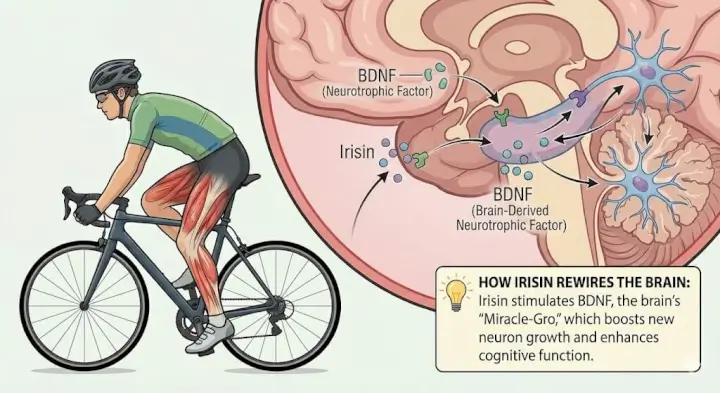
Once irisin enters the brain, it acts as a master switch for neurogenesis the growth of new neurons.
Historically, it was believed that the adult brain could not grow new brain cells.
We now know this is false, provided the right chemical environment exists. Irisin helps create that environment by stimulating the release of another critical protein: Brain-Derived Neurotrophic Factor, or BDNF.
You can think of BDNF as "Miracle-Gro" for the brain.
It encourages the survival of existing neurons and promotes the growth and differentiation of new ones and synapses.
Higher levels of BDNF are associated with improved cognitive function, faster learning, and better long-term memory.
By pedaling your bike, you are manually increasing the levels of irisin in your blood, which in turn elevates BDNF in your brain. This creates a physical change in neural structure.
The "clarity" you feel after a ride is not just a mood boost; it is the feeling of a brain that has been primed with high-performance fuel.
The Fight Against Alzheimer’s Disease
The most profound findings from Dr. Wrann’s study relate to Alzheimer’s disease.
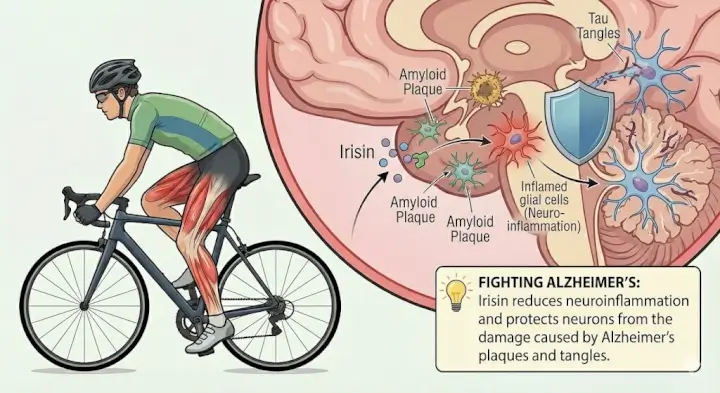
Alzheimer’s is characterized by the buildup of amyloid-beta plaques and tau tangles, which destroy communication between neurons, leading to memory loss and cognitive decline.
The study utilized mouse models genetically engineered to develop Alzheimer’s.
The results were startling. When irisin levels were boosted, the animals showed significantly better cognitive performance and less neuroinflammation.
Crucially, irisin does not just attack the amyloid plaques directly. Instead, it seems to reduce neuroinflammation, which is the "fire" that destroys brain cells in neurodegenerative diseases.
It acts on the brain's glial cells the support cells that protect neurons.
By calming the inflammatory response in the brain, irisin preserves the neural networks that Alzheimer’s seeks to destroy.
The study showed that even when Alzheimer’s pathology (the plaques) was already present, irisin could still improve cognitive function.
This suggests that cycling is not just a preventative measure; it is a therapeutic intervention that can help maintain brain function even in the face of aging and genetic risk factors.
Why Cycling is the Ideal Delivery System
While all physical activity is beneficial, cycling is uniquely positioned to maximize irisin production.
The production of FNDC5 and the subsequent release of irisin are triggered by sustained aerobic muscle contraction.
High-intensity bursts are effective, but the sustained, rhythmic nature of a bike ride where large muscle groups (legs and glutes) are engaged for 45 minutes, an hour, or longer creates a massive and consistent release of these myokines.
Running produces similar effects, but cycling allows for longer duration with less impact stress on the joints, making it a sustainable "medicine" for older adults who are most at risk for cognitive decline.
Furthermore, the aerobic nature of cycling increases blood flow to the brain, ensuring that the irisin produced in the legs is efficiently transported to the central nervous system.
It is a perfect closed-loop system: your legs generate the medicine, and your heart pumps it to the target.
The Protocol: How to Ride for Your Brain
If we treat movement as medicine, we must discuss the dosage.
You do not need to be a Tour de France pro to reap these benefits, but a leisurely coast around the block may not be enough to trigger significant irisin release.
1. Focus on Endurance: The studies suggest that endurance exercise is key. Aim for rides that keep your heart rate elevated for at least 45 to 60 minutes. This duration appears to be the "sweet spot" for metabolic changes that result in hormone release.
2. Moderate to Vigorous Intensity: You need to engage the muscles enough to stress them slightly. You should be breathing harder than normal but still able to speak in short sentences. This is often referred to as Zone 2 or Zone 3 training. It is this sustained muscular engagement that signals the body to produce FNDC5.
3. Consistency is King: Irisin has a transient effect. You cannot "bank" the benefits from one ride a month. To maintain high levels of BDNF and keep neuroinflammation at bay, you need regular doses. Aim for 3 to 4 rides per week.
4. Add Resistance: While aerobic capacity is important, the mechanical load on the muscle matters. Don't be afraid of the hills. Climbing requires more force from the quadriceps, potentially signaling a greater need for muscle adaptation and myokine release.
Science Now Confirms: Movement is Medicine
The phrase "Movement is Medicine" has been used for years by physical therapists and coaches, but we have reached a point where we can quantify that statement. We are no longer guessing.
We can trace the molecular pathway from the pedal stroke to the hippocampus. We can see the reduction in neuroinflammation.
We can observe the improvement in memory. The bicycle is arguably the most accessible, effective, and enjoyable way to administer this medicine.
In a world where pharmaceutical treatments for Alzheimer’s have often met with disappointment, the power of lifestyle intervention shines brighter than ever.
You have a pharmacy in your legs.
Every time you clip in and push off, you are filling a prescription that protects your mind, preserves your memories, and builds a stronger, more resilient brain.
So, the next time you struggle to find the motivation to ride, remember this: You aren't just working on your fitness. You are actively fighting for your future cognitive health.
References and Further Reading
For those interested in the deep science behind these findings, the pivotal study discussed in this article was published in Nature Metabolism.
Study: Irisin mediates effects on bone and fat via αV integrin receptors & Exercise hormone irisin is a critical regulator of cognitive function
Lead Author: Dr. Christiane Wrann, Massachusetts General Hospital / Harvard Medical School