Train your breathing like cadence: diaphragmatic breathing, stroke-synced rhythms, nasal sessions, and recovery patterns (box breathing, cyclic sighing) can reduce respiratory fatigue, improve efficiency, and help cyclists stay calmer and stronger for longer.
Most athletes rarely think about breathing. It happens automatically, so it often feels unnecessary to train it.
But breathing is not just a passive process. It is a physical skill that involves muscles, rhythm, and coordination with movement.
When those elements improve, performance can improve too.
Research in sports science suggests that breathing patterns can influence endurance performance by reducing the workload of respiratory muscles and delaying fatigue. When breathing becomes more efficient, athletes may conserve energy and maintain performance longer during exercise.
Cyclists, runners, and rowers all rely on the same system. Oxygen has to reach the muscles efficiently, and carbon dioxide must be removed quickly. If breathing becomes shallow or irregular, the body works harder to maintain the same output.
The good news is that breathing can be trained. Just like cadence, pacing, or posture, breathing can be practiced and improved over time. Below are several breathing techniques that can help cyclists ride more efficiently, stay calmer under stress, and recover faster after intense efforts.
Belly Breathing: The Foundation of Efficient Breathing
Before exploring more advanced breathing techniques, cyclists should first learn diaphragmatic breathing, commonly known as belly breathing.
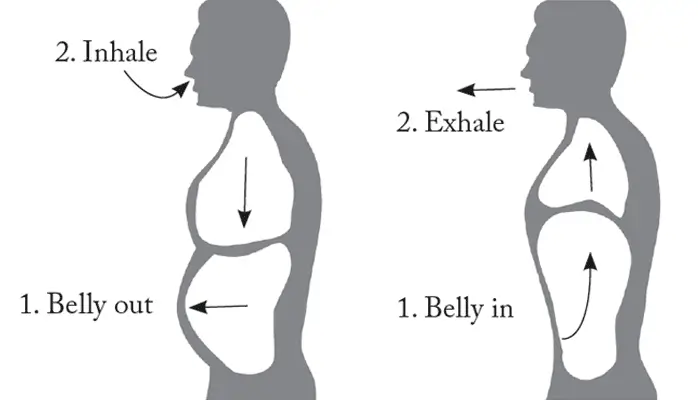
The diaphragm is the primary muscle responsible for breathing. When it contracts, it moves downward and allows the lungs to expand fully. This enables a larger volume of air to enter the lungs with each breath. Many people, however, rely mostly on shallow chest breathing, which limits oxygen intake and increases fatigue.
Belly Breathing Basics
Research suggests that diaphragmatic breathing can improve breathing efficiency, strengthen respiratory muscles, and support better movement stability in the body.
Unfortunately, modern habits make proper breathing harder. Long hours sitting at a desk, driving, or leaning over screens encourage shallow breathing patterns. Over time, the diaphragm becomes less active and the body adapts to inefficient breathing.
Practicing belly breathing helps restore the natural pattern.
To practice it, place one hand on your chest and the other on your abdomen. As you inhale, your stomach should expand outward while your chest stays relatively still. As you exhale, the abdomen gently contracts. Practicing this for a few minutes each day strengthens the diaphragm and prepares you for better breathing during exercise.
Technique 1: Three In, Three Out
One of the simplest breathing drills is controlled rhythmic breathing.
The goal of this exercise is to slow down breathing and build awareness of airflow. Many endurance coaches recommend reducing breathing frequency to around ten breaths per minute during relaxed breathing practice.
Start by inhaling slowly for three seconds and exhaling for three seconds. Continue this rhythm for several minutes.
While doing the exercise, focus on breathing deeply into the abdomen rather than the chest. Keep your shoulders relaxed and avoid forcing the breath.
This exercise is best done off the bike at first. You can practice it at home, at work, or even while commuting. Over time, this slower breathing rhythm trains your body to move more air with fewer breaths, improving breathing efficiency during rides.
Technique 2: Pedal Stroke Breathing
Once you are comfortable with diaphragmatic breathing, the next step is learning to synchronize breathing with movement.
Cycling already has a natural rhythm through pedal strokes. Aligning breathing with that rhythm helps maintain control during difficult sections of a ride.
Start by riding at a moderate cadence, around 90 revolutions per minute. Inhale naturally over three pedal downstrokes. Then exhale over six pedal downstrokes.
The longer exhale is important. It helps empty the lungs more completely and encourages deeper inhalation on the next breath.
During the exhale, lightly engage your abdominal muscles and imagine pulling your stomach toward your spine. Some riders find it helpful to make a soft “sss” sound as they breathe out. This helps regulate airflow and maintain focus.
The exact stroke count may vary depending on terrain and intensity. The important principle is keeping the exhale longer than the inhale. This encourages relaxed, controlled breathing even during challenging climbs.
Rhythmic breathing like this can also help distribute physical stress more evenly across the body and improve movement efficiency during endurance exercise.
Technique 3: Nasal Breathing Training
Many endurance athletes are now experimenting with nasal breathing during training sessions.
Breathing through the nose filters and humidifies the air while increasing nitric oxide production in the nasal passages. Nitric oxide helps improve oxygen delivery and blood flow.
Some research suggests that nasal breathing during aerobic exercise may improve respiratory efficiency and breathing performance over time.
However, nasal breathing can feel uncomfortable at first because it limits airflow. The key is to start slowly.
Try nasal breathing during easy rides or warm-ups. Focus on breathing calmly through the nose while maintaining a relaxed pace. If intensity increases, it is completely normal to switch to combined nose and mouth breathing.
Over time, the body adapts and nasal breathing becomes easier.
Technique 4: Box Breathing for Recovery
Box breathing is a structured breathing pattern often used by athletes, military personnel, and high-stress professionals to regain control of the nervous system.
The technique follows a simple four-step rhythm:
Inhale for four seconds Hold the breath for four seconds Exhale for four seconds Hold again for four seconds
This pattern creates a balanced breathing cycle that helps slow the heart rate and calm the body.
Deep breathing exercises like this can activate the parasympathetic nervous system, helping athletes regain focus and reduce stress during demanding situations.
Cyclists can use box breathing before races, during rest periods in training, or after intense intervals to help the body return to a calmer state.
Technique 5: Cyclic Sighing
Another breathing method gaining attention in research is cyclic sighing.
This technique involves a deep inhale through the nose followed by a second small inhale to fully expand the lungs. Then the air is slowly released through the mouth in a long sigh.
Studies suggest cyclic sighing can significantly reduce breathing rate and improve mood compared with other breathing techniques.
For athletes, this can be especially useful during recovery periods or after difficult efforts.
Cyclic sighing helps release tension in the respiratory system and restore relaxed breathing patterns.
Technique 6: Altitude Simulation Breathing
The final exercise challenges breathing capacity and tolerance to carbon dioxide buildup.
Start by walking at a comfortable pace. Exhale completely, then hold your breath while walking ten steps. After that, breathe normally for two or three steps.
Repeat the exercise while gradually increasing the number of steps during the breath hold. Eventually you can work up to fifty steps.
A cycling variation is also possible. Ride at a moderate cadence and follow a pattern such as:
Inhale for two pedal strokes Hold the breath for two strokes Exhale for four strokes
If this feels too restrictive, extend the pattern to four strokes in, four strokes holding, and eight strokes exhaling.
This exercise simulates the breathing stress experienced at altitude and helps improve control of breathing during demanding conditions.
However, breath holding should always be practiced cautiously and never during high-risk riding situations.
Why Breathing Training Matters
Breathing muscles fatigue just like any other muscles in the body. When the diaphragm and respiratory muscles become tired, they compete with working muscles for oxygen and blood flow.
Some studies show that respiratory muscle training can improve cycling time trial performance by several percent by increasing respiratory endurance and ventilatory efficiency.
That improvement may sound small, but in endurance sports small gains accumulate.
Better breathing means more oxygen delivered to the muscles, improved pacing control, and less wasted energy.