Iron Deficiency Is Quietly Crushing Your Cycling. Here Is How To Spot It
A 2024 systematic review found iron deficiency drops endurance performance by 3 to 4%, yet most standard blood panels label cyclists with low stores as "normal."
Peak plasma caffeine hits 45 to 60 minutes after you drink it, and the dose that actually moves your watts is 2 to 3 times bigger than a single espresso.

Walk into any group ride start lot and count the coffee cups.
Almost every rider is sipping an espresso or americano in the ten minutes before the wheels roll.
It feels like a ritual. It is also, biochemically, mistimed.
The science on caffeine and endurance is one of the most settled topics in sports nutrition. The problem is that the science has almost nothing to do with how most cyclists actually use it.
In 2021, the International Society of Sports Nutrition published an updated position stand on caffeine and exercise performance.
It is the most cited document in this category. You can read the full Guest et al. position stand on JISSN.
The conclusions are unusually direct for an academic paper.
Caffeine produces small to moderate performance benefits across endurance events lasting 5 to 150 minutes, at doses between 3 and 6 mg per kilogram of bodyweight, taken 30 to 90 minutes before exercise.
That is the operating manual. Almost nobody follows it.
For a 75 kg rider (165 lb), the low end of that range is 225 mg of caffeine. A standard double espresso has roughly 125 mg.
You can see the gap.
Caffeine does not work on contact. It has to be absorbed through the gut, processed by the liver, and circulated to the central nervous system before it changes anything about how hard you can push.
That process takes time.
Peak plasma concentration arrives 45 to 60 minutes after ingestion for most people. Some research stretches that window to 90 minutes for capsules and slow-release forms.
So if you neck your espresso at the start line and you are racing for 60 minutes, the caffeine peaks roughly as you cross the finish.
This is not a small detail. It is the whole game.
The math gets uncomfortable for most riders.
At 3 mg per kg, a 60 kg cyclist needs 180 mg, and a 90 kg cyclist needs 270 mg. At the higher end of the proven range (6 mg per kg), those numbers jump to 360 mg and 540 mg respectively.
Here is how that translates to common sources:
A 75 kg rider hitting the 3 mg per kg minimum needs more than three espressos, two full mugs of coffee, or one and a half tablets. Not one cute ceramic cup at the cafe stop.

Natural Elite Caffeine Pills with L-Theanine
✓primeCaffeine and L-Theanine work together to deliver smooth, sustained energy and mental focus without harsh spikes or crashes.
$15 from AmazonAs an Amazon Associate, we earn from qualifying purchases.
Caffeine is not creatine for sprinters. It does not change your physiology.
What it does is reduce perceived exertion. The same wattage feels easier, which means you tend to hold it longer before you cave.
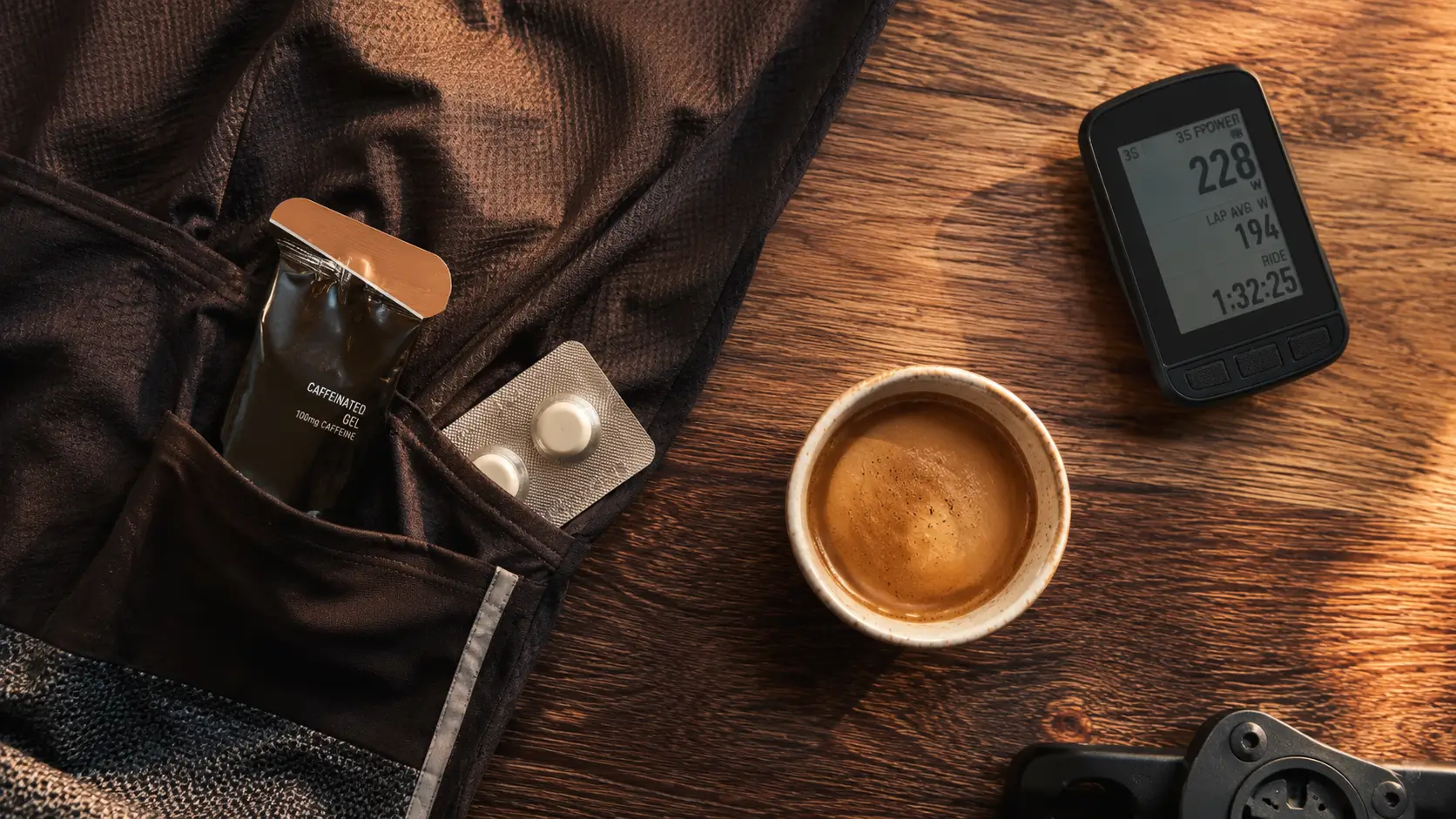
Time-trial studies typically show improvements in the 2 to 4 percent range at properly dosed caffeine intakes.
That sounds tiny until you remember that a 1 percent improvement on a 40 km TT is the difference between fifth and the podium.
Caffeine also has well-documented effects on mood, alertness, reaction time, and pain tolerance under fatigue.
Endurance riding is largely a fight against the brain's protective mechanisms, and caffeine quietly tilts that fight in your favor.
This is also why pros lean on Coca-Cola in the final third of grand tour stages: sugar plus caffeine, fast, in liquid form. We broke that habit down in our piece on why Tour de France riders swear by Coca-Cola for a mid-race boost.
Caffeine is not magic. It has a cost.
The most common one is gut distress. A large dose on an empty stomach, taken with the adrenaline of a race start, can hand you cramps you cannot ride out of.
It also wrecks sleep when used carelessly. Caffeine has a half-life of around 5 hours in most adults, but 8 to 9 hours in slow metabolizers.
A 6 pm dose on an evening club ride is still pharmacologically active at 11 pm. Sleep loss is the fastest way to undo whatever caffeine bought you that day.
And tolerance builds fast. A rider doing 400 mg of pre-ride caffeine daily will see most of the performance effect blunt within two to three weeks.
The honest move is to treat caffeine like a tactical weapon. Save it for hard sessions, races, and long efforts where the ergogenic ceiling matters.
Here is the protocol that lines up with the evidence.
For a 60 to 75 kg rider, aim for 200 to 300 mg. For a 75 to 90 kg rider, push to 300 to 400 mg.
Heavier than that, 400 mg is a reasonable ceiling for most non-elite riders.
Take it 45 to 60 minutes before the effort. If you are racing a crit at 9 am, your caffeine intake is happening at 8 am, not at the start line.
Use one source, not three. Layering espresso, a pre-workout, and a caffeinated gel is how you accidentally land at 600 mg with cramps and a heart rate that will not settle.
For very long efforts (gran fondos, gravel races over four hours), split the dose. Half before the start, half at roughly two-thirds distance, ideally via a caffeinated gel or Coke.
Pair it with smart fueling and the principles we cover in 10 best supplements for cyclists for the rest of the stack.
And test it in training. Race day is the worst possible time to discover that 350 mg of caffeine makes you sprint to the porta-potty.
Most cyclists love caffeine for the wrong reasons.
They use it for the smell, the warmth, the cafe culture, and the dopamine hit of the ritual itself.
Those are fine reasons to drink coffee. They are not the reasons it shows up in peer-reviewed sports science journals.
If you want the watts, you have to treat it like the drug it actually is. Right dose, right timing, right tolerance management.
Three milligrams per kilogram, forty-five minutes out, one clean source.
The espresso is for after.
Perfect for the new riders!
No spam. Cancel anytime.