The Only 3 Rides Cyclists Actually Need
A 2024 systematic review of 14 studies found the same thing across cyclists, runners, and triathletes. Three ride types, arranged deliberately, out-performs six random sessions every time.
Before you turn another pedal over, learn the bio-mechanical red flags of excessive saddle height and how to find the sweet spot for efficiency and pain-free riding.
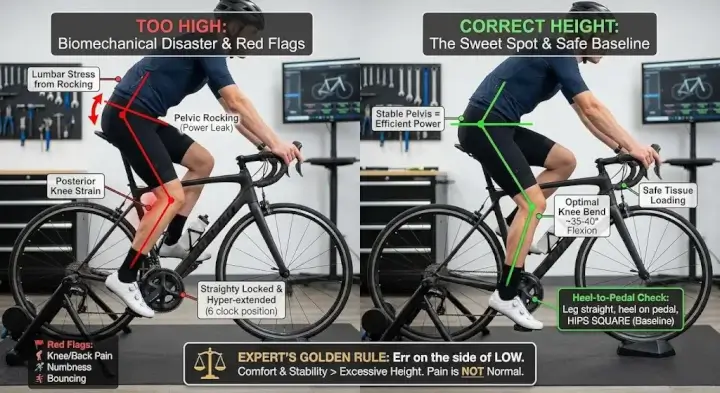
In my years working in bike fitting studios and analyzing riders on the road, one issue reigns supreme as the most frequent contributor to injury and inefficiency.
It isn't cleat position, it isn't handlebar reach, and it isn't tire pressure. It is excessive saddle height.
There is a pervasive, unspoken belief in amateur cycling culture that "higher is better."
Perhaps it stems from the aesthetic of the long seat post, or a misguided notion that a fully extended leg yields maximum leverage.
Whatever the cause, the result is an epidemic of hips rocking, hamstrings straining, and power vanishing into thin air.
If you are serious about your cycling whether that means crushing a local Strava segment or simply completing a century ride in comfort you must understand the mechanics of saddle height.
A position that is merely "tolerable" is not sustainable. The margin for error in bike fitting is surprisingly small; a saddle that is just 5 millimeters too high can wreak havoc on your kinetic chain over thousands of pedal strokes.
Here is the expert perspective on why a high saddle is so destructive, how to identify if you are a victim of it, and how to establish a safe baseline.
The bicycle is a fixed machine; the human body is dynamic. When you clip into the pedals, your body must adapt to the bicycle's contact points.
If the distance from the top of the saddle to the bottom of the pedal stroke is greater than the functional length of your leg, something has to give.
Your body is highly adaptive and will find a way to reach that pedal, but it will do so by sacrificing stability.
When your saddle is too high, you force your leg into hyper-extension at the bottom of the stroke (around the 5 o’clock to 6 o’clock position). Because your foot is attached to the pedal, it must travel that full circle.
If your knee cannot safely extend any further, your body compensates by dropping the hip on that side to close the gap.
This means that with every single revolution, your pelvis rocks side-to-side on the saddle.
Cycling efficiency relies entirely on having a stable pelvic platform from which your glutes and quads can drive power.
A rocking pelvis is a power leak.
Instead of driving energy directly into the drivetrain, you are dissipating it through lateral movement.
Furthermore, this constant rocking creates friction between your delicate soft tissues and the saddle, leading to persistent saddle sores.
It also forces the muscles at the back of your leg specifically the hamstrings and the gastrocnemius (calf muscle) to overstretch under load repeatedly.
This is a recipe for chronic tendinopathy that can keep you off the bike for months.
Riders often tolerate discomfort for far too long, assuming it is just part of the sport. Pain is not normal.
It is your body’s alarm system telling you something is mechanically wrong.
If you experience any of the following symptoms, there is a very high probability your saddle needs to come down.
This is the classic smoking gun.
Pain located at the back of the knee, deep in the crease or along the hamstring tendons where they insert into the lower leg, almost always indicates over-extension.
The "snap" at the bottom of the pedal stroke strains these tissues.
If you finish a ride and the backs of your knees feel tight or tender, lower your saddle immediately.
While lower back pain can have many causes (including a stem that is too long or a weak core), a high saddle is a primary culprit.
As mentioned, a high saddle causes pelvic rocking.
This rocking motion forces the lumbar spine to laterally flex and rotate with every pedal stroke motions it is not designed to handle under load for hours on end.
If your lower back seizes up on climbs or during sustained efforts, check your saddle height before buying a shorter stem.
If you have to constantly shift around to find comfort, or if your perineal area goes numb, your saddle might be too high.
When you have to reach for the pedals, you naturally rotate your hips forward to gain a few extra millimeters of functional leg length.
This rotates your pelvis onto the sensitive soft tissue rather than the supportive sit bones.
Similarly, reaching for the pedal often causes riders to point their toes aggressively at the bottom of the stroke, compressing nerves in the foot and leading to numbness.
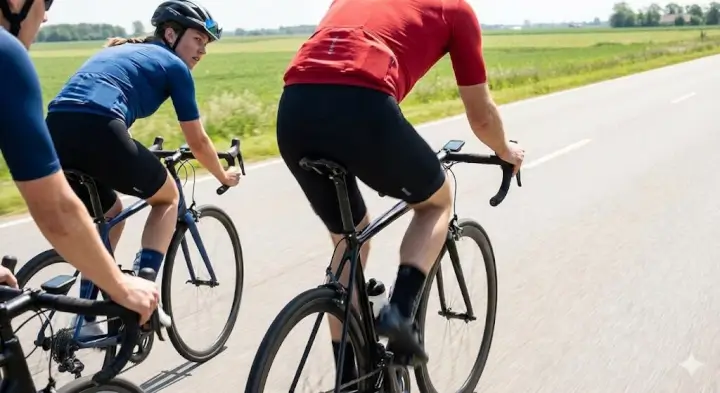
You may not feel your hips rocking, but the rider behind you certainly sees it.A
sk a riding buddy to watch you from behind. Your hips should be relatively still, with your legs acting like pistons pumping up and down.
If your lower back looks like it is swaying side-to-side, your saddle is too high. Alternatively, find a flat road and spin up to a high cadence (over 110 RPM).
If you start bouncing uncontrollably in the saddle, it is because your legs cannot track the pedals smoothly at the bottom of the stroke due to excessive extension.
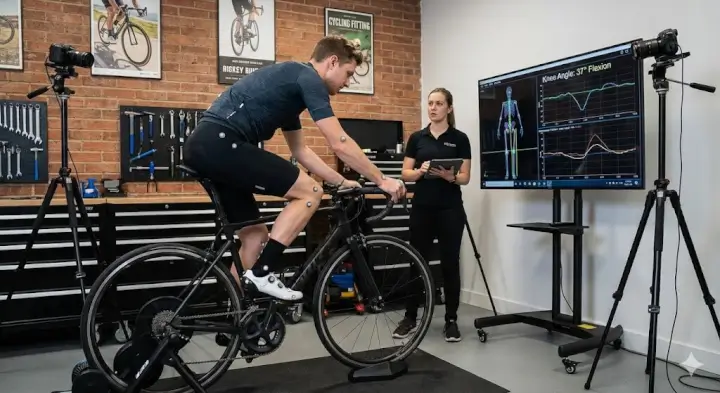
The gold standard for setting saddle height is a dynamic bike fit using motion capture technology, performed by an experienced professional.
They can measure the angle of your knee at maximum extension under load.
We generally look for a knee angle between 35 and 40 degrees of flexion (bend) at the very bottom of the pedal stroke. Anything straighter than 30 degrees is entering the danger zone for most riders.
However, if you cannot get a professional fit right now, you need a safe baseline. The old "heel-to-pedal" method is a reasonable starting point, provided it is done correctly.
When you clip in and ride, this setup should result in a slight, safe bend in the knee at the bottom of the stroke because the ball of your foot (where the cleat is) sits higher than your heel.
If you are unsure, lower your saddle.
In the world of biomechanics, the consequences of a saddle that is 10mm too low are minimal you might lose a tiny fraction of top-end power output, and your quads might fatigue slightly faster.
However, the consequences of a saddle that is 10mm too high are catastrophic hamstring tears, chronic back issues, and deep saddle sores.
Many riders fear lowering their saddle because it feels "cramped" initially.
Your muscles have likely adapted to a stretched-out position. Give your body time to adapt.
Lower your saddle by 5mm and ride it for a week.
You will likely find that your pedal stroke feels smoother through the dead spot at the bottom, your lower back feels more secure, and you can produce power more consistently without fighting your own equipment.
Comfort produces speed.
Stability produces power. Don't let vanity or outdated advice compromise your body. Check your saddle height today before your next ride; your knees will thank you for it.
Perfect for the new riders!
No spam. Cancel anytime.