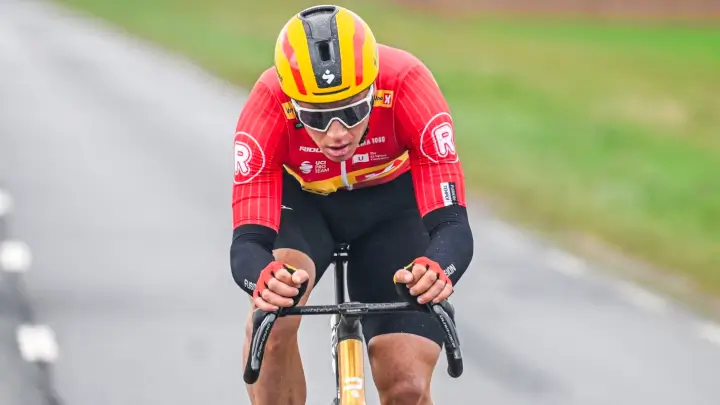
Dive deep into the extreme training protocols of the Norwegian breakaway specialist. From 30+ hour weeks and heat acclimatization to massive carbohydrate intake, we analyze the specific data behind his 2025 preparation.
In modern cycling, the gap between a good rider and a great rider often lies in the granular details of their preparation.
Jonas Abrahamsen, the relentless engine of Uno-X Mobility, has become a standout figure for his incredible durability and breakaway capabilities.
But how exactly does one build that kind of physiological resilience?
By analyzing his training data for the upcoming 2025 season, we can uncover the specific methodologies he employs.
From heat stress protocols to precise lactate monitoring, this is a breakdown of the work required to compete at the highest level of the World Tour.
Heat Training Protocols
One of the most striking elements of Abrahamsen’s 2025 preparation is his dedication to heat adaptation.
hese are not casual indoor rides; they are highly specific physiological stress sessions designed to boost blood plasma volume and efficiency.
The protocol involves intense "heat sessions" performed on the turbo trainer while wearing winter clothing in a room heated to over 30°C (86°F). The metrics for these sessions are grueling:
Duration/Power: 50 minutes sustained at 230–250 Watts.
Heart Rate: Reaching max values of 155–170 bpm, which correlates to heart rates usually seen during Zone 4 (Threshold) or Zone 5 (VO2) work, despite the lower power output.
Core Temperature: The target final body temperature exceeds 39.0°C.
Abrahamsen schedules three distinct "heat blocks" lasting three weeks each (4 to 5 sessions per week) during the first two-thirds of the season.
To ensure these hematological benefits are not lost, he includes recall sessions during the competitive period and immediately after altitude camps.
Altitude and Volume Management
Volume remains king in the Norwegian training philosophy. Abrahamsen’s log shows massive volume blocks, specifically seven weeks where training time ranges between 30 and 33 hours.
In terms of energy expenditure, this equates to 26,000 to 30,000 kJ per week.
A standout data point is his longest single session: a massive ride burning 7,600 kJ with a Training Stress Score (TSS) of approximately 450, incorporating work at both LT1 (aerobic threshold) and VO2 max.
regarding altitude, the strategy is straightforward. He utilizes two blocks of three weeks at 2350 meters above sea level prior to the competitive period.
Notably, he does not utilize the "Live High, Train Low" strategy, implying a sustained exposure to altitude for both living and training environments.
Lactate Testing and Intensity Control
The precision of the training is governed by constant lactate monitoring. Abrahamsen does not train by feeling; he trains by biology. His lactate targets reveal a very efficient aerobic engine:
LT1 Target: Less than 1.2–1.4 mmol/L.
LT2 Target: Between 2.0–2.5 mmol/L.
Interestingly, his interval workouts are rarely done at fixed power ranges.
Instead, he utilizes a progressive approach, increasing the intensity by approximately 20 Watts throughout the duration of the repetitions to account for cardiac drift and fatigue while keeping the internal metabolic cost stable.
Nutrition and Strength
To fuel 33-hour training weeks, the nutritional strategy must be aggressive. During training, Abrahamsen reports consuming up to 200 grams of carbohydrates per hour.
This is roughly double what was considered the upper limit of absorption just a few years ago, highlighting how highly trainable the gut is.
Strength training is periodized strictly. Heavy lifting in the gym is prioritized only during the first three months of the off-season.
As the season approaches, this shifts to occasional maintenance work focusing on core, conditioning, and mobility.
Analysis Methodology
It is important to note that Abrahamsen’s power curve is derived almost exclusively from race data rather than dedicated maximal testing on specific dates.
The figures regarding FTP, LT1, lactate targets, and core temperature are values declared by the athlete.
For this analysis, training zones were recalibrated to account for the physiological discrepancies found during indoor training, altitude exposure, and heat sessions.
Conclusion
Jonas Abrahamsen’s 2025 program is a testament to the "leave no stone unturned" approach of modern cycling.
It combines old-school volume with cutting-edge heat protocols and nutritional science.
By manipulating environmental stress and strictly controlling metabolic intensity via lactate testing, Abrahamsen is building a motor capable of sustaining high power outputs deep into the hardest races on the calendar.