We break down the physics of speed, the reality of comfort, and why your choice of handlebars might be the single most important decision for your ride quality.
The debate between flat bar and drop bar road bikes is one of the most persistent discussions in the cycling world.
For the uninitiated, the difference might seem purely aesthetic, but seasoned riders know that the choice of handlebar dictates the entire personality of the bicycle.
It fundamentally alters your aerodynamics, your leverage over the front wheel, your biomechanics, and ultimately, your enjoyment of the ride.
Choosing between the two is not simply a matter of asking "which is better?"
It is a matter of asking "what is the ride for?"
In this deep dive, we will strip away the marketing jargon and look at the physics and ergonomics that separate these two setups to help you make the right call for your specific riding style.
The Fundamental Difference: Geometry and Posture
The most immediate difference between flat and drop bars is the rider’s posture.
This is where the conversation about comfort begins, but it is also where many misconceptions arise.
A flat bar places the rider in a more upright, neutral position.
This opens up the chest and hips, which can be significantly more comfortable for riders with limited flexibility or those recovering from lower back issues.
The geometry of a dedicated flat bar road bike (often called a "fitness bike" or "hybrid") usually features a taller head tube and a shorter reach.
This setup keeps your head high and your eyes scanning the horizon, which is a massive advantage in urban environments where situational awareness is paramount.
In contrast, drop bars are designed to stretch the rider out.
Even when riding on the "hoods" (the brake lever covers), a drop bar setup generally requires a greater degree of hip flexion and core engagement.
This lower position shifts more weight onto the front wheel.
While this might sound less comfortable to a novice, it distributes the rider's weight more evenly between the saddle and the handlebars.
On a flat bar, the majority of your weight rests directly on your sit bones.
On a drop bar bike, that weight is shared with your hands and arms, which can actually reduce saddle soreness over the course of a long ride.
The Need for Speed: Aerodynamics and Efficiency
If your primary metric is speed, the conversation is short. Drop bars are undeniably faster.
The reason comes down to basic aerodynamics.
The rider’s body accounts for roughly 80% of the aerodynamic drag on a bicycle.
A flat bar forces you into a "parachute" position. Your torso is vertical, catching every bit of wind that comes your way. At speeds below 15 mph (24 km/h), this drag is negligible.
However, once you push past that threshold, air resistance increases exponentially. To maintain 20 mph on a flat bar bike requires significantly more watts than maintaining the same speed on a drop bar bike.
Drop bars offer three distinct positions, two of which are designed to cheat the wind.
When you move from the tops or hoods down into the "drops" (the curved lower section), you lower your torso and tuck your elbows in.
This reduces your frontal area effectively. It allows you to slice through headwinds and maintain momentum on descents without increasing your power output.
For riders looking to join group rides, fast club runs, or competitive events, the aerodynamic penalty of a flat bar is usually too great to overcome over long distances.
Comfort Over the Long Haul: Hand Positions and Fatigue
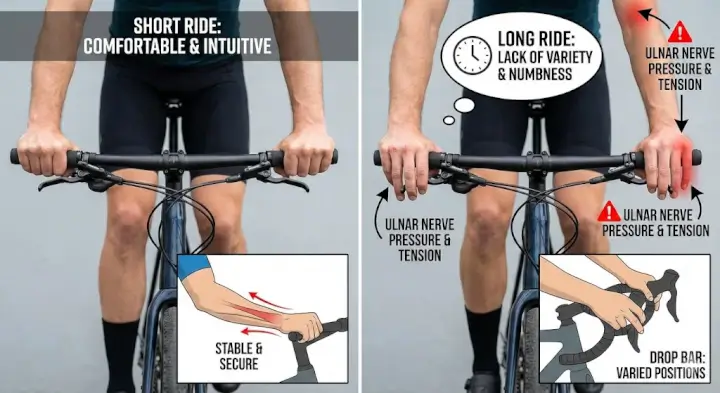
This is the category where the nuance of "comfort" really comes into play. If your ride is under one hour, a flat bar is often the winner.
The wide, neutral grip is intuitive and provides excellent leverage. It feels stable and secure, which translates to mental comfort and relaxation.
However, the major flaw of the flat bar design is the lack of variety. Your hands are locked into a single position: palms down, wrists pronated.
Over the course of a two or three-hour ride, this static position can lead to numbness in the fingers (specifically the ulnar nerve) and tension radiating up to the shoulders and neck.
While bar ends can be added to provide a second position, they are rarely as ergonomic as a native drop bar.
Drop bars are the kings of long-distance ergonomics because they offer three primary hand positions:
The Tops: Good for climbing and relaxed spinning.
The Hoods: The standard cruising position that offers access to brakes and shifters.
The Drops: For sprinting, descending, and headwinds.
Being able to micro-adjust your hand position and back angle every few minutes prevents muscles from stiffening up.
This is why you will never see a flat bar bike in the Tour de France or ultra-endurance events.
The ability to move around on the cockpit is essential for "all-day" comfort.
Control and Handling: Navigating Traffic vs. Descending
Control is relative to the terrain. If you are weaving through dense city traffic, hopping curbs, or navigating tight pedestrian paths, the flat bar is superior.
The wider stance gives you immense leverage over the front wheel, making steering inputs instantaneous and twitchy in a good way.
The brakes are also right at your fingertips at all times, meaning your reaction time to a car door opening or a pedestrian stepping out is practically zero.
This is why bike messengers and commuters often favor flat bars or riser bars.
Drop bars, however, offer superior stability at speed. When you are descending a mountain pass at 40 mph, you do not want the twitchy steering of a wide flat bar.
You want the stability that comes from a narrower grip and a lower center of gravity.
Being in the drops lowers your weight and locks you into the bike, giving you the confidence to lean deep into corners.
Furthermore, modern hydraulic disc brakes on drop bar bikes have closed the gap in braking power, though it does take a beginner some time to learn how to brake effectively from the hoods compared to the intuitive squeeze of a flat bar lever.
Component Compatibility and Customization
As a bike expert, it is crucial to mention the mechanical implications of your choice.
You generally cannot simply swap bars on a bike without changing the entire drivetrain ecosystem.
Flat bar road bikes typically use mountain bike (MTB) or specific "flat-bar road" shifters.
These are compatible with road derailleurs in some instances but often require specific pull ratios. If you want to upgrade your brakes or shifters later, you are often choosing from the MTB catalog.
Drop bar bikes use integrated shift/brake levers (like Shimano STI or SRAM DoubleTap).
These are complex pieces of engineering that are significantly more expensive than their flat bar counterparts.
Maintenance on these internal cable routings can be trickier, and crashing a drop bar bike is often more costly because the levers are exposed and fragile.
However, the aftermarket support for drop bar geometry is vast. You can adjust stem length, bar width, and flare (how much the drops angle out) to dial in a fit that is millimeter-perfect.
Flat bars are simpler: you can cut them narrower, but that is about the extent of the customization before you have to buy a new bar with a different rise or sweep.
Who Should Ride What? The Final Verdict
The decision ultimately relies on the duration and intensity of your riding.
Choose a Flat Bar Road Bike If:
You ride primarily in the city and value high-visibility and quick reaction times.
Your rides are typically under 90 minutes.
You have chronic back or neck issues that prevent you from bending over.
You are a beginner who finds the complexity of drop bar shifting intimidating.
You want a high-performance bike but prefer a casual, "jeans and t-shirt" aesthetic.
Choose a Drop Bar Road Bike If:
You care about speed, average pace, or Strava segments.
You plan on doing group rides where you need to hold a wheel and stay aerodynamic.
You ride for longer than 90 minutes and need to vary your hand positions to avoid numbness.
You enjoy the technical aspect of cornering and descending at speed.
You view cycling as a sport and a fitness discipline rather than just transportation.
Summary
Neither bar is objectively "better" in a vacuum.
The flat bar offers mastery over the immediate environment: traffic, potholes, and pedestrians. It is the tool of the urban tactical rider.
The drop bar offers mastery over the elements: wind, distance, and gravity. It is the tool of the endurance athlete.
Be honest with yourself about the riding you actually do, not the riding you think you should do.
If you are commuting five miles to work, a carbon fiber race bike with aggressive drop bars is overkill and likely uncomfortable. Conversely, if you sign up for a 100-mile charity ride on a hybrid flat bar bike, you will be fighting the wind and your own body for six hours straight.
Choose the right tool for the job, and the miles will take care of themselves.