Discover how Tadej Pogacar’s team is fine-tuning every aspect of his training, from strength work to nutrition, to ensure he continues improving and stays at the top of cycling.
Javier Sola, set to become Tadej Pogacar’s head coach in 2024, says the Slovenian rider hasn’t yet reached his full potential.
He takes over from Iñigo San Millán, who had guided Pogacar since he joined UAE Team Emirates in 2019.
This potential is the result of a detailed and scientific approach to training, refined each season by the team to keep him at the top.
At UAE Team Emirates-XRG’s pre-season camp in Alicante, Sola and performance manager Jeroen Swart shared insights into the elements that make Pogacar’s preparation so effective.
Their approach ensures he can perform at his best on every ride.
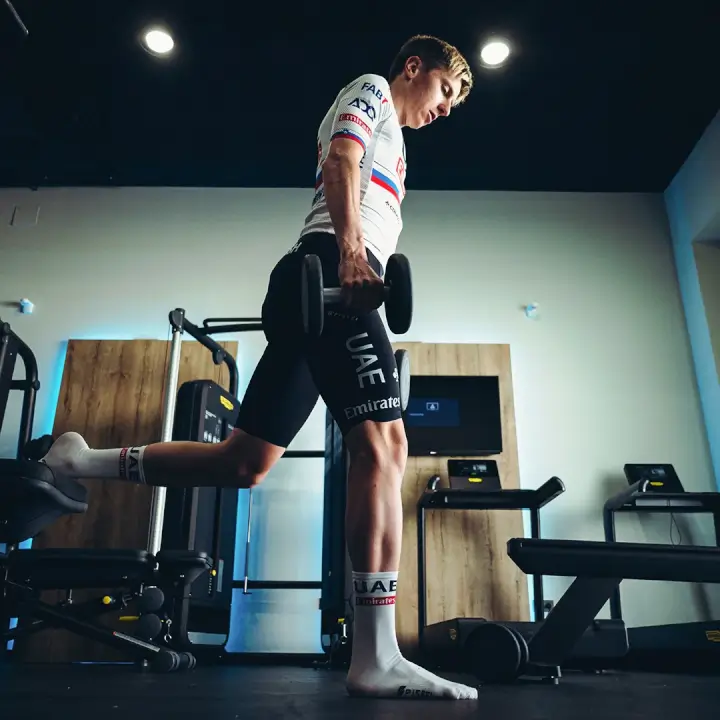
A standout feature of Pogacar’s program is off-bike strength training, now considered essential for his performance.
Sola notes that much of the progress Pogacar made in 2025 came from focusing on strength as a central part of his training.
Sola also highlighted that Pogacar’s solo attacks carry little risk thanks to the balance he has built between aerobic endurance and muscular strength, combined with his growing experience.
This efficiency is particularly clear in time trials, where precise power output is crucial.
Looking to 2026, the team plans to raise the intensity of his strength sessions while keeping the high volume of aerobic work consistent.
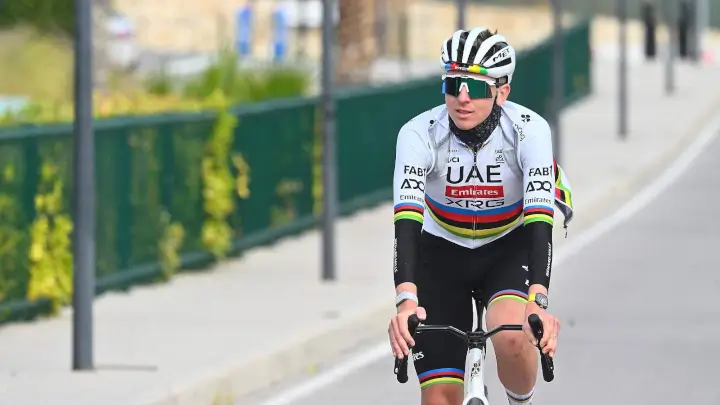
During camp, Pogacar frequently extended his rides by an extra hour after his teammates finished, showing his dedication to maintaining endurance.
Swart adds that the goal isn’t to increase training volume but to refine it.
Even small adjustments can turn excellent performance into something extraordinary.
Another key part of Pogacar’s program is compartmentalized training, separating aerobic and high-intensity sessions, sometimes across different cycles.
Nutrition also plays a central role, with fueling strategies that have evolved over time.
“Ten years ago, 60 grams of carbs per hour was typical; now, 120 grams per hour is standard,” Swart explains.
Every part of his preparation training, nutrition, and physiological monitoring is carefully tracked, allowing the team to make precise adjustments and maximize performance at every stage.