Big riders can dominate like Big Mig by compounding small wins: train with intent, dial in fit and efficiency, build power smart, and use pacing, cadence, and positioning to turn size into an advantage especially on climbs.
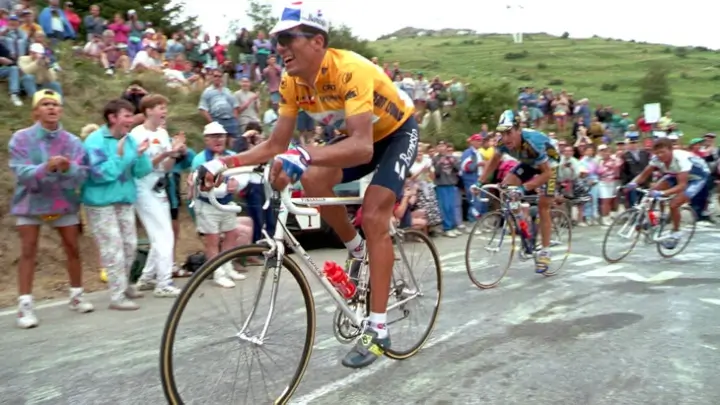
Miguel Induráin, known as Big Mig, did not fit the typical image of a lightweight climber. He was 188 cm tall, around 80 kg, and still dominated professional cycling.
He won the Tour de France five times in a row and completed the Giro-Tour double.
Miguel Induráin in 1996 Your De France (Credit: Getty Images)
Compared to most riders in the peloton, he was big. And yet he was faster, more efficient, and more consistent than almost everyone around him.
If you are also a bigger rider, the question is not whether you can compete. The question is how to use your physiology correctly.
The Principle That Changes Everything
There is no single breakthrough that transforms performance. What works is accumulation.
In 2003, Dave Brailsford introduced the idea of marginal gains in British Cycling. Instead of chasing one big improvement, the team focused on dozens of small ones. Each adjustment was minor on its own, but together they created a system that consistently outperformed competitors.
The result was multiple Olympic gold medals and Tour de France wins.
Most riders never apply this logic. They ride a lot, but they do not train with intent. That is where the gap appears.
Train Less, But With Purpose
More volume does not automatically mean more progress. In many cases, it slows it down.
Structured training focuses on specific adaptations. Each session has a purpose, whether it is endurance, power, or recovery. When training is intentional, you need less volume to get better results.
This is often counterintuitive. Riders expect improvement to come from doing more. In reality, it comes from doing the right work at the right intensity.
Build Efficiency Before Chasing Power
Efficiency is about how much speed you get for the energy you spend. For bigger riders, this is critical.
A proper bike fit alone can increase power output without any additional training. Small adjustments in position translate directly into measurable gains.
Muscle engagement also matters. Most riders rely too much on quads and neglect glutes. The strongest contribution to power comes from engaging larger muscle groups correctly. When the glutes are active, the pedal stroke becomes more powerful and more stable.
The core plays a supporting role here. It stabilizes the system. If your core is weak, energy leaks through unnecessary movement instead of transferring into the pedals.
Coordination is another overlooked factor. Muscles do not naturally fire in perfect sync. Sprint efforts help train this coordination by forcing maximum recruitment. Short sprints during rides improve how effectively your muscles work together.
Increase Power Strategically
Power is not just about pushing harder. It is about improving the system that produces force.
Weight matters, but it is only one variable. Reducing excess weight improves power-to-weight ratio, but it should not come at the expense of strength or recovery.
VO2 max training improves how much oxygen your body can use. This directly impacts how hard you can ride. These sessions are short, intense, and uncomfortable, but they create a higher performance ceiling.
Sweet Spot training builds sustainable power. It sits in a range where the muscles receive enough stress to adapt, but not so much that recovery becomes a limiting factor. Over time, this creates consistent, repeatable strength.
Learn to Use Your Advantage on Climbs
On flat terrain, bigger riders often benefit from higher absolute power.
On climbs, weight becomes more relevant, but technique and strategy can close the gap.
Climbing should be a regular part of training.
If there are no hills, wind can replicate resistance.
Movement control is key. Excess upper body motion wastes energy. The goal is to stay stable and direct effort into the pedals.
Staying seated is generally more efficient than standing. It conserves energy over longer efforts.
Cadence also matters. Keeping a steady rhythm allows you to maintain output without burning out too quickly.
Positioning in a group is another strategic layer. Entering a climb near the front gives you room to manage effort without immediately dropping off.
Finally, how you approach the top of a climb matters. Gradually increasing speed before the crest allows you to carry momentum into the descent, which reduces the need for additional effort later.
What Actually Makes the Difference
None of these changes are dramatic on their own. A better bike fit, slightly improved cadence, a few structured intervals each week.
But together, they compound.
That is the difference between just riding and actually progressing.
And that is how a bigger rider stops trying to keep up and starts setting the pace.