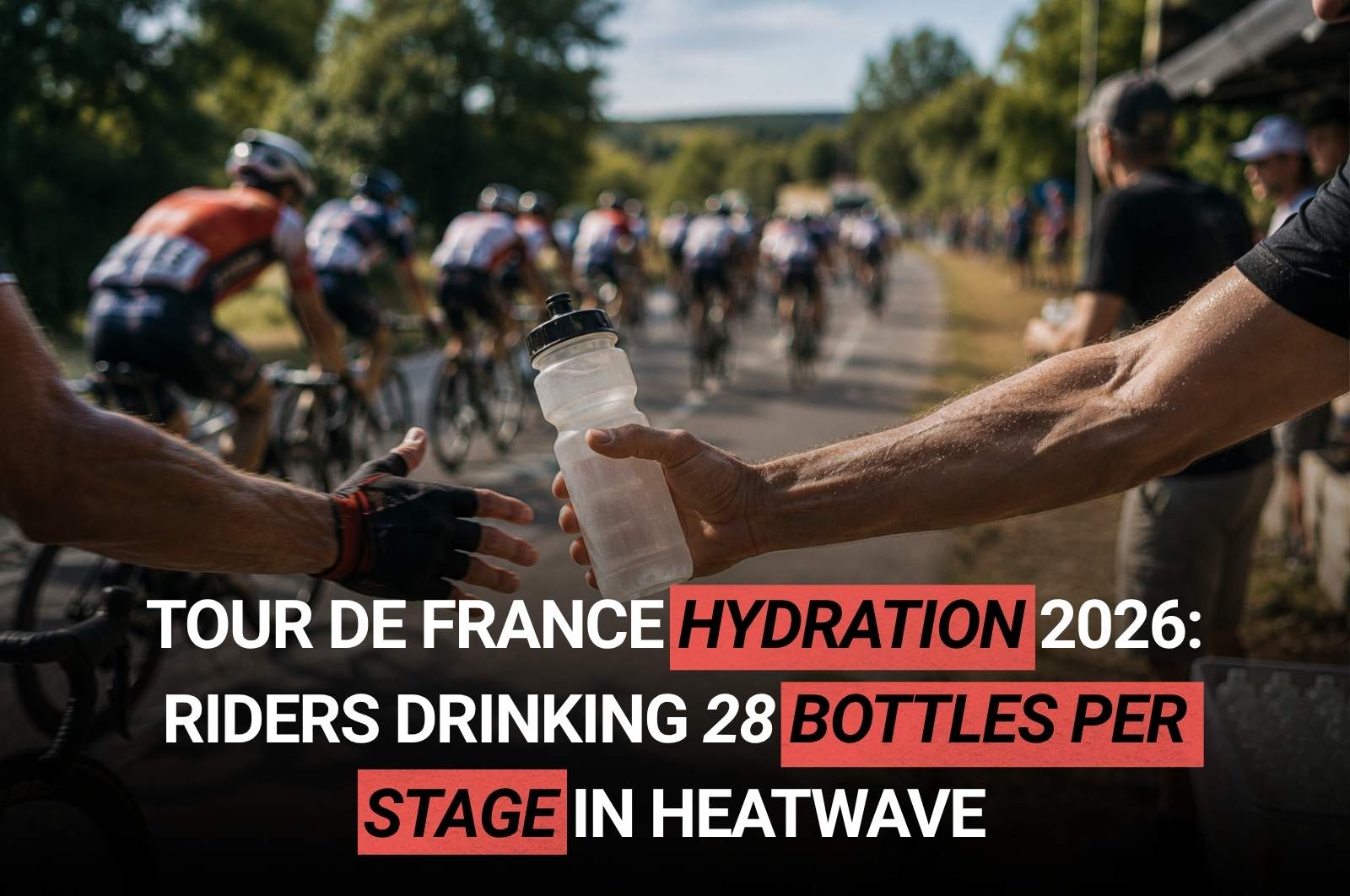
Picnic-PostNL soigneurs are handing out 28 bidons per rider on hot 2026 Tour stages. The number is not an outlier. It is what happens when cycling finally stops pretending heat is optional.
Ten years ago, a Grand Tour pro finishing a hot stage on six water bottles would have been considered well-hydrated.
Picnic-PostNL is now going through 28 bottles per rider per stage.
That number came out of a conversation between Picnic-PostNL coach Matt Winston and BikeRadar in the run-up to Stage 9 of the 2026 Tour de France, a stage that would eventually be shortened by 30 kilometres under the UCI's Extreme Weather Protocol.
It is not an outlier. It is the new floor.
The Numbers Nobody Is Really Talking About
Kurt Bogaerts, who coaches Tom Pidcock at Pinarello-Q36.5, told IDL Pro Cycling that his eight riders went through 160 bidons on Stage 2 alone.
Divide it out. That is an average of 20 bottles per rider, not counting the ones dumped straight over the head.
Bogaerts estimates roughly 10 litres of fluid per rider in a single stage, mostly consumed, some poured.
For context, until 1968 the UCI capped in-race fluid intake at two extra bottles.
The mantra of that generation, repeated in nutrition textbooks for decades, was blunt: driest is fastest.
We are now 14 times past that number, and the science says the old ceiling was wrong.
What Actually Changed
Two things happened at the same time.
The Tour de France got hotter. Stage 4 into Foix, on July 7, was recorded by ProCyclingStats as the hottest stage since their records began in 2007, with an average temperature of 36.5°C over four hours of racing.
Even race leader Tadej Pogačar admitted to a headache from the 40°C heat at the start of Stage 4.
Josh Tarling of Netcompany-Ineos described the air on Stage 5 in one sentence: "It just feels airless."
The other thing that happened is that sports science caught up.
Peer-reviewed physiology now shows that fluid losses above 2 percent of body mass measurably degrade endurance performance, and thermoregulation collapses as core temperature climbs past 39°C.
Coaches who used to ration bottles now push them. Aggressively.
How the Bottles Actually Move
The UCI updated feed zone rules mid-Tour to allow more bidons and ice packs to be handed up, and to give team cars greater latitude in when they could pull alongside.
Firefighters were misting fans at the finish line in Pau.
Riders were arriving with ice packs under their jerseys, wearing cooling vests that circulate chilled fluid, and pre-cooling their core temperature before the flag drops.
This is not marketing. This is triage.
What This Means for Age-Group Riders
The professionals ride in temperatures most amateurs would not train in. But the physiology is the same.
Sweat rate scales with body mass, work rate, ambient temperature, and humidity.
A 75 kg amateur on a hilly Saturday century ride in 32°C weather can easily lose 1.2 to 1.8 litres per hour, and often more.
If you are riding four hours in that heat, you need somewhere between five and seven bottles just to break even. Most club riders show up with two.
The gap between what riders actually need and what they carry is the reason so many amateur riders bonk on hot rides and blame their nutrition.
It is usually not nutrition. It is water. And the sodium that goes with it.
The Sodium Question
Winston told BikeRadar that the Picnic-PostNL bottles are not straight water. They are mixed with electrolytes and carbohydrate at concentrations calibrated to each rider's sweat sodium concentration, which the team tests in the off-season.
Sodium concentrations in cycling bottles typically land between 500 and 1,500 mg per litre, depending on the rider.
Pure water at 28 bottles a day would risk hyponatremia, a condition that can be more dangerous than mild dehydration.
This is the part most amateur riders skip.
They drink water. They do not replace sodium. Then they cramp and blame magnesium.
Where the Hydration Story Falls Short
There is a real risk of over-correcting.
The industry loves to sell more bottles, more powders, more tablets, and the 28-bottle number will absolutely be turned into a marketing slogan.
Amateurs riding in temperate weather at moderate intensity do not need pro-level intake.
The physiology does not change, but the demand does.
The honest read from the coaches interviewed at this Tour is that hydration is conditional. It scales with what the day is throwing at you.
One thing bidon counts do not capture: what pros actually drink in the last hour of a hot stage.
The answer, according to soigneurs and team doctors, is often Coca-Cola.
The sugar, sodium, and small caffeine hit are unusually well-suited to end-of-race fatigue, which is why you see riders reaching for cans on the final climb.