A 2025 BMC Sports Science study measured a 10% power drop in trained cyclists after 1,000 kJ of prior work. Lombardia's decisive climbs come at 4,500 kJ. That gap is the entire story of why the race keeps breaking the pre-race favourites.
Il Lombardia does not reward the best climber in the world.
It rewards the best climber in the world at kilometre 215, after 4,500 kJ of work, on gradients averaging 9.7 percent.
That is not the same athlete. The peer-reviewed research is now explicit about why.
A new concept in exercise physiology called durability has, in the past three years, started to explain race results that classical FTP and VO2max metrics never could. Lombardia is the Monument where durability matters most.
This is the science behind why the pure climber keeps losing it, and the diesel keeps winning it.
What Durability Actually Is
The term is new. The physiology is not.
In 2025, Barsumyan and colleagues published Durability as an independent parameter of endurance performance in cycling in BMC Sports Science, Medicine and Rehabilitation. The study measured 20 well-trained male cyclists in two states: fresh, and after a fatigue protocol of 1,000 kJ of accumulated work at 80% of their 20-minute power.
The result was blunt.
After that fatigue protocol, their 20-minute power dropped by 10.1%. Their 5-minute power dropped by 10.8%.
The authors defined durability as "the ability to minimize this shift in physiological capacity."
Which means the real race-day performance ceiling is not the FTP a rider holds fresh. It is the FTP they hold at kilometre 200.
Why This Matters More at Lombardia Than Anywhere Else
The 2026 Il Lombardia route is 239 km with over 4,600 metres of climbing.
A WorldTour rider at 65 to 70 kg will burn roughly 5,500 to 6,500 kJ across the full day. The decisive climbs come late.
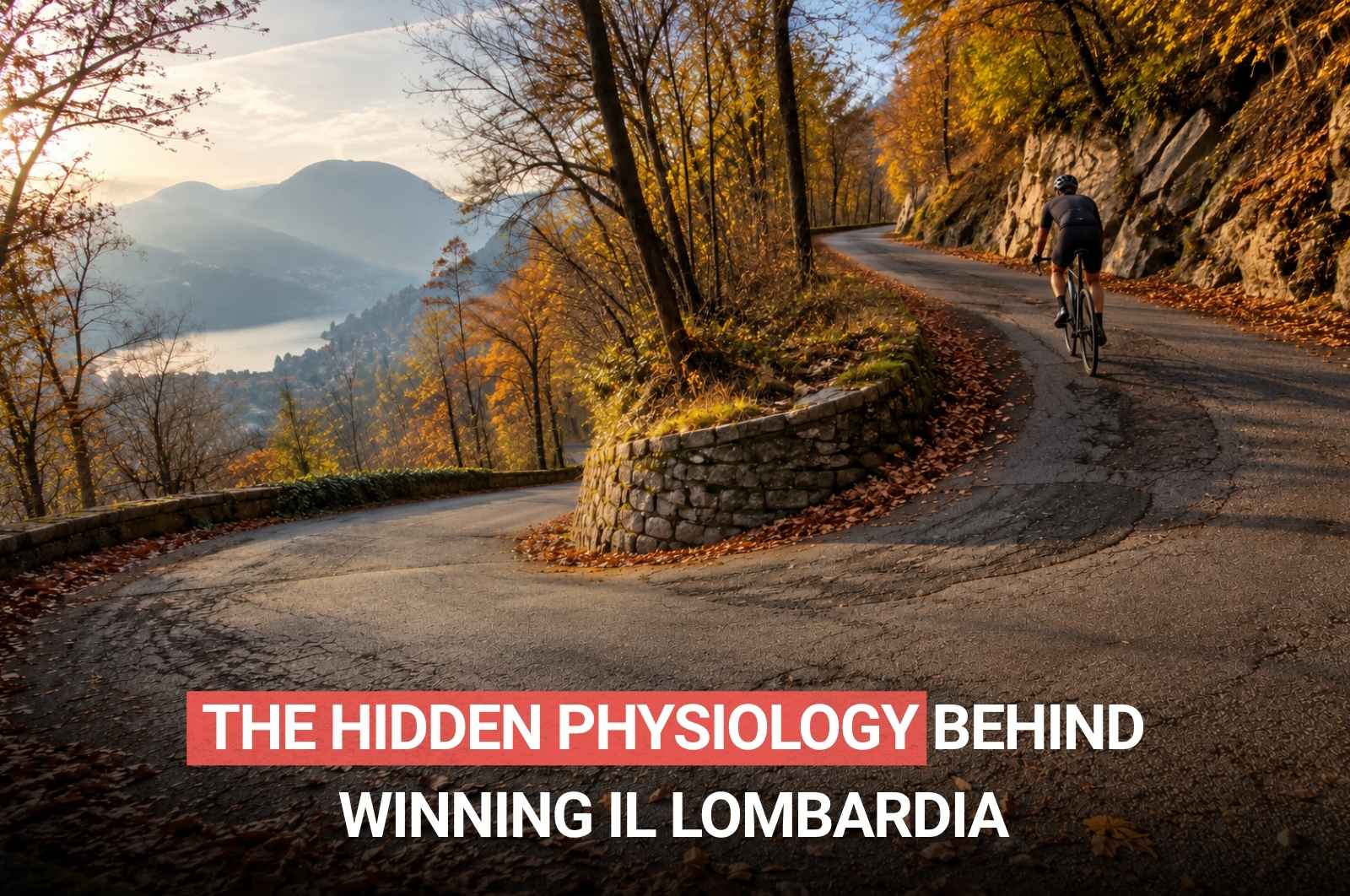
The Civiglio, at 4.2 km and 9.7% average, is 16 km from the finish. By that point, riders have accumulated roughly 4,500 to 5,000 kJ of prior work. That is well past the 1,000 kJ threshold at which the Barsumyan paper measured a ~10% power drop.
Which means every rider in the lead group on the Civiglio is doing it in a durability-degraded state. The gap between them is not who has the highest fresh FTP. It is who has lost the least of it over the preceding five hours.
That is a different physiological trait entirely.
Why Pure Climbers Keep Underperforming
Pure climbers tend to be lighter, with higher power-to-weight ratios on short efforts and lower total aerobic reserves. They are built for 20 to 30 minute efforts on gradients.
They are not built for five hours of surging through valleys at tempo before the climbs even start.
Lombardia punishes the W/kg specialist in two specific ways.
First, the course has over four hours of racing before the Civiglio even appears. A 55 kg climber accumulating kJ at the same percentage of max as a 68 kg all-rounder is burning through aerobic reserves disproportionately.
Second, the gradient-plus-length profile of the final climbs is near the exact range where accumulated fatigue hits hardest. 4.2 km at 9.7% is a 12-to-14-minute effort.
That is precisely the duration where the Barsumyan paper's 10% power drop was measured.
Pure climbers lose more there, in absolute terms, than durable all-rounders. Even though their fresh VO2max numbers may be higher.
Why This Explains Lombardia's Surprise Winners
Look at the recent history.
Vincenzo Nibali won Lombardia in 2015 and 2017. Nibali's reputation was as a stage-racer, not a pure climber. His W/kg numbers were below several contemporary specialists.
Esteban Chaves won in 2016 as a surprise selection, coming off a Giro podium. Not a short-climb specialist.
Fuglsang won in 2020 at 35. His win came from a late attack on gradients that had already shed the pure climbers.
Pogacar's five straight wins from 2021 onward obscured the pattern, because he is both a world-class climber and one of the most durable riders ever measured.
He combines both profiles.
With him absent in 2026, the pattern should reassert itself. The winner will be chosen for durability, not for peak W/kg on a cold Zwift test.
What the Training Difference Actually Looks Like
Pros who build for Lombardia-style races do not just train more volume. They train with specific fatigue overlays.
That is a different session than a classical FTP workout. It targets a different physiology. And it is the exact adaptation Lombardia selects for.
What Amateurs Can Steal From This
The durability principle is not just a WorldTour concept.
If you ride long sportives, gran fondos, or any event over three hours, your race-day performance is set by durability, not fresh FTP.
Training specifically for that trait requires two protocol changes.
First, do your highest-intensity intervals at the end of long rides, not at the start. A 20-minute threshold effort at the three-hour mark trains a different quality than the same effort fresh.
Second, extend endurance rides to accumulate kJ load. The Barsumyan threshold was 1,000 kJ, roughly 2.5 to 3 hours for a trained amateur at tempo.
Rides shorter than that do not reach the fatigue zone where durability adapts.
The pros do this every week. Amateurs almost never do it.
Where the Durability Framework Falls Short
Durability is still new. Two honest caveats.
The 1,000 kJ fatigue protocol in the Barsumyan paper is a laboratory standard, not a race-specific one. Real Monuments have surges, descents, and tactical lulls that lab protocols do not replicate.
The 10% figure is directional, not predictive.
Durability is also strongly correlated with weekly training volume. Which means the trait is partially a proxy for the kind of life structure that allows 20-plus hour training weeks.
Not everyone can access it.
For amateurs, that reality is uncomfortable but important. You can improve durability in training, but your ceiling is still partially set by how much time you can commit.
Why Saturday Will Prove the Theory
Il Lombardia 2026 is 239 km with 4,600 metres of climbing. Without Pogacar on the start line, no single rider should dominate.
If the theory holds, the winner will not be the rider with the highest W/kg on paper. It will be the rider whose five-minute power at kilometre 215 drops the least from their fresh baseline.
Watch what happens on the Civiglio. Watch who is still accelerating 16 km from Como when they should be bleeding power.
That rider will tell you what durability actually looks like, at the sharp end of a Monument, when the pure climbers crack and the diesel engines take over.
The 1,000 kJ threshold has been there in the physiology all along.
Lombardia just happens to be the race where it is most ruthlessly tested.
Which is also why it keeps producing winners nobody saw coming.
Saturday will not be an exception.
It will be the proof.