Peer-reviewed data on polarized training suggests his winter block bears almost no resemblance to what amateurs call "base training."
Jonas Vingegaard won the 2026 Giro d'Italia in May.
That was after a January training crash, a February UAE Tour withdrawal, and a March return at Paris-Nice where he beat Daniel Martínez by 4:23.
Read that gap again.
Four minutes and twenty-three seconds in an eight-day stage race.
The question every amateur cyclist should be asking right now is not "what watts did he push in the mountains."
It is "what did he do in November and December to make March possible?"
The honest answer is going to annoy a lot of people.
It looks nothing like the LSD-heavy, high-volume, low-intensity block that dominates cycling forums every autumn.
The Amateur Base Miles Myth
Walk into any cycling club in October and you will hear the same advice: log the hours, stay in Zone 2, build the aerobic engine. It is the same speech every autumn.
That advice is not wrong.
It is incomplete, and the incompleteness is what costs amateurs their spring form.
The classic "base miles" prescription is roughly 15 to 25 hours a week at 65 to 75% of maximum heart rate, all winter, with almost no intensity.
It comes from a 1980s reading of pro training that was itself a simplification of what pros actually did.
Modern WorldTour riders do not train that way.
And Vingegaard, statistically the second-best rider of his generation, definitely does not.
What Vingegaard Actually Does
Visma-Lease a Bike does not publish training files.
What they have said publicly, and what Vingegaard's Strava reveals in the winter months, points to a polarized model with three specific features that most amateur programs skip.
Feature one: intensity survives the winter.
Even in November, Vingegaard's team includes two hard interval sessions a week, and these are not race-pace efforts.
They are short sprint interval training blocks, 30 seconds all-out, six to twelve reps.
And high-intensity intervals at 90 to 100% of maximal aerobic power, four to six reps of four minutes each.
Feature two: the long ride is longer than yours.
His Zone 1 rides in the base block run five to six hours, not two.
That volume is not junk miles.
It is where the mitochondrial density adaptations actually happen, and it is what separates his December from yours.
Feature three: the middle zone stays empty.
Vingegaard almost never rides at "sweet spot" or "tempo" in the winter, choosing either below threshold or well above it with nothing in between.
The Peer-Reviewed Evidence for This Model
Polarized training is the most heavily studied intensity distribution in endurance sport, and the evidence is unusually clear for exercise science.
A 2024 systematic review published on PubMed Central looked at studies where endurance athletes trained in a distribution of roughly 75 to 80% low intensity and 15 to 20% high intensity, with almost nothing in the middle zone.
Every study showed meaningful improvements in VO2 max and work economy.
Athletes who follow the 80/20 model gain aerobic capacity faster than athletes who spend the same total hours in the moderate zone.
The difference is not small.
Why the Middle Zone Kills Progress
The physiological reason is simple.
Moderate-intensity riding, the classic "cycling club chain gang" pace, is hard enough to accumulate fatigue but not hard enough to trigger the strongest cellular adaptations.
You end up too tired for the truly hard sessions and too fatigued to enjoy the truly easy ones.
Here is what a polarized November looks like for a serious amateur, adapted from the Visma model.
Monday: Rest, or 45 minutes very easy spin.
Tuesday: Sprint interval session. Warm-up, then 8 x 30 seconds all-out with 3 minutes recovery, then a 60 minute Zone 1 cool-down.
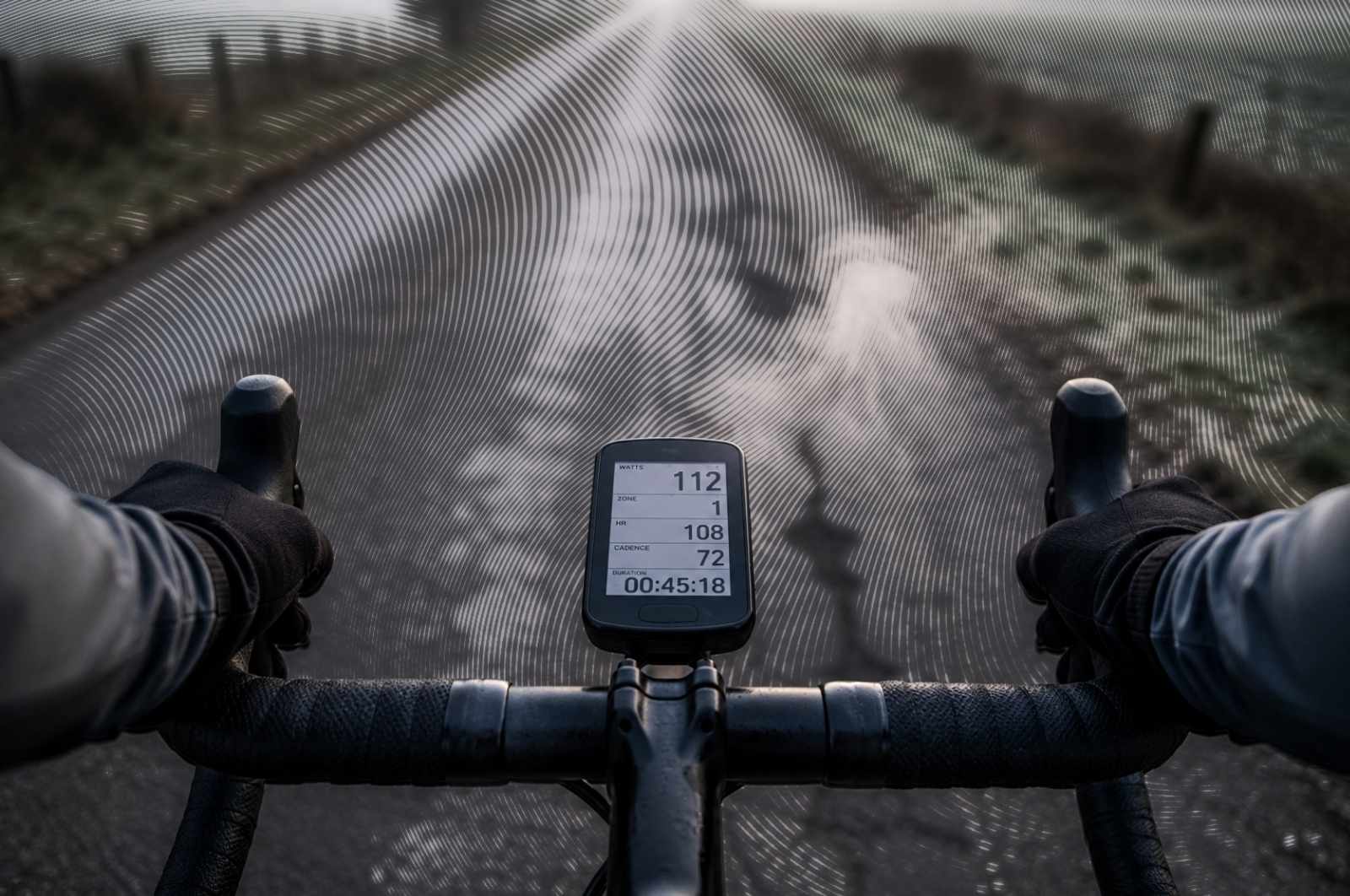
Wednesday: Long Zone 1 endurance, 2.5 to 4 hours at 65 to 72% of maximum heart rate.
Thursday: High-intensity intervals, 4 x 4 minutes at 92% max HR with 4 minutes recovery. Total ride 90 minutes.
Friday: Rest or easy commute miles.
Saturday: The long ride, 4 to 6 hours at Zone 1. This is the session that builds the engine.
Sunday: 2 hours easy, technical work, or a short group ride at Zone 1 pace.
The weekly total lands between 10 and 15 hours with roughly 80% of that time in Zone 1 and 15 to 20% in Zone 3 or above. Almost none of it is spent in the middle.
Where This Approach Falls Short
The polarized model assumes you can execute both ends properly.
If your intervals are half-hearted, you get half the adaptation.
It also assumes recovery.
Two proper hard sessions a week, on top of a five-hour Saturday, only works if you sleep well, eat enough carbohydrate, and manage life stress carefully.
Time-crunched cyclists on fewer than eight hours a week may do better with a pyramidal distribution, more time at tempo and less at sprint.
The polarized model is optimal for the volume Vingegaard actually rides, not the volume most people ride.
And critically, this is a base block, not a permanent state.
By late February the intensity distribution shifts, race-pace efforts appear, and specific race preparation begins.
The Indoor Question
A large fraction of amateur base training in the Northern Hemisphere happens indoors, on Zwift or a smart trainer.
That is a legitimate choice, but the indoor bias needs a counterweight.
Handling skills degrade fast when you never ride outside, and the biomechanics of a trainer are subtly different from the road.
Look at what he has already won in 2026: the Volta ao Algarve (previously), Paris-Nice, and the Giro d'Italia. That is not luck.
That is the visible output of a winter block that started at altitude in November, kept the intensity work through December, and never touched the middle zone.
His January crash cost him the UAE Tour but not his base.
By the time he pinned on a number at Paris-Nice, the aerobic engine was fully built. Everything after was expression, not construction.

.webp)