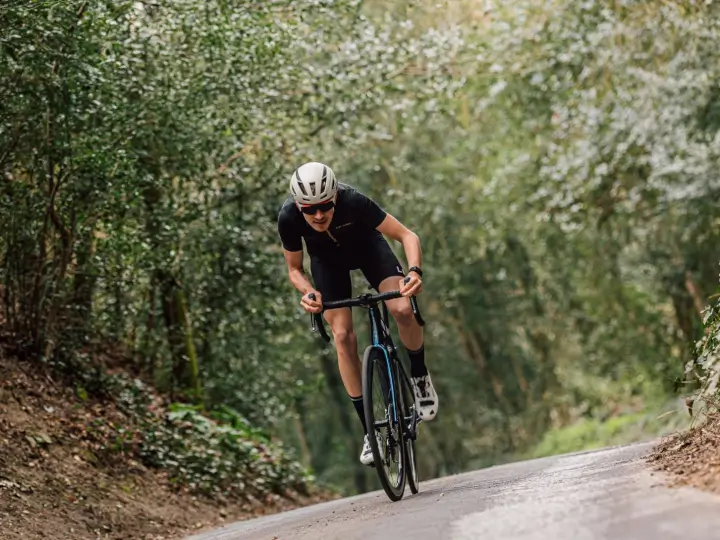
Raise your VO2 max on the bike without lab gear: use structured high-intensity intervals to lift your aerobic ceiling, back it with steady endurance rides and strength training, and let consistency and recovery turn hard efforts into controlled power.
It sounds technical, almost lab-coated, but at its core, VO2 max is simply your body’s ability to take in oxygen, transport it, and use it to produce energy during hard efforts. The higher and more efficient that system is, the more power you can sustain before everything starts to fall apart.
You do not need a lab or a mask hooked up to tubes to start improving it. You need smart training, a bit of patience, and a willingness to flirt with discomfort in a structured way.
Here is how to do exactly that.
First, What VO2 Max Really Means for Your Riding
Think of VO2 max as your aerobic ceiling.
It is not just about how much oxygen you can breathe in. It is about how effectively your heart, blood, muscles, and mitochondria coordinate to turn that oxygen into usable energy.
A higher VO2 max does not just mean you can go harder. It means you can go hard with more control.
Climbs feel less suffocating. Surges in group rides stop feeling like sudden emergencies. Recovery between efforts becomes faster and more predictable.
Even if you never measure the exact number, you will feel the difference.
Most modern smartwatches and cycling computers offer VO2 max estimates. They are not perfect, but they are useful for tracking trends. What matters more than the absolute number is whether it is moving in the right direction.
1. Use High Intensity Intervals to Raise the Ceiling
If VO2 max is your aerobic ceiling, high intensity interval training is how you push that ceiling higher.
There is a reason coaches return to intervals again and again. They force your cardiovascular system to operate near its limits, which is exactly the stimulus needed to improve oxygen uptake and utilization.
Research consistently shows that HIIT can increase VO2 max more effectively than steady riding alone. In some studies, athletes saw dramatic improvements over a few months when intervals were performed regularly.
The key is structure.
A simple and effective session for beginner to intermediate riders looks like this:
- Warm up for 15 minutes at an easy pace
- Ride 6 intervals of 3 minutes at very hard effort
- Recover for 4 minutes of easy spinning between each interval
- Cool down for 10 minutes
During those work intervals, you should feel like you are operating close to your limit. Breathing is deep and fast. Holding a conversation is not an option.
For more experienced riders, the volume and density can increase:
- Warm up for 15 minutes
- Ride 6 intervals of 4 minutes at very hard effort with 4 minutes recovery
- Continue directly into 20 minutes of steady zone 2 riding
- Cool down for 10 to 15 minutes
This combination builds both your top end and your ability to sustain effort after repeated stress.
One subtle but important detail is recovery. Longer recovery between sprints can actually lead to better VO2 max gains because it allows each effort to be truly maximal. Think quality over chaos.
Two sessions per week is plenty for most riders. More is not better if it compromises recovery.
2. Keep Your Endurance Engine Running
Intervals are the fireworks. Endurance rides are the quiet infrastructure.
Long, steady rides at a comfortable pace might not feel dramatic, but they are doing deep work inside your body. They increase mitochondrial density, expand capillary networks, and improve your ability to use fat as fuel.
All of that contributes to better oxygen efficiency.
In simple terms, your body becomes better at doing more with less.
A classic endurance ride is one where you can hold a conversation without gasping. The effort feels sustainable for hours. You are not chasing speed. You are building capacity.
These rides create the foundation that allows your VO2 max improvements to actually stick.
Without them, high intensity work becomes less effective and harder to recover from.
Aim for at least one longer ride per week. Depending on your level, that might be anywhere from 90 minutes to several hours.
Over time, you will notice something interesting. Your steady pace becomes faster without feeling harder. That is your efficiency improving in real time.
3. Add Strength Training to Improve Efficiency
Cyclists often think in terms of lungs and legs, but strength plays a surprisingly important role in VO2 max.
Not because lifting weights directly increases your oxygen intake, but because it improves how efficiently your muscles use that oxygen.
High load strength training, which means heavier weights with fewer repetitions, has been shown to improve what is called movement economy. In cycling, that translates to producing more power with less wasted energy.
Your muscles become better at recruiting fibers. Your pedal stroke becomes more effective. You spend less energy on unnecessary movement.
All of this reduces the oxygen cost of a given effort.
Focus on compound lower body exercises such as squats, deadlifts, and lunges. Keep the repetitions relatively low and the weight challenging, while maintaining good form.
Two sessions per week can make a noticeable difference, especially when combined with your on-bike training.
Think of strength work as tuning the engine rather than increasing its size.
4. Train Consistently, Not Perfectly
There is a quiet truth about VO2 max improvement.
It responds best to consistency.
Not heroic weeks followed by burnout. Not random bursts of motivation. Steady, repeatable training over time.
If you are new to intervals, start with one session per week. Let your body adapt. After a few weeks, add a second session on a non-consecutive day.
Build gradually.
Pay attention to how your efforts feel. This is where perceived exertion becomes valuable. If your usual intervals start to feel slightly more manageable, that is not a sign to relax. It is a signal that you have adapted.
That is when you increase the challenge. Slightly longer intervals, slightly higher intensity, or reduced recovery.
Progression does not need to be dramatic. It just needs to be consistent.
And just as important as training is recovery. Sleep, nutrition, and easy days are not optional. They are where the adaptation actually happens.
5. Learn to Notice the Subtle Wins
You might never step into a lab to measure your VO2 max with scientific precision.
That is fine.
Your body will tell you everything you need to know.
You will notice it when a climb that used to break your rhythm becomes manageable. When you can respond to a surge in a group ride without immediately fading. When your breathing settles faster after a hard effort.
You will notice it in how your rides feel overall. Less frantic. More controlled. More… spacious.
That is the real reward.
Because improving VO2 max is not just about increasing a number. It is about changing your relationship with effort.
Hard efforts do not disappear. They simply become something you can handle with more confidence and less fear.
The Long Game of Breathing Better
Improving VO2 max is not a quick hack. It is a layered process.
Intervals push your limits. Endurance builds your base. Strength refines your efficiency. Consistency ties everything together.
Over time, these pieces start to work in harmony.
And one day, without fanfare, you realize that the rides that once felt overwhelming now feel… doable. Still challenging, still engaging, but no longer intimidating.
You are breathing harder, yes.
But you are also riding smarter.
And that is where performance really begins.