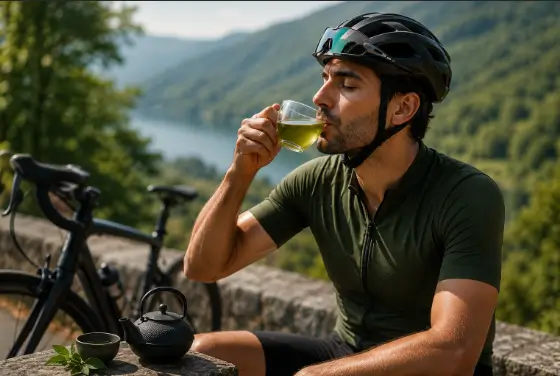
A new wave of peer-reviewed research shows that 15 days of green tea extract can reduce muscle damage and oxidative stress in trained cyclists, for less than the price of a single sports gel.
Most cyclists obsess over what happens during the ride.
The smarter ones know the real gains come from what happens after.
For years, that "after" market has been dominated by branded recovery shakes, salmon-protein tablets, and sub-zero ice baths most people can't afford or fit into a Tuesday evening.
Now a quietly growing pile of peer-reviewed research is pointing toward something almost embarrassing in its simplicity: a hot cup of green tea.
And we're not talking about wellness-blog speculation. We're talking about controlled trials done on actual cyclists, on actual bikes, under actual fatigue.
The Study That Made Cyclists Look Twice
In 2018, a triple-blinded, placebo-controlled trial published in Frontiers in Physiology tested whether green tea extract could change how the body recovers from repeated cycling efforts.
The setup was tight.
Sixteen trained amateur male athletes took 500 mg of green tea extract per day for 15 days.
Then they hit a repeated cycling protocol at 60% of peak power output, designed to push them into cumulative fatigue.
Researchers measured muscle damage, oxidative stress, and neuromuscular activation across the trials.
The result wasn't subtle.
The green tea group showed lower muscle damage markers and lower oxidative stress than the placebo group.
Their neuromuscular activity held up better under fatigue.
The placebo group, by contrast, showed exactly what you'd expect from cyclists running on empty: more damage, more stress, less efficient firing patterns.
The researchers' conclusion was cautious but pointed. Green tea extract, they wrote, "may have potential to serve as a strategy to improve performance and recovery in conditions of cumulative exercise."
For weekend warriors stacking back-to-back rides, that sentence quietly changes the conversation.
What Actually Happens Inside Your Muscles After a Hard Ride
To understand why a leaf in hot water is showing up in cycling research, you have to zoom in on what hard riding actually does to you.
Every time you grind out a long Z3 effort or a hill repeat, your muscles take small amounts of mechanical damage and produce a flood of free radicals. These are unstable molecules created as a byproduct of burning oxygen at high rates.
A little of this is healthy. It's the signal your body needs to adapt.
Too much of it is the reason your legs feel like cement two days after a hard weekend.
This excess is called oxidative stress, and it's one of the main drivers of delayed-onset muscle soreness, sluggish recovery, and the "stale" feeling that bleeds into your next ride.
Anything that helps your body neutralize free radicals faster also helps you turn the next pedal stroke without that lead-leg tax.
That's exactly where green tea steps in.
EGCG: The Molecule Doing Most of the Work
Green tea contains a family of plant compounds called catechins. Among them is one heavyweight: epigallocatechin-3-gallate, almost always shortened to EGCG.
EGCG is what makes green tea different from your morning English breakfast or your afternoon oat-milk latte.
It's a powerful antioxidant. It's anti-inflammatory. And in animal and human studies, it has been linked to improved mitochondrial function and more efficient fat metabolism during exercise. Both are directly relevant to endurance riders.
A separate review in Molecules on the anti-fatigue effects of EGCG concluded that the catechin "can be used to design nutraceutical supplements aimed to facilitate recovery from fatigue and attenuate exhaustive exercise-induced oxidative damage."
Translated out of academic-speak: EGCG appears to do, naturally, a chunk of what overpriced "recovery boosters" claim to do.
The kicker is how cheap the source material is.
The Numbers Researchers Couldn't Ignore
The 2018 cycling study isn't a one-off.
Other research has piled on across endurance sport.
A study on sprinters found that green tea extract supplementation reduced exercise-induced oxidative stress after repeated cycling sprints.
A trial on healthy men showed that green tea extract supplementation "gives protection against exercise-induced oxidative damage."
A 2024 systematic review in Frontiers in Physiology on polyphenol supplementation across endurance sports concluded that compounds like those in green tea can boost aerobic endurance in trained athletes.
And in long-term studies, EGCG supplementation has been associated with a measurable bump in VO2 max, the same physiological marker that defines Tour de France champions like Tadej Pogačar.
Nobody is claiming a cup of green tea will turn you into a WorldTour pro.
But the pattern across studies is consistent. Across short sprints, long endurance bouts, and cumulative fatigue, riders supplemented with green tea or its active compounds tend to come out the other side a little less wrecked.
For a sport that obsesses over single-watt improvements, that's not nothing.
How Much Green Tea You'd Actually Need
This is the question almost every cycling blog handles badly.
So let's be precise.
Most of the strongest studies, including the 2018 cycling trial, used standardized green tea extract at doses around 500 mg per day, taken consistently for at least 10 to 15 days.
That's not the same as one cup of tea before bed.
A typical brewed cup of green tea contains roughly 50 to 100 mg of catechins, of which a fraction is EGCG. To approach the doses used in the studies through tea alone, you'd realistically need 3 to 5 cups per day, brewed steadily and consumed across the day.
Matcha changes the math. Because you ingest the whole powdered leaf, a single 1-gram serving of matcha can deliver roughly 60 to 70 mg of EGCG, meaning two to three servings of matcha can get you in the same neighborhood as a moderate supplement dose.
Capsules close the gap fastest, but they also strip away the ritual most cyclists actually enjoy: the warm cup after a long ride, the five quiet minutes before the next thing.
There's a reason riders are choosing the kettle over the pill bottle.
Where Green Tea Falls Short (Be Honest About This)
A good recovery hack is only useful if you're honest about what it doesn't do.
Green tea isn't a carb source. It won't refill your glycogen stores after a four-hour ride. You still need real food, real protein, and real hydration for that work. That's the kind of post-ride fueling we break down in our guide to exactly what to eat after a long bike ride for peak recovery.
Green tea also contains caffeine. Useful before a ride, less useful at 9 PM if you want to sleep, and sleep is where the bulk of your real recovery happens.
And like every "miracle" ingredient, EGCG at very high supplement doses (well above what tea drinkers consume) has been associated with rare cases of liver stress. The dose that shows up in trials is well within safe ranges, but stacking high-dose green tea pills with other supplements without medical guidance is a bad idea.
Used thoughtfully, though, the downsides are minor.
The upside is a research-backed, cheap, low-effort addition to a recovery stack that most cyclists are already trying to optimize anyway.
Building Green Tea Into Your Recovery Stack
If you're going to test this on yourself, the structure that maps cleanest onto the research is simple.
Aim for the equivalent of roughly 400 to 500 mg of catechins per day, spread out. That's two to three cups of brewed green tea, or one to two servings of matcha, or a single standardized supplement if that's your preference.
Time it around your training, not against your sleep. A cup in the morning, another after a hard ride or strength session, and that's the pattern most closely matched to the protocols that produced results.
Stay consistent for at least two to three weeks before deciding whether it works for you. The studies didn't see effects after a single cup. They saw them after sustained intake during a real training block.
And don't treat it as a replacement for the basics. Green tea is the cherry, not the cake. The cake is still sleep, protein, carbohydrates, structured rest days, and the kind of evidence-backed nutrition strategies we covered in our breakdown of beetroot's effect on cycling performance.
Layer green tea on top of those, and the data suggests you'll recover a little cleaner, train a little fresher, and lose a little less of your hard-won fitness to oxidative stress.
Final Thoughts
The most underrated cycling upgrades are usually the unglamorous ones. The tube swap. The bike fit. The 30 extra grams of carbs per hour. The hour of sleep you stopped negotiating.
Green tea fits squarely into that category.
It won't headline a magazine cover. It won't outperform a smart power meter or a well-built training plan. But for the price of a small bag of leaves, you get a research-backed compound that helps your muscles take less damage and your body clear stress faster after the kind of efforts that define our sport.
In a market saturated with $60 recovery powders and "scientifically formulated" tablets, that's a quietly powerful trade.
Next time you finish a long ride, before you reach for the shake, try reaching for the kettle.
.webp)