A $36 pair of Spexcel bibs is outlasting $230 Castelli in one tester's rotation, and Rapha's own factory in China quietly explains why the price gap is a marketing choice, not a quality one.
Cycling apparel is having a very awkward moment.
For twenty years the pitch was simple.
If you wanted a jersey that lasted, breathed, and didn't chafe on hour four, you paid for European craft.
Italian fabrics, British tailoring, Swiss chamois. The logo justified the number on the tag.
Then a wave of direct-from-China brands showed up on AliExpress with jerseys at $30 and bibs at $36.
Their claim was the one nobody in the premium tier wanted to test: same factories, same fabrics, five to ten times cheaper.
The uncomfortable answer, three seasons in, is that they are not lying about all of it. They are not telling the whole truth either.
So let's be precise.
The Brand That Started the Argument
The name on most cyclists' lips when this comes up is Spexcel.
It has been on AliExpress since roughly 2016. It built its reputation on solid-color jerseys and bibs that look like premium kit, feel close to premium kit, and cost a fraction of premium kit.
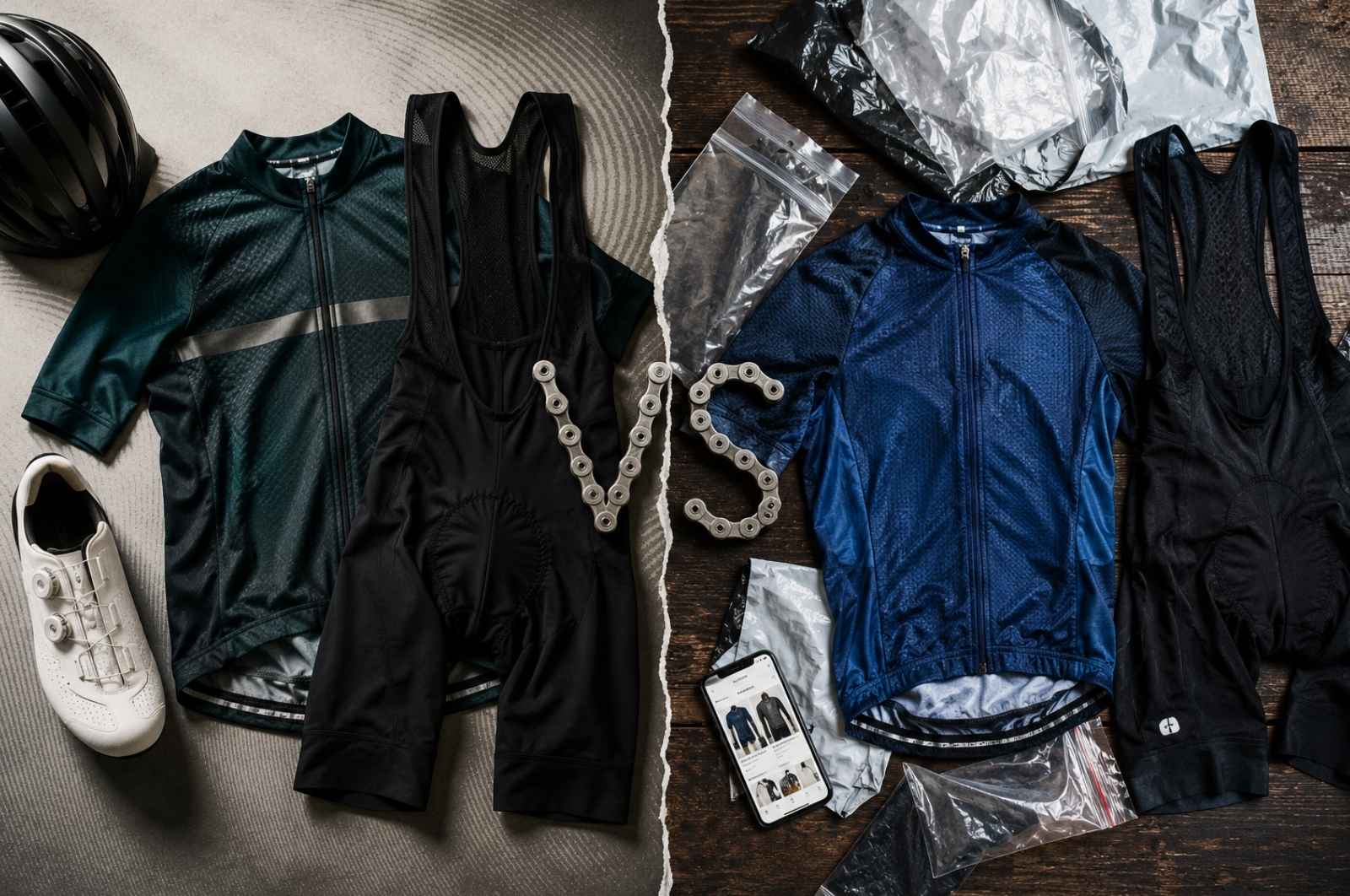
A Spexcel Pro Team II bib retails around $36 on AliExpress before shipping. The nearest equivalent from Castelli, the Free Aero RC, is $230.
That is not a discount. That is a different pricing category.
What a Working Journalist Found
Aliya Barnwell, a cycling journalist writing for VeloNews, ran a long-term test on Spexcel gear against bootleg kit and the real premium articles.
Her verdict on Spexcel was blunt.
Her Spexcel winter jersey-jacket was "still going strong after quite a few wears and washes," the fit was spot-on for her frame, and she admitted she would order another.
That is not the review a $150 brand wants a working journalist to write.
What the Weight Weenies Crowd Said
Riders on the Weight Weenies forum, which is not a place that hands out compliments to junk kit, echoed the finding.
One rider with a Spexcel Pro Team II bib over a year old reported it was still in his rotation for long rides.
He ranked it above his Assos T Equipe Evo on chamois preference. Assos retails those bibs north of $260.
So the low end of the story is real. Spexcel is not knock-off tier.
Why the Chinese Kit Question Isn't What Riders Think It Is
Here is the part almost nobody covers.
Most premium cycling brands already manufacture in China. Not the fake ones, the real ones.
Rapha's Own Words
Rapha publishes this on its own website.
Their long-time apparel partner is KTC, a firm founded in Hong Kong in 1971 and now based on the Chinese mainland, which also produces for other premium athletic brands.
KTC's managing director, Gerhard Flatz, told Rapha for a piece on Rapha's own editorial site that "the capabilities of Chinese manufacturers are far beyond those in Europe."
He specifically named the depth of the engineering workforce and the scale of skilled labor as the reason.
Rapha's public position, in Rapha's own words, is that Chinese manufacturing is a quality decision. It is not a cost concession.
Read that again.
The brand whose $200 jersey people are trying to replace with Spexcel is telling you, on its own site, that its jersey is made in China because Chinese factories are better.
That is quietly powerful.
Where the Other Big Names Actually Stitch
Castelli sits in a similar spot. Owners of Castelli winter jackets have reported labels reading "Made in Macau," which is a China special administrative region.
Assos is one of the rare holdouts that publicly emphasizes Swiss design and Swiss assembly on its top tier.
Even Assos concedes on its own site that assembly of some lines happens "where the most skilled hands are."
So the honest framing is not "cheap Chinese kit versus real European kit."
It is "kit made in the same country, sold through different marketing channels, at very different prices."
Where the Chinese Kit Actually Loses
Now the tradeoffs. Because they are real.
The Chamois Gap
Chamois quality is the single biggest gap. Barnwell was direct on this in VeloNews.
She wrote that AliExpress chamois are "usually several steps down from chamois made by every mid-range company" she had tested. For a two-hour café ride, that is fine.
For a six-hour endurance day or a gravel epic, that is a chafing problem waiting to happen.
The named-pad ecosystem that comes with premium bibs, meaning Elastic Interface, Progetto X2 Air, and the Assos in-house pads, is the piece the Chinese direct-to-consumer world hasn't fully closed.
Fit Consistency Is a Lottery
The same Weight Weenies rider who praised Spexcel bibs also noted a wind jacket from the brand that arrived with arms noticeably too short.
Sizing charts are translated from a body archetype that isn't always European or American.
There is no local return route for most orders. If it doesn't fit, it goes in a drawer.
Resale and Support Are Effectively Zero
A used Rapha Pro Team jersey clears $50 to $80 on the second-hand market. A used Spexcel jersey clears whatever you can convince a friend to pay for it.
Premium brands ship warranty replacements.
AliExpress storefronts refund, sometimes, if you fight for it.
There is no showroom, no direct email to a product manager, no chain of accountability.
If you want a plain black or plain navy training jersey, a Spexcel at $30 delivers what a Rapha at $180 delivers, minus the logo. This is the strongest case for direct-from-China.
There is no design IP to steal, no branding to fake. Just fabric and stitch.
Winter Kit Punches Above Its Price
Long-sleeve jerseys, gilets, and jacket-style pieces have held up in multiple long-term tests.
The fabric weights are similar to premium options.
Thermal performance in reviews has been consistent through repeat washes.
This is the category where the price gap looks the most absurd.
Fabrics on the Shell Are Frequently Identical
Many riders report that the jersey fabrics, meaning the outer material and not the chamois, feel close to identical to premium options.
That tracks with what we already know about the manufacturing overlap.
The Rotation Math
If you are doing 200 miles a week and burning through jerseys every eighteen months on rear-pocket grit, salt lines, and crash abrasion, the math changes hard.
Five Spexcel jerseys for one Rapha means you rotate kit like a WorldTour mechanic instead of babying a single piece.
That is a real quality-of-life change over a season. It is not a small one.
The Honest Verdict for the Enthusiast Rider
For a rider doing weekend centuries, weekday intervals, and the occasional gran fondo, here is a workable strategy.
It comes out of three seasons of rider experience across forums, journalist testing, and the manufacturing paper trail.
Where to Spend Premium
Buy your race-day bibs from a premium brand. The chamois matters, the fit matters, and the confidence on hour six matters.
The premium tier is worth it where the contact patch is, meaning bibs, shoes, and helmet.
Where to Spend Cheap
Buy your training jerseys, winter jackets, arm warmers, and solid-color base layers from Spexcel or a similar direct-from-China brand.
These are the pieces that die from wear anyway.
Spending premium money on kit that gets shredded in a year is the definition of a category error. Save that budget for the bibs.
What to Skip Entirely
Skip the fake replica team kits entirely. Not because they are cheap.
Because the chamois on those specifically is what Barnwell warned about.
And because the imagery is stolen from working pro teams.
That is a different conversation from the honest direct-to-consumer brands like Spexcel, which design their own kits and don't lean on stolen pro-team graphics.
.webp)