What We Actually Found
In "Where bikes are made: The silent manufacturers at the helm of the industry," Cyclingnews reviewed documents and manufacturer disclosures to trace who actually stitches carbon frames.
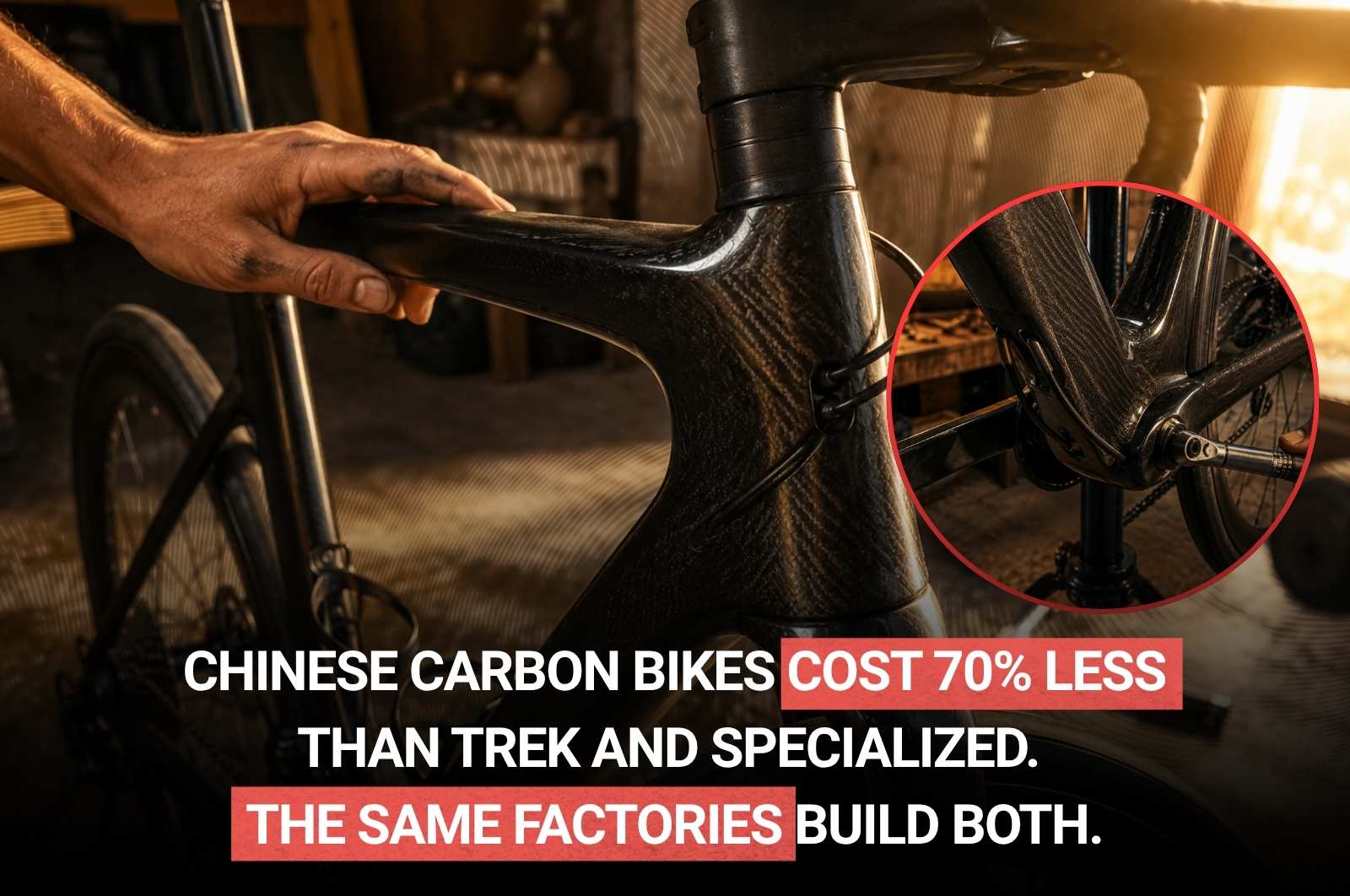
The names on the receipts are not the names on the down tubes. XDS Carbon Tech, also known as Xidesheng, is the title sponsor of the WorldTour XDS Astana team.
According to documentation Cyclingnews reviewed, XDS makes frames for Trek, Haro Bikes, and BH Bikes.
That is not a knockoff scandal. That is a public OEM relationship.
The Named OEMs
Topkey, headquartered in Taiwan with China production, states directly on its own website that it works "with customers such as 'Specialized' and 'Cannondale.'"
It claims more than 25% of global market share in carbon bicycle manufacturing.
Quest Composite Technology, split across China and Taiwan, publishes photos of Trek and Canyon bicycles on its site as reference clients.
Ten-Tech Composites, based in Dongguan, has appeared on trading-partner documents for Cervélo.
Analysts have separately traced 2008 Tour de France bikes from Cervélo, Specialized, and Ridley back to Ten-Tech's lines.
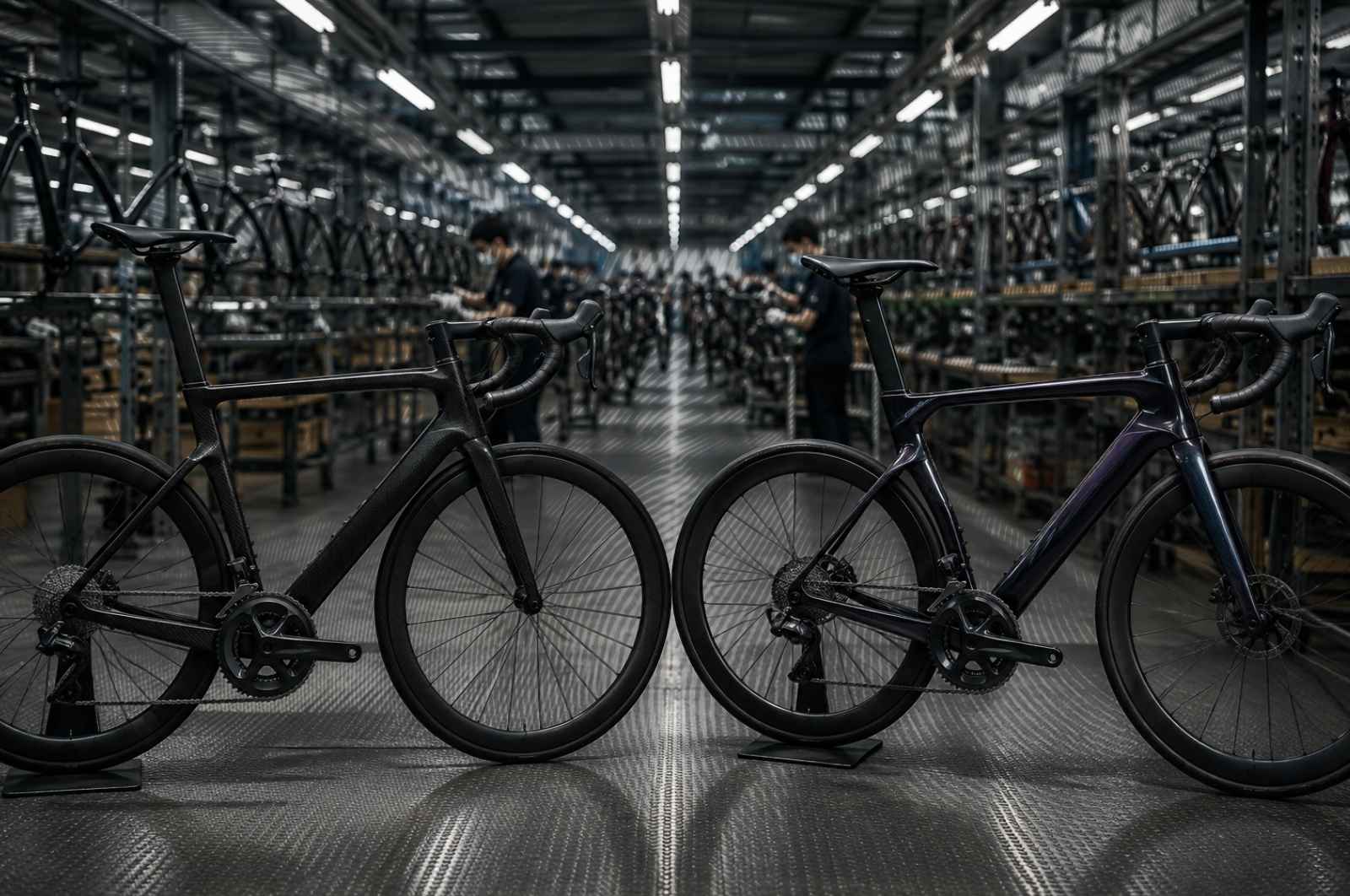
The takeaway from that reporting is uncomfortable for the premium-brand narrative. The dominant premium road bikes are built by a small handful of Chinese and Taiwanese OEMs.
The rider who spent $12,000 on a Trek Madone and the rider who spent $2,400 on a Winspace T1600 may be riding out of buildings within driving distance of each other.
The Direct-to-Consumer Chinese Brands Worth Naming
Not every Chinese bike is worth buying. But the honest direct-to-consumer brands are now serious enough that Western engineers are testing them and shrugging.
Winspace, the Current Reference Point
Founded in 2008, Winspace has become the reference brand for the "buy direct from China" argument.
Its T1600 aero frameset is priced around $2,400 to $2,850 depending on colorway, and a complete build with Shimano Ultegra Di2 lands near $5,999 on the brand's own site.
For comparison, a Specialized S-Works Tarmac SL8 with Dura-Ace Di2 runs comfortably north of $12,000 retail. The Winspace with the same groupset lands significantly lower.
Petr Minarik, who runs long-term testing at Cyclists Hub and has reviewed dozens of Chinese framesets, has consistently ranked the T1600 at or near the top of his aero road board.
Independent aero testing referenced by Winspace shows the frame delivering, in the brand's own claim, up to 98% of top-tier flagship aero performance.
Yoeleo, the Frame-Only Play
Yoeleo is the other name that comes up.
Its R12 frameset is a persistent value pick, though the brand sells framesets only, and you source the groupset yourself.
Testing at Velo Fanatics placed the R12 DB as runner-up in the 2026 Chinese aero board, ahead of many higher-priced options but behind Winspace. The R12 build-your-own trade-off is either a feature or a headache depending on your mechanic budget.
The Rest of the Field
Elves, SEKA, Lightcarbon, and Quick Pro are the second tier.
Elves' Falath Pro and Vanyar framesets have real followings, and SEKA's Exceed has a distinct seat-tube design that stands out.
The gap between the top two brands and this second tier is closing quickly.
That was not the case three years ago.
What the Engineers Actually Say
The most credible independent voice on this is Hambini, a UK-based aerospace engineer who tears down bikes with micrometers and CT scans instead of vibes.
His long-form teardown of the Winspace T1600 concluded that at around $2,500 USD, the frame "makes an uncomfortable point for Western brands." Those are his words.
In his engineering assessment, Winspace "offers a product that is clearly engineered to a high standard at a far more reasonable price."
That is not a value review. That is an engineer looking at layup, tolerances, and finish, and saying the premium markup is not defensible on the build.
Where the Skeptics Are Still Right
Skeptics have a case, and it is not the case they usually make.
The case is not that Chinese frames are structurally worse.
The case is that there are three tiers of Chinese factories, and only the top tier produces the bikes worth buying.
BikeBiz laid out the tiers years ago and the framing still holds. The "cream" factories, meaning Topkey, Quest, XDS, Ten-Tech, produce for both the premium brands and the top-tier Chinese direct-to-consumer names.
The "competent" factories serve mid-market brands. The "cowboy" factories are the ones behind the too-good-to-be-true $400 framesets on AliExpress and Alibaba, with murky origins and no traceable QC.
The Winspace T1600 comes out of a cream factory. A generic $400 Alibaba frame does not.
Both are made in China, but only one is worth buying.
The Honest Trade-offs When You Buy Direct
Buying a Winspace or a Yoeleo is not free of downsides. They are just different downsides than paying $12,000.
Import Duty and Anti-Dumping Tariffs
The listed price is not the delivered price in most markets.
EU customers pay anti-dumping duties on Chinese bicycles, and US customers face tariff exposure that has been shifting under multiple administrations.
It does not close. But it narrows.
Warranty and Service Are Long-Distance
If the frame cracks, you are shipping it back to China.
If the paint chips, you are living with it.
Local dealers do not service Winspace or Yoeleo, and your local Trek shop will not touch a T1600. That is a real cost if something goes wrong on the road.
Sizing and Fit Come With No Test Ride
You are buying blind. There is no showroom, no test ride, and no local fit specialist doing the ordering.
For a rider with unusual geometry needs, that is a real risk.
Resale Value Is Real But Lower
A used S-Works Tarmac SL8 clears strong money on the secondary market.
A used Winspace T1600 clears money too, just less of it.
If you flip bikes every two seasons, the premium brand math still works.
If you keep bikes five years or more, the depreciation gap disappears into the price gap you saved on day one.
What the Cheap Bikes Genuinely Beat the Expensive Bikes At
The wins are real and they are specific.
Value per Watt of Aero Performance
At $2,400 for a frameset delivering claimed aero performance within striking distance of a $6,000 Western flagship, the value math is not close.
It is a rout.
Design Flexibility
Winspace and Yoeleo iterate faster than the big Western brands.
he T1600 was announced, released, and shipping globally inside twelve months.
A Trek or Specialized flagship redesign takes three to five years.
That means you often get more current aerodynamic thinking, current tire-clearance standards, and current cockpit integration in the Chinese bike.
The Rotation Argument
If you race gravel, crit, and road across a season, the money you save on one Chinese carbon build could fund a second gravel-specific bike.
That is a season-changing option, not a marginal upgrade.
The premium industry has spent decades convincing amateur riders they need a $12,000 bike to be taken seriously.
The math no longer supports the story.
The Honest Verdict for the Enthusiast Rider
For a rider doing weekend group rides, gran fondos, and the occasional local race, here is a framework worth using.
When to Go Chinese Direct-to-Consumer
Buy Winspace, Yoeleo, or a top-tier equivalent if you are mechanically confident, comfortable with long-distance warranty, and know your fit numbers cold.
The savings are structural and the engineering is legitimate.
Go direct if a second bike or upgraded wheelset is the alternative use of the money.
That is where the arithmetic tips hardest.
When to Stay with the Western Brands
Stay with Trek, Specialized, Cervélo, or Canyon if service, warranty support, and dealer network matter to you. Stay premium if you race sanctioned events at high level and want the peace-of-mind of team-issue kit.
Stay premium if you flip bikes on a two-year cycle.
Resale protects the premium spend.
What to Skip Entirely
Skip generic Alibaba framesets from unknown sellers.
Not because they are cheap, but because they are unknown factory output with no traceable QC and no accountability.
The gap between a Winspace and a $400 no-name frame is not a marketing gap.
It is a layup, tolerance, and testing gap, and it is the difference between cream tier and cowboy tier.
The Statement Cycling Just Made
The cycling apparel category went through this three years ago.
Now the bike category is having its version of the same conversation, only bigger.
The premium brands are not going away, and they shouldn't.
Sponsorship of racing, dealer service, industry investment, and design IP are all real value.
But the story that a Chinese carbon frame cannot possibly ride as well as a Western flagship is now falling apart in the light of Cyclingnews' own reporting. Because in many cases, the two frames rolled off adjacent moulds in the same factory. One got a Trek decal, the other went in a box direct to a garage in Ohio.
The rider in the garage saved seven grand.
That is not nothing.