Bond Almand is 22, holds five world records, and is riding to all 30 NFL stadiums before kickoff. What 180 miles a day actually does to a body.
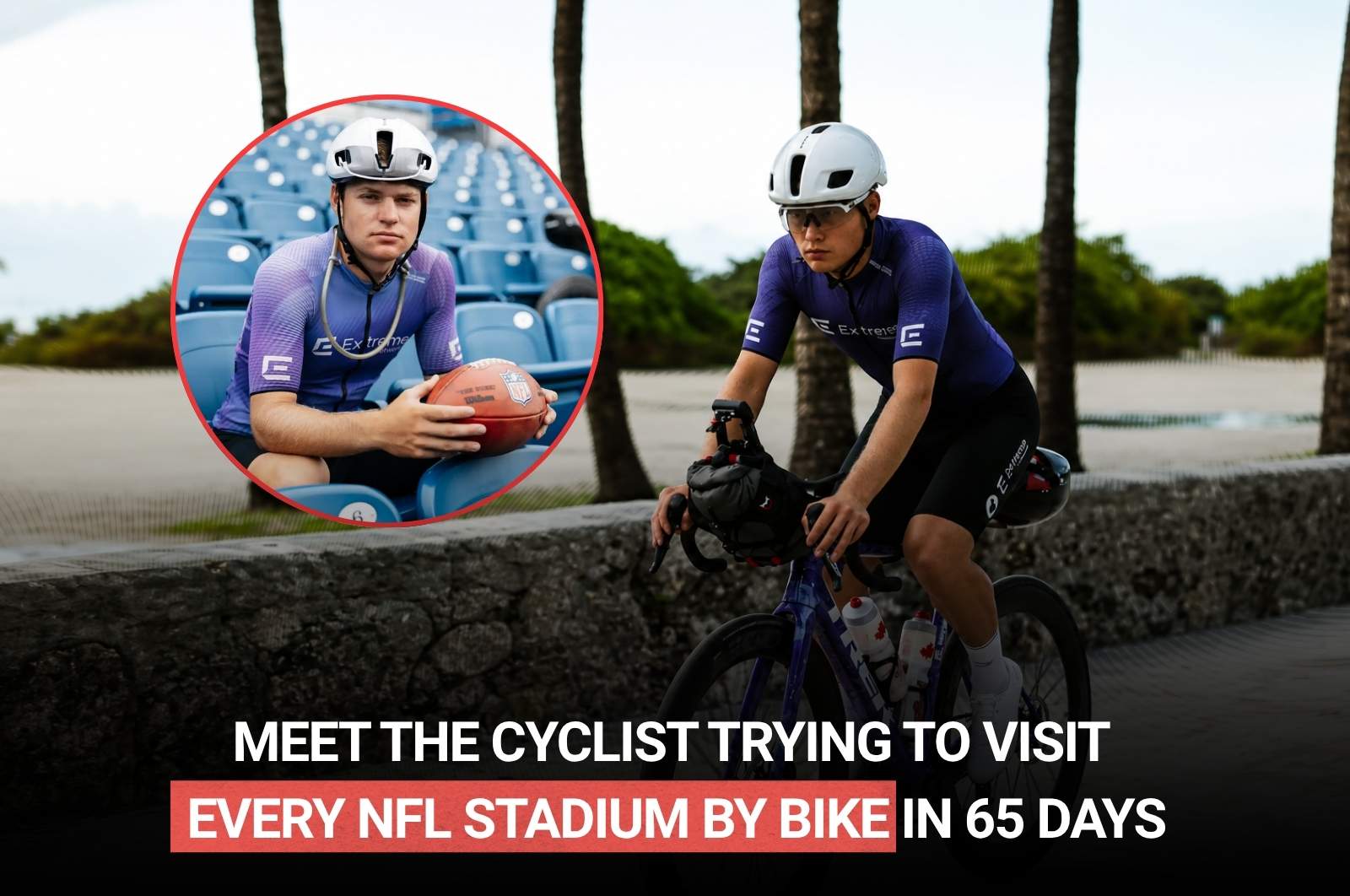
Credit: Extreme NetworksBond Almand is 22 years old and he is somewhere on an American highway right now.
He is riding to all 30 NFL stadiums, and he is doing most of it alone.
The ride began in Miami and finishes at Lumen Field in Seattle on September 9, the night the NFL season kicks off.
Daily distance: between 170 and 200 miles.
For context, a strong amateur century is 100 miles and most riders need the rest of the weekend to recover from it. Almand is doing nearly double that, then getting up and doing it again.
The Résumé Is The Strange Part
This is not a stunt by somebody who bought a bike in March.
On 15 November 2024, when he was a 20-year-old student, Almand finished a 14,000-mile solo unsupported bikepacking expedition from the north coast of Alaska to Tierra del Fuego at the southern tip of Argentina.
He set a world record for the Pan-American route in 75 days.
Run that number. Fourteen thousand miles divided by seventy-five days is roughly 187 miles per day, every day, for two and a half months, carrying his own gear.
The following September he took another world record, this time for the fastest north-to-south cycle crossing of the United States.
He now holds five world records.
The Football Is Not A Gimmick
One official football travels the entire route with him.
By the time it reaches Seattle it is meant to carry signatures collected at every stadium, then be delivered on the field at kickoff.
It is a corporate-sponsored ride, and we should say that plainly.
The project is backed by a technology company with NFL partnerships, timed to America's 250th anniversary.
But the sponsorship does not pedal the bike. The mileage is real regardless of who paid for the jersey.
Credit: Extreme Networks & Getty
What 180 Miles A Day Actually Does To A Body
This is where the story stops being inspirational and starts being physiological.
At that volume, the limiting factor is almost never the legs. It is caloric intake, sleep debt, and soft tissue.
A rider covering 180 miles daily is burning somewhere in the range of 6,000 to 9,000 calories, depending on terrain, pace and body mass.
Consuming that much while also spending 11 or 12 hours on a bike is a logistical problem before it is a nutritional one.
Sleep is the second wall.
Chronic sleep restriction blunts recovery hormone response and slows tissue repair, which is why multi-week efforts tend to fail in week three rather than week one.
The third is contact points.
Hands, feet and saddle contact accumulate damage that no fitness level prevents.
Nerve Compression Is The Underrated Risk
Riders at this volume routinely develop ulnar neuropathy, sometimes called handlebar palsy, from sustained pressure on the ulnar nerve at the base of the palm.
It presents as numbness or weakness in the ring and little finger, and it can persist for weeks after the riding stops.
The fix is unglamorous: frequent hand-position changes, thicker bar tape, and gloves with genuine padding rather than fashion padding.
We covered the mechanism and the fixes in detail in our guide to why your hands go numb while cycling, and everything in it scales up rather than disappearing at elite volume.
The Punctures Tell You Something
Almand has reported around seven punctures on this ride, mostly from riding on the shoulder of highways where debris collects.
He also noted that before this trip he rode over 10,000 miles without a single puncture.
He started on tubeless, tore a tyre 30 miles in, made an unscheduled bike shop stop, and has been running tubes since.
That detail is worth more than any motivational quote in this article.
Tubeless is the better system on most surfaces most of the time.
On a route that is mostly highway shoulder covered in metal fragments and glass, a system you can fix with a patch and a lever beats a system that needs a plug kit and sealant you cannot resupply in rural Wyoming.
The right equipment is the equipment you can repair where you actually are.
Where The Story Gets Complicated
Two things about this ride deserve honesty.
First, the distance figure moves.
The project was announced as a 10,000-mile expedition, and Almand has since described the total as closer to 11,000 miles.
Route improvisation on a ride this long makes that unsurprising, but both numbers are in circulation.
Second, riding 170 to 200 miles a day on American highway shoulders for two months is genuinely dangerous, and it is not a template anyone should copy.
The traffic exposure alone is a risk profile that has nothing to do with fitness.
Neither is the sleep deprivation.
Extraordinary rides make excellent reading and terrible training plans.
What A Normal Rider Can Actually Take From This
The transferable part is not the mileage. It is the repeatability.
Almand's records were not built on one enormous day.
They were built on the ability to produce a large day, recover enough overnight to produce another one, and do that without the wheels falling off in week three.
That is the same skill an amateur needs for a multi-day tour or a first double century, just scaled down.
The practical version: build weekly consistency before you build peak distance, treat fuelling as a trained skill rather than an afterthought, and fix your contact points before they become injuries.
Almand will become the first person to ride solo to all 30 NFL stadiums when he reaches Seattle.
He has been ranking the stadiums as he goes, and he ranked one of them seventh out of the thirteen he had seen at that point, describing it as solid but not standing out.
That is a very funny thing to say after riding four thousand miles to look at it.
It also tells you something about the mindset.
He is not treating this as a spiritual pilgrimage, but as a job with a deadline and a very heavy commute.
.webp)


