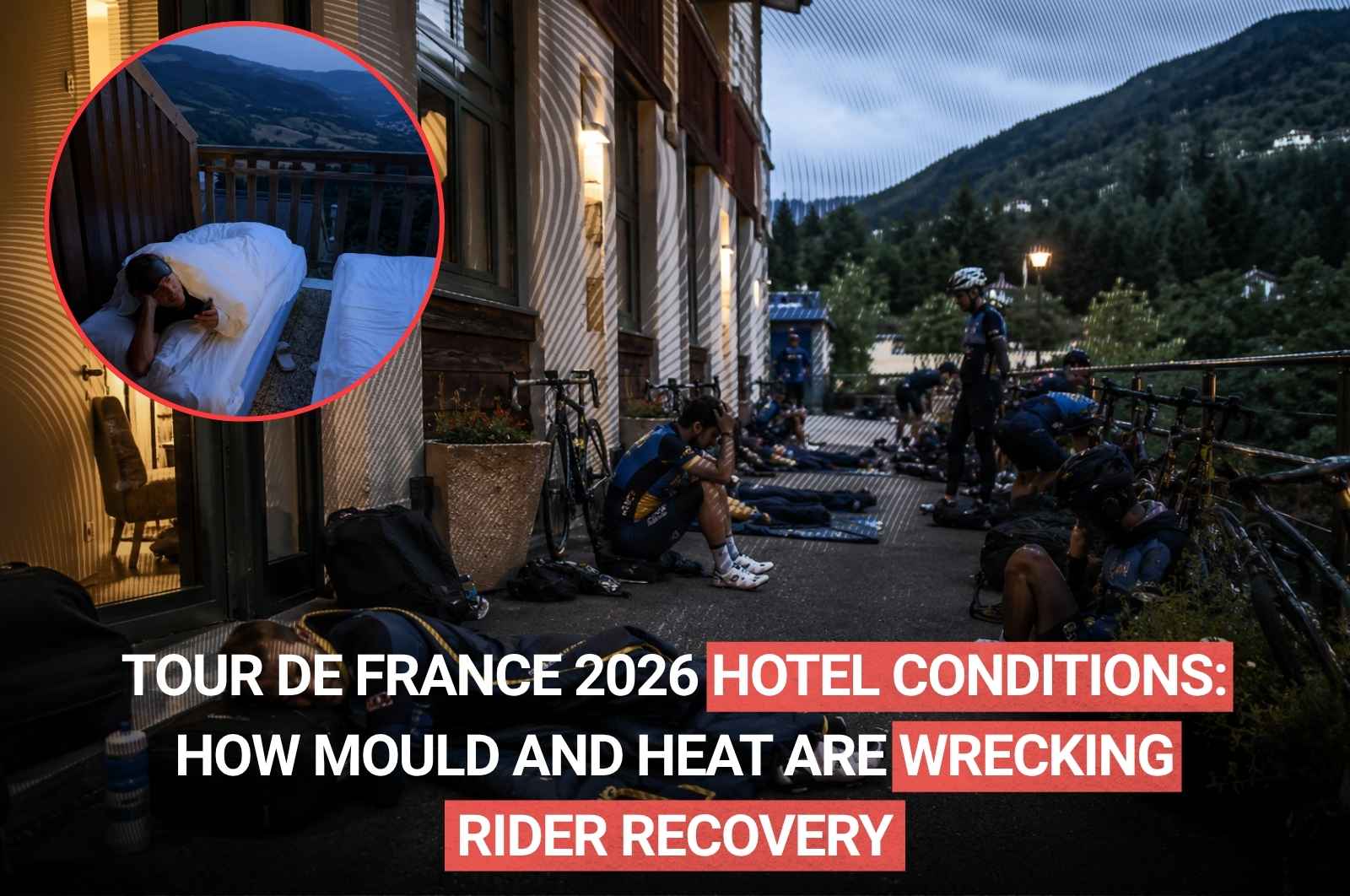
Uno-X, Alpecin-Premier Tech, and Picnic PostNL riders slept on hotel balconies during the 2026 Tour rest day. The recovery cost is not just uncomfortable, it is measurable in HRV and deep sleep.
Magnus Cort rated the Uno-X Mobility team's rest-day hotel at the 2026 Tour de France as one out of seven stars.
It is amongst the worst places I have stayed, he wrote in his now-cult Instagram hotel reviews.
Cort singled out the dirtiness, the broken toilet roll holder, and a small smell of rot.
Silvan Dillier of Alpecin-Premier Tech slept on the balcony rather than the bed.
The Halland Johannessen brothers of Uno-X did the same, posting photos of cobwebs and dead insects in their rooms.
Adrie van der Poel, father of Mathieu and a former Tour of Flanders winner, told reporters he saw cockroaches, rust, mould under the bed in the accommodation given to his son's team.
The reflex reaction is to laugh. That is a mistake.
The physiology of what a bad hotel does to a WorldTour rider is measurable, published, and worse than most people realise. It is also happening on top of a second recovery-killer nobody is talking about together with the hotels.
The 2am doping wake-ups.
What Actually Went Wrong in the Massif Central
The rest-day accommodation problem centred on an apartment hotel in Le Lioran during the first week of the race.
According to Cyclingnews reporting, riders from Uno-X Mobility, Alpecin-Premier Tech, and Picnic PostNL stayed in rooms with no air conditioning, no WiFi, and visible mould.
UAE Team Emirates-XRG and Lidl-Trek stayed in a different hotel that also lacked air conditioning during a heatwave in which Cyclingnews reported outdoor temperatures well above 30°C.
Tour director Christian Prudhomme defended the allocation system, telling reporters that the Tour's route and logistical demands leave organisers with limited options.
That may be true. But it does not change what the sleep-science literature says about what happens next.
The Recovery Cost Nobody Is Naming
The single biggest environmental input to sleep quality is ambient temperature.
Every peer-reviewed sleep-science paper on this agrees on the direction, and most agree on the range.
The consensus optimal bedroom temperature is 16°C to 19°C.
That is not a wellness-blog number. It is a physiology number.
The results are precise. Compared to a control condition, sleeping at cooler first-half-of-the-night temperatures produced:
Deep sleep up by 14 minutes, a 22% mean change, p equals 0.003.
REM sleep up by 9 minutes, a 25% mean change, p equals 0.033.
Overnight HRV up by 7% overall, statistically significant at p less than 0.01.
Now Flip It
That study measured what happens when temperature is optimised.
The Tour hotel problem is the opposite.
A hot, humid, poorly ventilated room, in a heatwave, with mould in the corners, is the physiological worst case. And it is landing on riders who are three-quarters through a Grand Tour.
If a cool-temperature setup produces a 22% deep-sleep gain, a hot-temperature setup is losing at least that much.
Fourteen minutes of deep sleep for an amateur runner is a nice-to-have. Fourteen minutes for a GC contender staring down a mountain stage is measurable in watts, reaction time, and injury risk.
The HRV Piece That Ties It Together
Heart rate variability, or HRV, is the single most sensitive marker of overnight autonomic recovery.
The finding was blunt. Higher nighttime bedroom temperatures were associated with lower HRV during sleep, and the effect scaled with heat exposure.
The study concluded that hot nights impair sleep and autonomic recovery in a way that has real cardiovascular consequences.
That was in older adults, in Queensland summer. Translate the mechanism to a 24-year-old WorldTour rider stacking a 40°C stage day on top of a 30°C hotel night with no air conditioning, and the recovery hit compounds.
The Two Recovery Killers Stacking on Top of Each Other
Here is where the hotel story stops being funny.
In our earlier coverage of the Tour de France, we broke down the 2am doping-test wake-ups that hit Vingegaard, Pogačar, and at least five other teams' riders before the queen stage.
Combine that with the hotel problem, and you have two independent recovery-destroying variables landing at the same time.
A 30°C sleeping environment already cuts deep sleep by 22% and pushes HRV down measurably.
A 2am knock on the door on top of that removes 75 to 120 minutes of REM sleep from the second half of the night, which is exactly when motor-skill consolidation happens.
The two stresses do not average out. They compound.
The literature on stacked partial-sleep-deprivation, covered comprehensively in our earlier piece sleep is the free watts nobody is selling you, is clear on this. Sub-optimal sleep environment plus interrupted sleep is not additive, it is multiplicative.
What the Top Teams Are Quietly Doing About It
The three WorldTour teams with the deepest budgets, Visma-Lease a Bike, UAE Team Emirates-XRG, and INEOS Grenadiers, have all invested in mobile sleep infrastructure.
That includes dedicated team-bus sleep pods with controlled ambient temperature, portable HEPA air-purifier units for hotel rooms, and bring-your-own hypoallergenic mattress toppers.
Some teams now travel with dehumidifiers as standard kit. Adrie van der Poel confirmed this on the record, saying Alpecin-Premier Tech had brought our own mattresses and portable air conditioners to the Massif Central.
The mattresses and dehumidifiers cost a few thousand euros per team. The HRV protection they buy is worth considerably more than that in Grand Tour finishing position.
Smaller teams cannot afford this. That is a structural fairness problem the Tour has not addressed.
What Amateurs Can Learn From This
The practical takeaway for the amateur rider is direct.
If your sleeping environment is above 22°C, humid, or noisy, you are losing measurable deep sleep and measurable HRV. That translates into higher perceived exertion at the same wattage the next day.
A simple fix is a fan and blackout curtains. A more serious fix is a portable air conditioner if your budget allows.
Prudhomme is right that the Tour's route through remote parts of France limits accommodation options.
He is also right that the current allocation system was designed to treat every team equally.
But equal in this case means equally bad. And the teams with private sleep-pod investment are quietly winning a recovery race the rest of the peloton cannot even enter.
The obvious fix is a published minimum accommodation standard for the Tour, enforceable through ASO and audited by an independent body.
Ambient temperature ceiling. Humidity ceiling.
Air-quality floor. No mould, no infestation.
None of that is unreasonable. All of it is measurable.
The Statement Cycling Just Made
For a hundred years, the Tour has been defined by suffering that riders accept as the price of glory.
The heat of the Ventoux climb. The rain on the pavé of Roubaix.
Those are part of the sport.
The cockroaches under the bed and the water running down the wall are not.
There is a real, published, quantifiable cost to what the Tour is currently asking its riders to sleep through.
And there is a real gap opening up between the teams that can spend their way around it and the ones that cannot.
If the sport wants a level playing field, the leveller has to reach the beds. Not just the bikes.