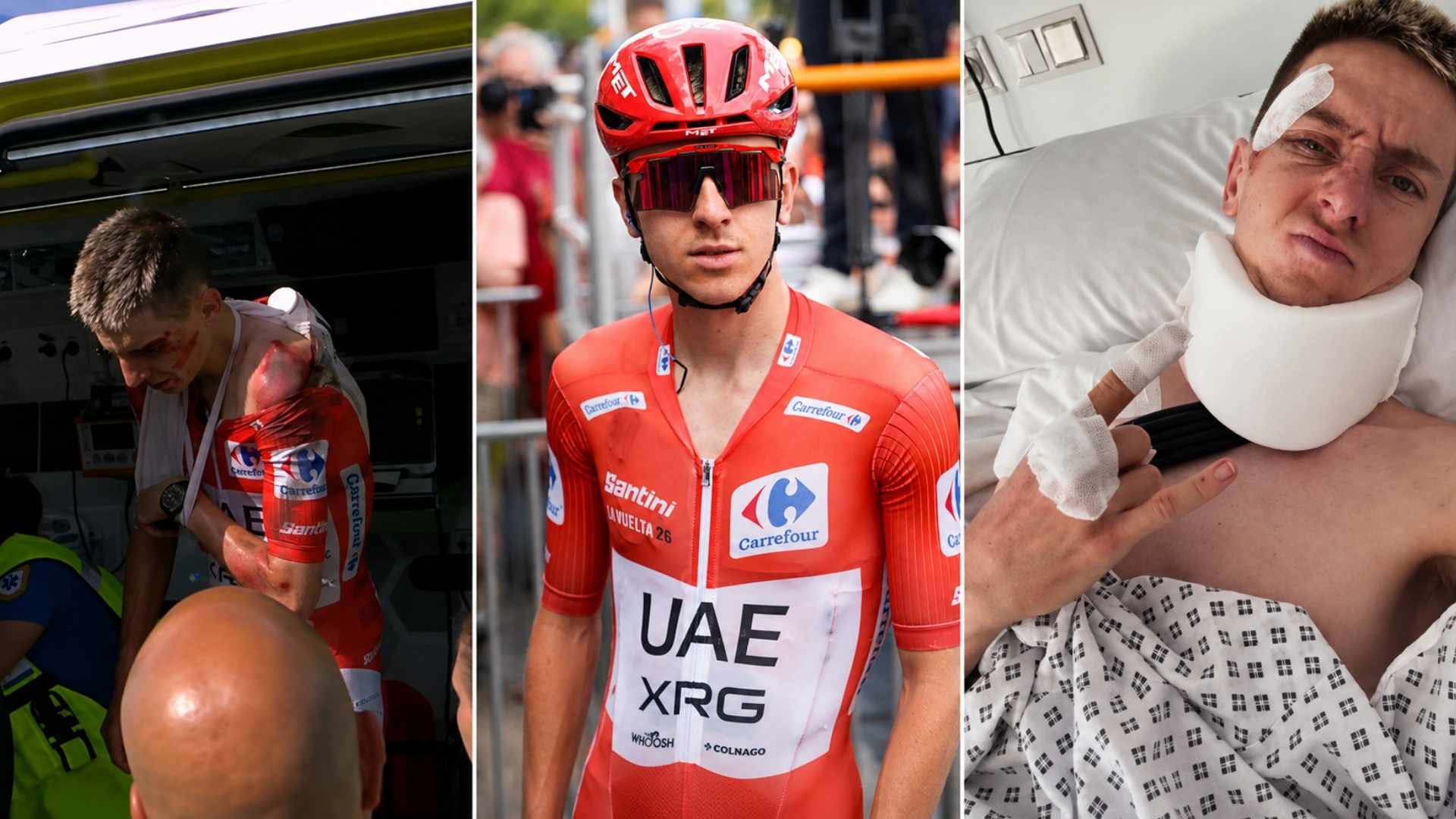
A peer-reviewed study of 111 elite cyclists with isolated clavicle fractures found a mean return-to-competition time of 56.7 days. Pogacar has 27.
Picture from Pogacar/Instagram
The mainstream cycling press has spent the past 48 hours reporting that UAE Team Emirates-XRG "won't rule out" a Worlds defence for Tadej Pogacar in Montreal on September 27. What none of it has done is run the actual bone-healing science against the calendar.
The science is not close.
Pogacar's injuries from stage 8 of the 2026 Vuelta a España: a displaced left clavicle fracture, a stable C7 cervical vertebra fracture, concussion, and multiple abrasions. Surgery was performed in Barcelona on Monday, August 31, delayed 24 hours as a precaution against the concussion.
That leaves roughly four weeks to the elite men's road race in Canada. Every one of them counts against a body of published sports-medicine data.
What the Peer-Reviewed Data Actually Shows
A 2022 study published in the Journal of Orthopaedics reviewed 1,449 professional cyclists over five seasons and identified 188 clavicle fractures. For isolated clavicle fractures, mean return to elite competition was 56.7 days. The paper is available on PubMed Central. That is 29 days longer than Pogacar has to Montreal.
Even in the fastest-returning subset (surgical fixation with rapid rehab protocols), the earliest documented returns for pro cyclists have been around 3 to 4 weeks to training, not to a WorldTour-level one-day race with a 6-hour, 250 km parcours. Returning to indoor trainer work by day 7 is possible. Returning to Worlds-winning form in 27 days is a different order of ask.
That is the isolated-fracture picture. Pogacar does not have an isolated fracture.
The C7 Fracture Nobody Is Talking About
The cervical spine injury changes the calculus significantly. A stable C7 fracture typically requires 6 to 8 weeks of collar immobilization and restricted head-loading positions before any high-load activity resumes.
On a road bike, the head is held in a low, forward, sustained-flexion position for hours at a time. That is precisely the loading pattern a healing C7 needs to avoid.
Any rider recovering from a stable cervical fracture would be advised against sustained drop-bar riding for at least a month post-surgery. Sustained hood riding for 6 hours in a bunch sprint at Worlds effort is not a plausible activity 27 days after that surgery.
Even indoor trainer work in an upright position carries risk if the fracture site is under-supported. The typical clinical guidance is a hard cervical collar for the first 4 to 6 weeks, followed by a graduated collar-free reintroduction. That timeline alone rules Montreal out under standard protocols.
The Concussion Layer
Modern sports concussion protocols require stepwise graduated return-to-sport with symptom monitoring at each stage. The standard progression is 6 stages spread over a minimum of 6 days, but only after the athlete is symptom-free at rest.
Pogacar has not been medically cleared as symptom-free yet. His surgery was delayed specifically because of the concussion.
Three injuries stacked: bone, spine, brain. Each has its own return-to-sport clock, and they do not run in parallel; the slowest one governs the whole timeline.
What UAE Is Actually Doing
Read the team statements carefully. UAE sports manager Joxean "Matxin" Fernández has not said Pogacar will be at Montreal.
He has said the team will "analyse the situation, wait for the operation to take place, and once it has, find out how it went and draw conclusions from it all." That is not a commitment. It is a placeholder while the marketing and sponsor pressure builds.
Pogacar's agent Alex Carera has taken a similar line: no rush to declare the season over, but no promises either. In elite cycling, this is what a soft-landing announcement looks like. The definitive "he's out" statement typically comes 10 to 14 days out from the target event, once the training window has empirically closed.
The Real Target Now: Il Lombardia, October 10
Il Lombardia falls on Saturday, October 10, giving Pogacar six weeks from the crash. That is still an ambitious recovery, but it is where the math starts to work.
He has won every edition of Il Lombardia since 2021, five consecutive victories, and a sixth would be one of the defining records of his career. If any race justifies aggressive rehabilitation, it is this one.
The European Championships on home roads in Slovenia on October 4 would sit awkwardly in the middle, seven weeks post-crash but only six days before Lombardia. If forced to pick, Lombardia wins.
What This Opens Up for the Rest of the Peloton
Montreal without Pogacar is a genuine race for the first time in three years. The rainbow jersey has stayed with him since 2023, and defending it three times consecutively would have equaled Peter Sagan's modern record.
Without him, Remco Evenepoel is now the outright favorite. The Belgian's punchy-climb tactical style suits the Montreal course, and he has been shadowing Pogacar's results all season without breaking through.
Mathieu van der Poel enters as the wild card, and Wout van Aert has form back after his summer illness.
Isaac del Toro, Juan Ayuso, and Ben O'Connor become genuine dark horses for the Slovenian, Australian, and mixed-nation teams. The rainbow jersey is suddenly the most open it has been in three years.
Where This Analysis Falls Short
Pogacar is genuinely an outlier physiologically, and clinical averages do not map cleanly onto athletes at the extreme end of the distribution. His recovery from previous injuries has consistently beaten typical timelines, and UAE has one of the most sophisticated rehabilitation setups in the sport.
If any rider could return to a WorldTour road race 27 days after that injury package, it would be him. But the operative word is "could," not "will."
The published data on cervical fractures and clavicle recovery in high-load sport is unambiguous about the risk of returning too early. A refracture, a nonunion, or a concussion recurrence would end more than his 2026 season.
What This Costs UAE Team Emirates-XRG
Pogacar is not just a rider on UAE's roster. He is the entire commercial architecture of the team's 2026 season.
Every sponsor activation, every media plan, every rider-development timeline has been built around his Grand Tour and Monument calendar. Losing the back-third of that calendar shifts several dozen commercial commitments simultaneously.
The team's fallback riders (Adam Yates, Juan Ayuso, Isaac del Toro, João Almeida) are legitimate GC contenders in their own right. But none of them draws the sponsor attention Pogacar does, and none has the punchy classics profile to attempt a Worlds substitution.
Expect UAE to pivot marketing weight toward the Ayuso-del Toro rivalry storyline and Lombardia as the season closer, regardless of whether Pogacar starts at either. The team has too much invested in the fourth quarter of the calendar to let it go quiet.
The 2027 Season Just Got More Complicated
A six-week layoff at the end of 2026 has downstream effects. Pogacar was already scheduled to attempt an unprecedented Vuelta-Worlds-Lombardia treble to close his season. Missing that block compresses his off-season recovery.
His 2027 base training typically starts in early November. A late-October return at Lombardia followed by a compressed transition would give him roughly three weeks of full rest before pre-season builds.
That is workable but not ideal. Riders coming off serious mid-season injuries typically show reduced early-season form the following spring, even when the physical injury has healed cleanly.
His Milano-Sanremo, Strade Bianche, and Flanders campaigns in March and April 2027 may see him arrive slightly under his usual level. That opens the door for Mathieu van der Poel to reassert the Classics dominance Pogacar took from him in 2025 and 2026.
The Verdict Nobody Will Say Out Loud Yet
Pogacar will not race Worlds in Montreal. He will not officially miss it either, not for another week or two, because the announcement itself is a delicate PR moment for UAE, for Slovenia's federation, and for the rider's brand.
But the bone-healing biology has already decided. The C7 has already decided.
The concussion has already decided too.
Il Lombardia on October 10 remains realistic. Everything before it does not.
The 2026 Worlds will crown someone new. The peloton just doesn't know it yet.