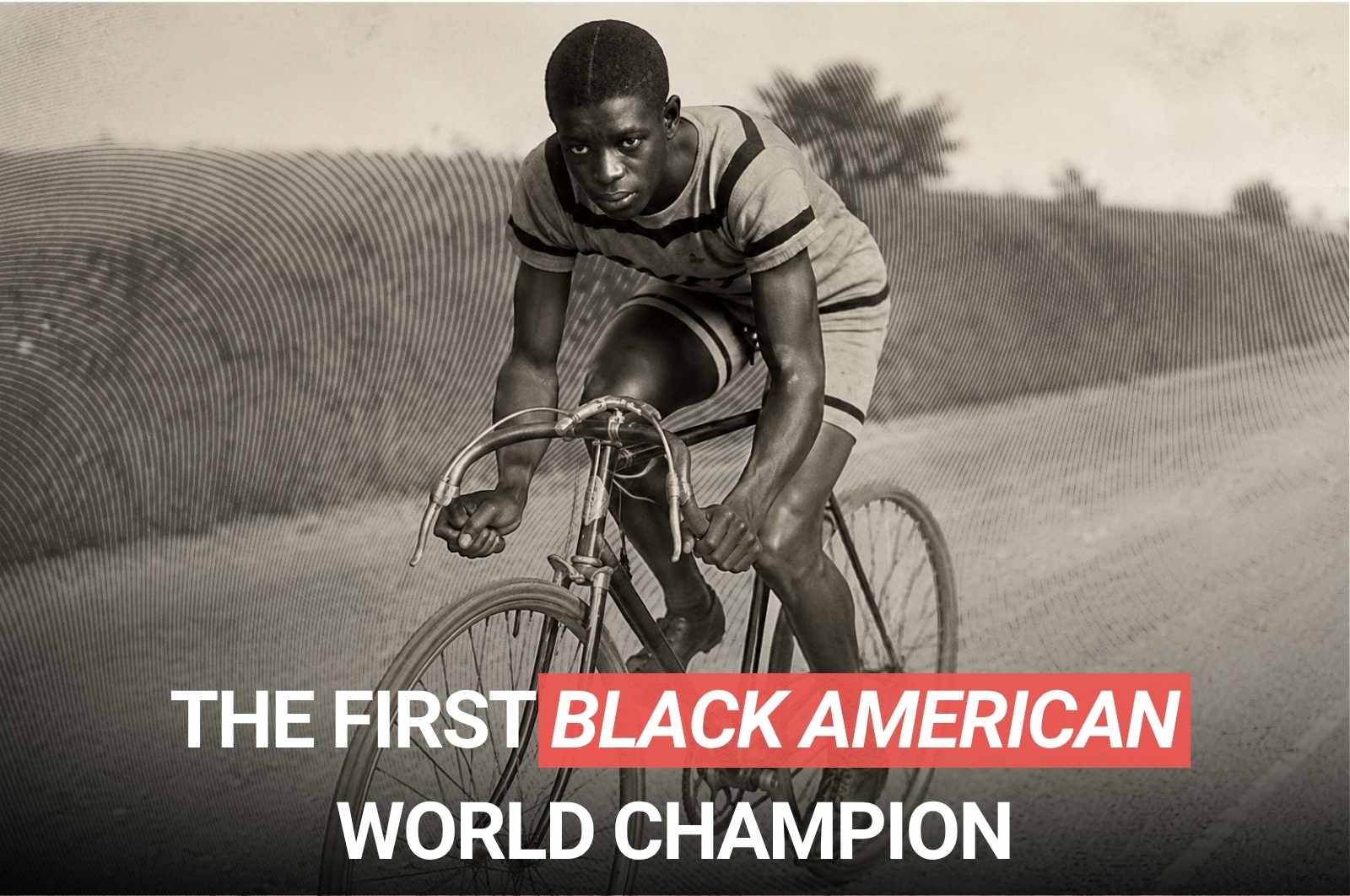
Marshall Major Taylor set seven world records before he turned 21. He was choked unconscious by a rival, banned from tracks in his home state, and paid to ride under police protection.
On August 10, 1899, a 20-year-old sprinter from Indianapolis took the line at the world track championships in Montreal.
He had already been paid to leave the country.
Race promoters in the American South had blacklisted him.
White competitors had refused to line up against him.
His own hometown had banned him from its velodrome after he broke two world records there.
He won anyway. One mile. Twenty years old. Marshall Walter Taylor, known to the sporting press as Major Taylor, became the first Black American to hold a world title in any sport.
Ten years before Jack Johnson took the heavyweight belt from Tommy Burns. Nearly half a century before Jackie Robinson stepped onto a Major League field.
Cycling produced the first Black American world champion. And cycling has done a very poor job remembering it.
The Records He Set Before He Could Legally Drink
Between 1898 and 1899, Taylor set seven world records across distances from the quarter-mile to the two-mile.
He won 29 of the 49 races he entered as a teenager, according to reporting by Smithsonian Magazine on the era's newspaper accounts.
His signature event was the sprint, an all-out effort on a wooden velodrome banked so steeply that fatal crashes were routine. Six-day races drew tens of thousands of spectators.
Riders reached for cocaine and strychnine as stimulants. Sleep deprivation was the sport.
Taylor's advantage was not chemistry. It was mechanics.
His trainer, a former high-wheel racer named Louis Birdie Munger, had trained him from adolescence to hold a lower, more aerodynamic tuck than any of his rivals, at a moment when almost no one in the sport thought about drag.
He was also, by every account we have from the era, the strongest pure sprinter alive.
The Racism Was Not Background. It Was The Story.
Newspapers called him the Black Cyclone and printed his skin color in the headlines above his results.
Promoters marketed his races as spectacles of a colored rider against white cyclists.
The League of American Wheelmen, the sport's governing body, formally banned Black riders in 1894, the year Taylor turned 15.
He raced on anyway, often in unsanctioned events, and often at physical risk.
The most well-documented incident happened at a race in Taunton, Massachusetts.
A white rival, W. E. Becker, pulled Taylor off his bicycle after the finish and choked him until he passed out. Becker was fined 50 dollars.
Other white racers donated money to pay it for him.
He was banned from tracks in his home state of Indiana after beating white cyclists and setting records in front of them.
He was refused hotel rooms, meals, and, at one Southern race, threatened with death if he crossed the finish line first.
He raced anyway. Britannica's biographical entry, updated in 2024, catalogs the pattern in detail: Jim Crow restrictions, coordinated on-track boxing-in by white riders, and periodic threats that would have ended a lesser rider's career on day one.
The Faith Clause In His Contracts
There is a detail that gets left out of most short retellings and is worth pausing on.
Taylor was a devout member of the John Street Baptist Church in Worcester, Massachusetts.
He would not race on Sundays, on religious grounds.
For years, this cost him.
The most lucrative European velodrome events, especially in France, were held on Sundays.
He turned down offers that would have made him wealthy on the spot, from promoters who could not believe he was serious.
Eventually the promoters blinked.
French organizers rescheduled marquee events off Sunday specifically to bring him over.
He toured Europe in the early 1900s and became one of the best-paid athletes in the world.
According to Smithsonian Magazine, he won multiple national and international titles across France, Belgium, Australia, and the United States.
A 20-something Black American from Indianapolis moved the calendar of European professional cycling. That is worth sitting with.
Why Cycling Almost Forgot Him
Taylor retired in 1910. He self-published his autobiography, The Fastest Bicycle Rider In The World, in 1928, largely selling copies out of the trunk of his car.
He died in 1932 in the charity ward of a Chicago hospital, effectively broke. He was 53 years old. He was buried in an unmarked grave.
It took 16 years for a group of former pro cyclists, led by the frame builder Frank Schwinn, to raise money and rebury him with a proper headstone.
That was in 1948. By then, most of cycling had moved on.
The reason his name has faded, compared to Jackie Robinson or Jesse Owens, is not complicated. Cycling itself faded in America.
Track racing collapsed after the 1930s.
The velodromes were torn down.
The six-day races vanished. Baseball had a modern professional infrastructure that kept telling its own history. Cycling did not.
The bike, the sport that produced America's first Black world champion, became a children's Christmas present.
And the man who broke the color barrier a full decade before boxing did got filed away as an eccentric footnote.
What This Story Should Do To Modern Cycling
There is a version of this piece that ends with a call to name more velodromes after him, and that is fine.
Worcester renamed a section of its downtown boulevard Major Taylor Boulevard in 2006. Indianapolis has the Major Taylor Velodrome.
There is a statue outside the Worcester Public Library.
Cycling clubs in his name now exist in more than 60 US cities.
But the real move is smaller and harder.
It is remembering that the modern peloton, from the amateur level up, is not the product of a linear meritocracy.
It was gatekept for a century. Barriers to entry, from equipment costs to club culture to route safety in specific neighborhoods, still shape who ends up racing.
What Taylor's story adds is a reminder that who gets to line up has always been a policy decision, not a natural fact.
The 2026 pro season is heading into its Spring Classics window.
It is who is the fittest of the riders modern cycling has been willing to line up.
Where This History Falls Short
Two honest caveats.
The primary sources on Taylor lean heavily on his own autobiography and on newspaper reporting from the 1890s and 1900s, both of which have obvious biases.
His race counts and record claims have been verified where possible against contemporary results, but small discrepancies exist across biographies.
The 1899 world championship title, his status as the second Black world champion in any sport after Canadian boxer George Dixon, and the seven world records set in 1898 and 1899 are the strongest documented facts.
Second, the modern first Black American world champion in any sport framing is accurate for American-born athletes.
Canadian bantamweight boxer George Dixon, who was Black and won a world title around 1890, predates Taylor globally.
In the context of American sport, Taylor was first.
The Statement Cycling Just Made
The bike was, briefly, the most important piece of technology in America.
For a window of roughly a decade around 1900, cycling was the dominant spectator sport in the United States.
Velodromes drew larger crowds than baseball.
Pro cyclists were among the highest-paid athletes in the country.
And the fastest of them, on a world stage, was a young Black man from Indianapolis who had been legally banned from the sport's governing body.
That story belongs to cycling. Not to a Black History Month post from a bike brand.
Not to a footnote in a velodrome plaque. To the sport itself.
When the peloton lines up for the Spring Classics in a few weeks, Major Taylor will not be on the start list. He does not need to be.
He has already crossed the line.