Replacing bike pedals seems simple, but a single mistake with the reverse threading can instantly destroy your crankset. This step-by-step expert guide teaches you the essential "Golden Rule" to safely swap your pedals in under fifteen minutes.
As a bicycle mechanic for over a decade, I’ve seen my fair share of DIY disasters. But few are as heartbreaking and expensive as a ruined crank arm caused by improper pedal installation.
Your pedals are perhaps the most critical contact point on the bicycle.
They are where your power transfers into forward motion.
Yet, they are often overlooked until bearings start grinding, the grip wears smooth, or you decide to make the leap from flat pedals to a clipless system.
Changing pedals is theoretically one of the easiest upgrades you can perform at home.
However, it requires specific knowledge of bicycle mechanics that differs from almost every other bolt in the world.
If you approach this job assuming "righty-tighty, lefty-loosey" applies to both sides of your bike, you are going to have a very bad time.
This guide will walk you through the process safely, ensuring your new pedals are secure and your cranks remain undamaged.
Understanding The Golden Rule of Pedals
Before we touch a tool, you need to understand the physics of bicycle pedals. This is where most beginners make catastrophic mistakes.
To prevent your pedals from unscrewing themselves while you ride due to the forces of precession, bicycle manufacturers use reverse threading on one side of the bike.
The Right Pedal (Drive Side - the side with the chainrings) has standard threads. It tightens clockwise and loosens counter-clockwise.
The Left Pedal (Non-Drive Side) has reverse threads. It tightens counter-clockwise and loosens clockwise.
If you try to loosen the left pedal by turning it counter-clockwise (the standard way), you will actually be tightening it with immense force, potentially stripping the aluminum threads right out of your crank arm.
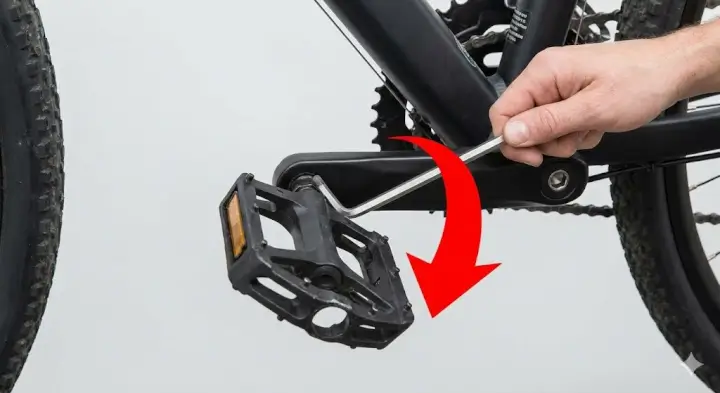
An easy way to remember this when working on the bike: To loosen pedals, turn the wrench toward the back wheel. To tighten pedals, turn the wrench toward the front wheel.
This rule applies to both sides.
Gathering The Correct Tools
You don't need a full shop setup to change pedals, but using the wrong tools can lead to rounded bolts and skinned knuckles.
Which tool you need depends entirely on the pedals currently on your bike and the new ones you are installing.
A Pedal Wrench: This is not a standard crescent wrench. Pedal wrenches are thinner and flatter, designed to fit between the pedal body and the crank arm. Most are 15mm. Standard spanners are usually too thick to fit.
Hex Keys (Allen Keys): Many modern pedals, particularly higher-end road and mountain bike pedals, do not have flats for a wrench. Instead, they use a hex socket on the end of the pedal spindle (viewed from the back of the crank arm). This is usually a 6mm or 8mm size. You will need a long-handled Allen key for sufficient leverage.
Bicycle Grease/Anti-Seize: This is non-negotiable. Do not install pedals dry.
Shop Rags: For cleaning the crank threads.
Removing the Old Pedals
If your pedals have been on the bike for years and were installed without grease, removing them will be the hardest part of this job.
The aluminum crank and steel pedal spindle can undergo "galvanic corrosion," essentially fusing them together.
Preparation:Shift your chain into the big chainring in the front. This gives you a little protection from the sharp teeth if your hand slips while wrenching.
Step 1: Removing the Right (Drive-Side) Pedal
We always start with the drive side because it uses standard threading, helping you get the feel for the torque required.
Position the right crank arm so it is facing forward (roughly the 3 o'clock position).
Identify how your pedal attaches. Locate the 15mm flats on the spindle next to the crank, or the hex bolt on the back of the pedal axle.
Attach your tool so the handle is facing horizontally toward the back of the bike.
Push down firmly on the tool handle. Remember the rule: you are turning the wrench toward the back wheel to loosen it. (Counter-clockwise).
Expert Tip for Stubborn Pedals: If it won't budge, position the crank arm facing backward (9 o'clock) and the tool facing forward. You can then use your foot to firmly step down on the wrench handle. Your leg has much more power than your arm.
Once the initial tension is broken, you should be able to spin the pedal off quickly by hand.
Step 2: Removing the Left (Non-Drive Side) Pedal
This is the moment of truth. Remember: Reverse Threads.
Position the left crank arm facing forward (roughly the 9 o'clock position looking from the non-drive side).
Attach your 15mm wrench or hex key. Position the tool handle facing horizontally toward the rear of the bike.
Push down on the tool. You are turning the spindle clockwise to loosen it. Again, turning toward the back of the bike loosens.
If you are using a hex key from the backside of the crank arm, the physics can get confusing.
Just stick to the rule: get the tool handle so you are pushing it toward the rear hub to loosen.
Installing the New Pedals
With the old pedals off, the hard work is done. Installation is all about finesse and ensuring you don't "cross-thread" the new pedals.
Step 3: Cleaning and Prep
Look inside the threaded holes on your crank arms.
They are likely filthy with old grit and grime. Use a rag to wipe these threads completely clean. If you have degreaser, use a little on the rag to get them sparkling.
Next, prepare the new pedals.
Take a generous dab of waterproof bicycle grease or anti-seize compound and coat the threads of the new pedal spindles entirely.
Why Grease is Vital: Grease does two things.
First, it allows you to tighten the pedal sufficiently without excessive friction. Second, and most importantly, it prevents corrosion between the steel pedal and the aluminum crank.
If you skip grease today, you might find it impossible to remove these pedals in two years.
Step 4: Identifying Right and Left Pedals
You cannot put a left pedal into a right crank arm, or vice versa. Trying to do so will destroy the crank arm threads instantly.
Almost every pedal manufactured has markings stamped onto the end of the spindle or on the pedal body itself. Look closely for an "R" (Right/Drive Side) and an "L" (Left/Non-Drive Side). Some higher-end pedals may use a small groove machined into the spindle of the Left pedal to denote the reverse thread.
Step 5: Threading By Hand
This is the most crucial step for preventing damage. Do not use a wrench yet.
Take the Right ("R") pedal to the drive side of the bike.
Insert the tip of the pedal into the crank arm hole.
Gently begin turning the pedal axle clockwise (toward the front wheel) with your fingers.
It should thread in smoothly and easily. If you feel resistance immediately, STOP. You are cross-threading it (the threads aren't aligned). Back it out, realign, and try again. You should be able to thread it almost all the way in just using your fingers.
Repeat the process for the Left ("L") pedal on the non-drive side. Remember, you must turn this pedal counter-clockwise (toward the front wheel) to tighten it.
Step 6: Final Tightening
Once the pedals are threaded in hand-tight against the crank arm, it's time for the final torque.
Use your pedal wrench or hex key to tighten them down firmly. Turn the tools toward the front of the bike.
How tight? Pedals need to be quite tight. Torque specifications vary, but usually range around 35–40 Newton meters (Nm).
Without a torque wrench, the rule of thumb is "very snug." You want to use significant leverage to snug it down, but you don't need to hang your entire body weight off the wrench. The grease you applied earlier will ensure you can get them tight enough.
Post-Installation Check
Wipe away any excess grease that squeezed out from the crank interface. Give the pedals a spin to ensure they move freely.
Take the bike for a short, gentle test ride around the block. Do not go for a sprint immediately.
Test the engagement if you installed clipless pedals.
After your first real ride (say, 10-20 miles), take your wrench and just double-check that the pedals are still tight.
They rarely loosen up if installed correctly, but this safety check is best practice.