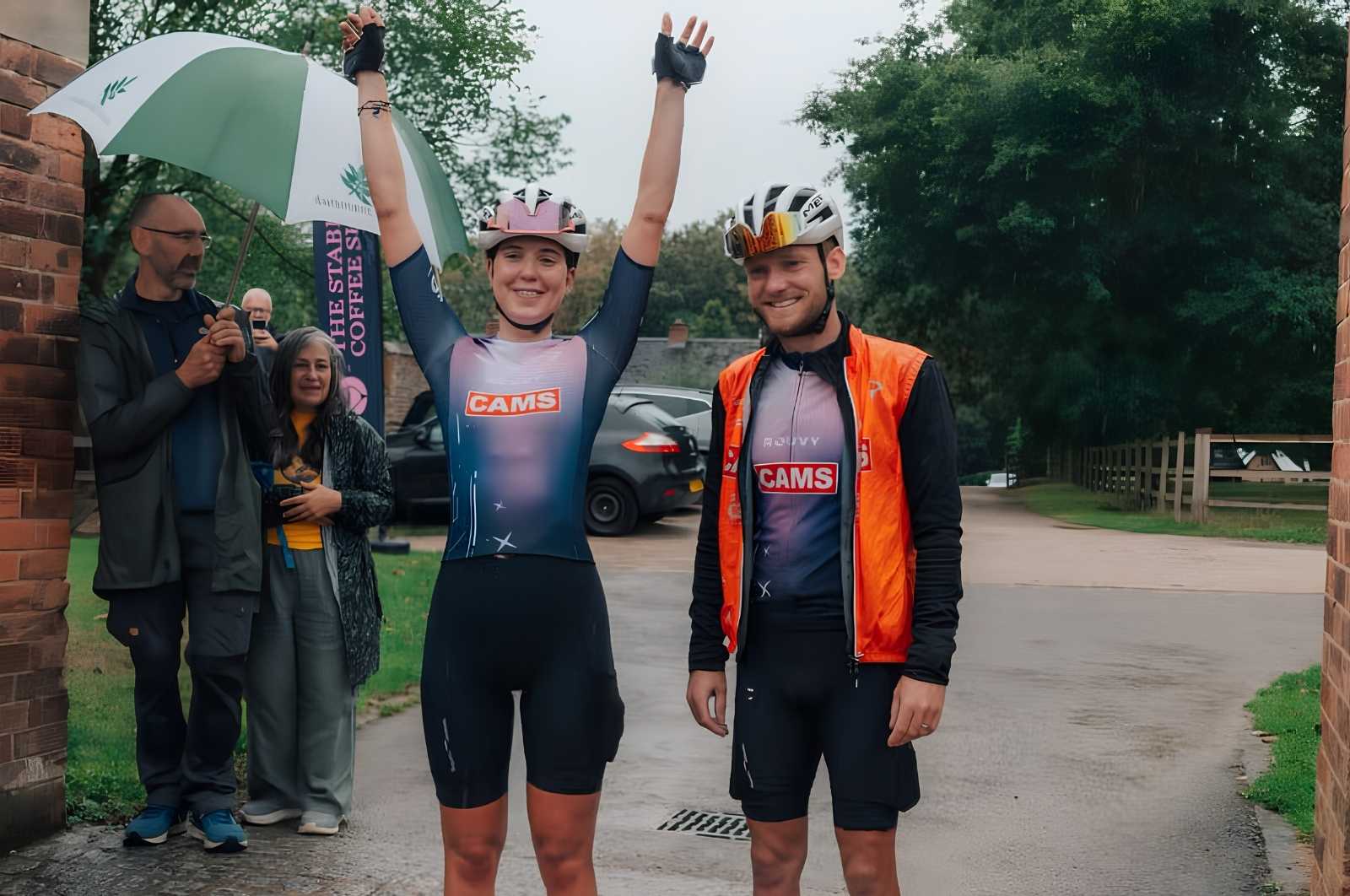
Amy and Kyle Hudson crossed the finish line in Derbyshire on September 2, having beaten the previous couples record for cycling around the world by 81 days. The story of how they did it, without killing each other, is stranger than the numbers.
Media credit Amy Hudson
There is a specific kind of exhaustion that only exists after 4am starts, 150 miles a day, and four straight months of doing it with the same person on your rear wheel.
Amy and Kyle Hudson know it now. The British couple rolled back into their home county of Derby on September 2, 2026, and stopped the clock at 123 days, 23 hours and 24 minutes.
That is the new Guinness world record for the fastest couple to circumnavigate the globe by bicycle, self-supported. The previous mark was 205 days, set by French pair David Ferguson and Caroline Soubayroux in 2023.
The Hudsons did not chip it. They took a hammer to it, finishing 81 days quicker.
And yes, they are still talking to each other.
The Numbers Are Almost Rude
Consider the ledger. 18,100 miles, across 20 countries, both hemispheres, as the record rules require.
They rode around 150 miles per cycling day, often stretched across 10 to 12 hours in the saddle. Their cumulative elevation gain was roughly 470,435 feet, which is Everest sixteen times over.
Then the damage report. 53 punctures, six crashes, one broken collarbone.
That last one nearly ended the whole thing. The collarbone came courtesy of a Montreal driver who turned left across a bike path without checking.
They were, at that point, well ahead of schedule. The crash could have wiped out weeks.
"We were just getting out of Montreal, on a bike path, when a car decided to turn left without any right of way," Kyle told Cycling Weekly from the ambulance.
Amy hit the brakes. Kyle had nowhere to go.
Instead of losing weeks, they lost a fraction of that. Because Kyle rode on.
There is not really a polite way to say what that means. He kept pedalling, most of the way around a planet, with a broken bone knitting itself back together underneath a jersey.
Amy Hudson Was A Nurse Five Years Ago
The most useful thing to understand about this record is that Amy Hudson barely rode a bike before 2021.
She was a mental health nurse. The job took a toll, including anxiety, an eating disorder, and intrusive thoughts.
Kyle bought her a bike during lockdown as, essentially, a lifeline. Within three years she had ridden all 21 stages of the Tour de France solo, including the transfers.
That solo effort covered 6,556 km in 29 days in the summer of 2025. It also raised £93,000 for the mental health charity Shout.
The round-the-world was the sequel. Same charity, bigger canvas.
Kyle, meanwhile, was a full-time builder training around a work schedule that would flatten most amateurs. He is not a former pro.
He is a bloke from Derby who watched his wife turn into an ultra-endurance athlete. He decided he would rather be on the bike next to her than at home worrying about her.
That backstory matters because it changes the physics of the record. Most attempts at this distance come from riders with decades of racing volume in the legs.
The Hudsons did not have that. What they had was volume, consistency, and each other.
What Riding 150 Miles A Day For Four Months Actually Requires
Amy has been open, on the ROUVY podcast and elsewhere, about how the training worked. The topline is that she logs between 12,000 and 13,000 miles per year, roughly 19,300 to 20,900 km.
That is real WorldTour-adjacent volume for an amateur. And the training was not just distance.
Her coach ran threshold-focused intervals on the indoor platform to build lactate clearance. That is the physiological currency for going hard, day after day, without cratering.
Strength work was built in. And crucially, back-to-back long days trained the body to accept that yesterday's fatigue is not an excuse for today.
The 4am Alarm Is The Whole Job
The schedule was blunt. Alarm at 4am, on the bike shortly after, off the bike around 8pm.
Repeat for 123 days.
That means the actual physical challenge is not aerobic. Aerobically, both riders were absurdly capable well before they clipped in on May 1.
The challenge is stacking day on day on day, without letting fatigue, saddle sores, weather, or a broken collarbone break the rhythm. That is a different sport from a single hard event.
The Hudsons, in effect, had already spent years living inside a version of that plan. That is why the record was thinkable.
Image from CAMS
Riding With A Partner Is Not A Cheat Code
There is a temptation to assume that riding with your spouse for four months is easier than doing it alone. It is not, and it might even be harder.
A 2023 study published in PLOS ONE on the passionate engagement journey of ultra-endurance athletes argues that ultra-distance sport reshapes identity, relationships, and daily life in ways solo athletes rarely appreciate before they are already inside it. You can read the full study here on PMC. What that research also shows is that shared adversity in ultra-endurance sport tends to strengthen partnerships when the couple already had a strong base. It stress-tests them into pieces when they did not.
Amy and Kyle had rules. Wrong turns and fatigue and weather were going to spark shouting, and that was fine.
The rule was clear. Apologise, move on, and do not ride miserable.
There is a moment, told on the ROUVY podcast, from the Col du Tourmalet leg of Amy's earlier Tour de France ride. Kyle was trying to encourage her to look up and enjoy the view.
Amy, deep in the pain cave, shouted back: "I can't see anything but tarmac."
That is what a good partnership under load actually sounds like. Not curated harmony, but honesty at speed.
The Route Was A Weather Sampler From Hell
The Hudsons crossed 20 countries in four months. That is not tourism, that is a rolling audit of every climate zone the planet can throw at a bike.
They started in Derbyshire on May 1. From there the ride threaded through Malaysia in the wet-heat months, where humidity turns any effort into a slog.
Then Australia and New Zealand for the vast, wind-hammered sections. Alaska followed, and then the long crossings of Canada and the United States, where Kyle's collarbone was broken.
Finally back through Portugal and Spain for the last European leg into Derby. The GPS logged 29,544.30 km at the end.
Everything self-supported. No chase car, no soigneur, no team van.
Just two people, two bikes, and a phone number for the nearest bike shop.
What The Record Actually Signals
There is a bigger story sitting underneath the numbers. The couples round-the-world record, until this week, was a niche corner of Guinness that had been bumped along by a few dedicated pairs.
205 days was a serious mark. 123 days is a different sport.
That kind of jump is what happens when a discipline attracts athletes with legitimate volume, structured training, and modern equipment. Rather than adventurers who taught themselves as they went.
The Hudsons are the tell. Expect the record to fall again, and expect it to fall to a couple who saw what Amy and Kyle just did and decided they could go faster still.
There is also a mental-health story that Amy has been careful to keep front and centre. The whole point of the ride, from her side, was to bang the drum for the charity Shout.
She wanted to show what a nurse who once fought her own head can now do on a bike. That framing is not decoration.
It is the thing that got her through the last hard hour of the last hard day.
Editorial Caveats
A few honest notes.
The 123 days, 23 hours, 24 minutes figure is the couple's own recorded time, tracked by GPS. It is pending official Guinness ratification at the time of writing.
The previous record of 205 days, held by David Ferguson and Caroline Soubayroux, is the ratified benchmark. Elevation and distance totals are drawn from the couple's public tracking and support-partner reporting.
Fundraising totals are still updating. The £93,000 figure is from Amy's earlier Tour de France solo ride, and round-the-world fundraising continues.
The Statement They Just Made
The Hudsons will get their Guinness certificate, their headlines, and a very long sleep. Then they will do something else difficult, because that is the pattern now.
The takeaway for the rest of us is simpler than it looks. Volume beats talent, and consistency beats intensity.
And apparently, if the person you love is willing to yell at you on a mountain and then apologise ten miles later, four months is not too long to spend on a bike together.
Twenty countries, eighteen thousand miles, one marriage still standing. That is quietly astonishing.