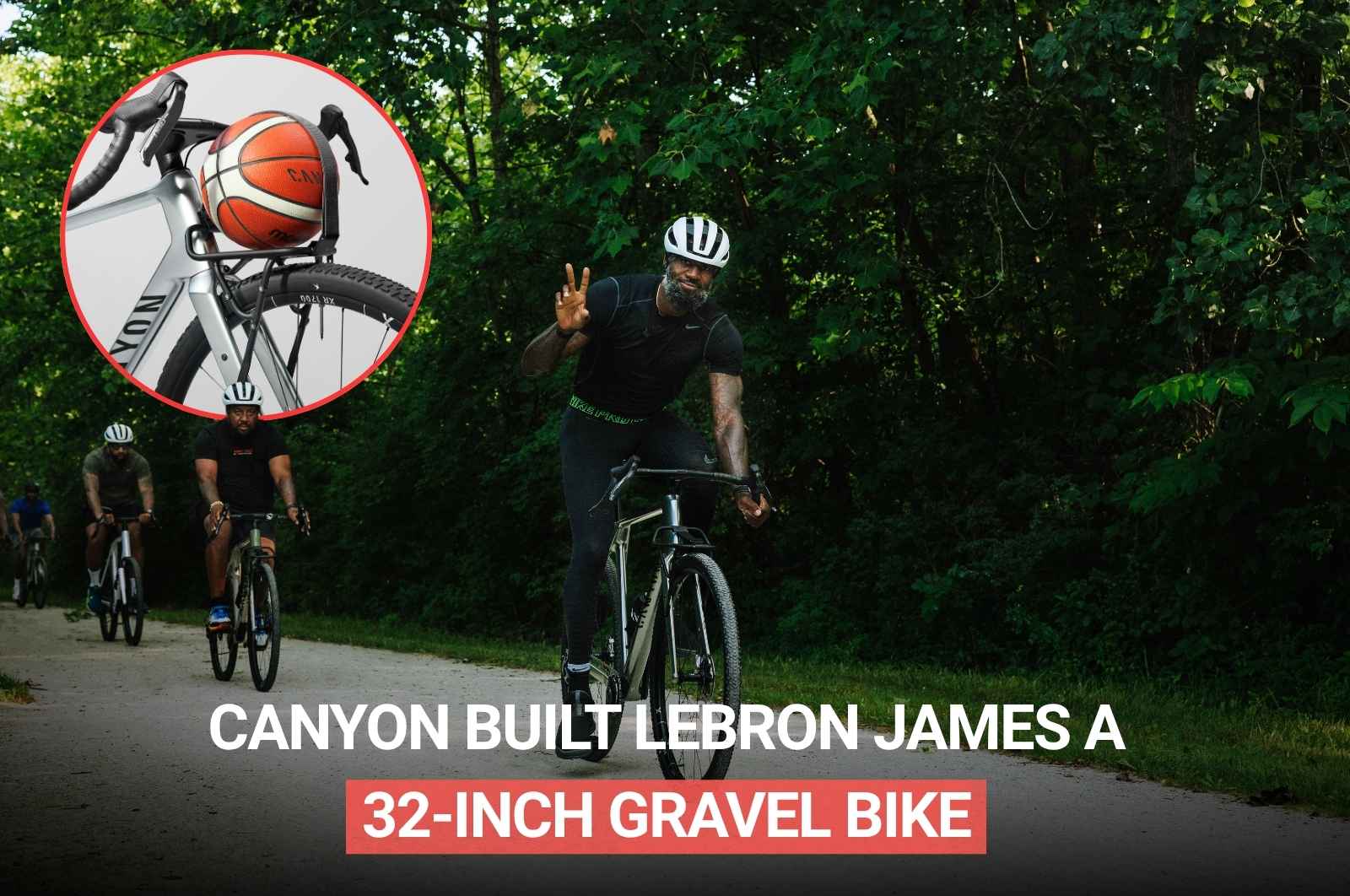
The 32-inch wheel debate has been simmering in gravel for two years. Canyon just committed carbon layup R&D to it and handed the first bike to a 6'9" NBA icon.
He rode it that same day in Akron, Ohio, alongside his old Fab Five high school teammates.
The internet did what it always does with celebrity bikes. It gawked at the size, laughed at the wheels, and moved on.
That reaction misses the actual story. Canyon is the first mainstream carbon brand to publicly commit engineering budget to 32-inch wheels.
The bike is the announcement. LeBron is the megaphone.
Every serious framebuilder in gravel has been quietly moving in this direction for eighteen months. Canyon just made it impossible to ignore.
What Canyon Actually Built
The bike is a full ground-up carbon project, not a stretched 2XL. Wolfgang Kohl, Canyon's lead engineer for gravel, was blunt about why.
"The geometry might land in the right place, but the loads don't scale the way the dimensions do," Kohl told press at the reveal.
"Everything needed to get re-engineered or the bike simply wouldn't function as a responsive system to the rider."
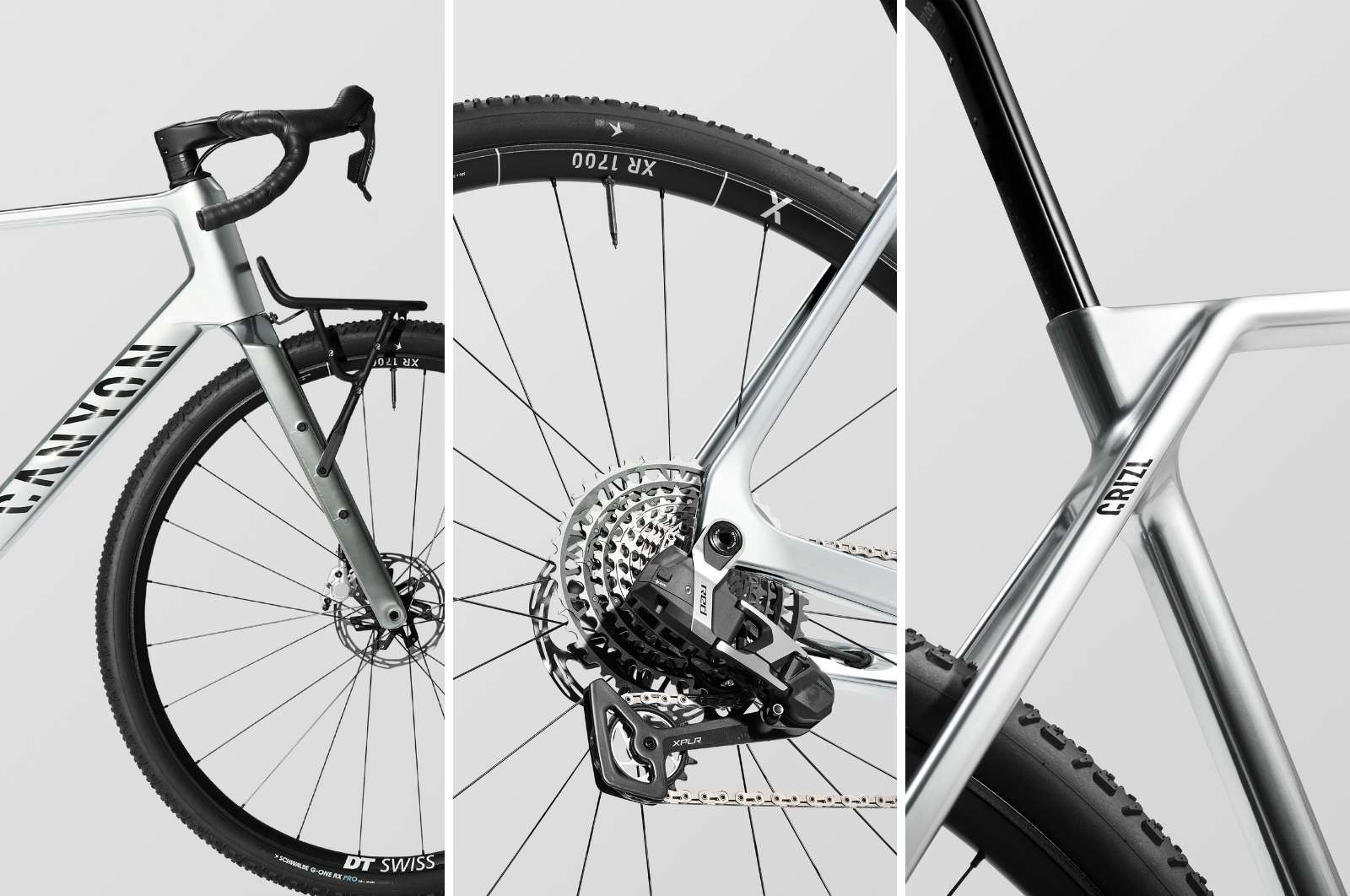
The spec reads like a shopping list of components that don't exist off the shelf. DT Swiss XR1700 32-inch prototype wheels, wrapped in Schwalbe G-ONE RX tires.
The drivetrain is SRAM RED AXS XPLR with a 38T chainring and 10-46T cassette. Custom CNC-machined thru-axles handle boost spacing.
There is a custom seat clamp. And a new carbon layup designed to handle the loads a 6'9", 250-pound rider puts through a frame.
The geometry is genuinely new. 625mm seat tube, 642mm top tube, 680mm stack, 470mm reach, 476mm chainstays, 1,201mm wheelbase, 71.2-degree head tube angle.
Canyon's largest production Grizl tops out at 2XL. Even that comes nowhere near these numbers.
Why This Isn't a Vanity Project
Canyon could have taken the easy road. Scale an existing 2XL up, throw on a longer seatpost, call it custom, ship it.
They didn't. And the reason they didn't is the real news.
Bikerumor* noted the same thing in its coverage. *The bike was a test bench.
Canyon used the LeBron project to prototype construction processes it plans to apply across future production runs, at both the pro and consumer level. LeBron gets the bike, Canyon gets the R&D dataset.
That is how quiet industry pivots start. One high-profile custom project, a carbon layup that works, a geometry file that validates.
Then the layup gets refined. The geometry gets scaled down to fit real riders.
Eighteen months later there is a production 32-inch Grizl in the catalog next to the 700c one.
The Broader Signal: 32-Inch Just Went Mainstream
Zoom out. The context around this bike matters more than the bike itself.
At Sea Otter 2026 in April, 32-inch wheels were the story. Multiple brands showed prototypes.
Vittoria displayed a 32 x 2.4-inch Peyote tire. Industry Nine showed carbon hoops.
Bike Ahead Composites was already supplying wheelsets to unnamed brands for prototype testing.
At MADE 2026 in Portland in August, the show floor had three production-ready 32-inch gravel bikes. Mosaic's GT i55 32 in titanium launched with Zero Components' new 32-inch fork.
Salsa's Fargo 32 shipped in steel and titanium, sized small through extra-large. Salsa targets riders from 5'2" to 6'7" without toe overlap.
Rare Earth Cycle's aero 32-inch bike debuted with Berd's Sparrow 50 Gold deep-dish rims. Three brands, three production-ready platforms, one show.
The racing side has receipts too. Felix Stehli won a stage of the 2026 Absa Cape Epic in March riding 32-inch wheels.
Not a demo lap. A stage win.
Pictures from Canyon
What This Means for Buyers in the Next 24 Months
Here is the honest read.
32-inch wheels are not going to replace 700c. They will not be the default gravel setup by 2028.
Most riders will be on 700c or 650b for the foreseeable future. The geometry, the tire ecosystem, and the price point all favor the incumbents.
But 32-inch is now a real category, not a fringe experiment. Expect one of the big four (Trek, Specialized, Giant, Cannondale) to launch a production 32-inch gravel platform inside eighteen months.
Expect the tire options to double by mid-2027. Expect the price premium to shrink from "boutique" to "expensive but reasonable" by 2028.
The riders who benefit first are the ones for whom 700c never really worked. Tall riders over 6'3" who have spent years on frames that were geometrically compromised.
Bikepackers and adventure riders who value rollover on rough surfaces more than they value low weight. Racers on genuinely rough parcours where the momentum advantage on obstacles outweighs the modest weight penalty.
For a mid-height rider on smooth-to-moderate gravel, the picture is different. 700c remains the smarter buy.
Better tire selection. Better frame selection.
Better resale, and cheaper by a meaningful margin.
Where 32-Inch Still Falls Short
The wheel size is not without real tradeoffs. Canyon's engineers are the first to admit it.
Tire options are still scarce. As of September 2026, you can count the production 32-inch gravel tires on two hands.
Schwalbe, Vittoria, and a handful of specialists cover the current market. That is a fraction of what is available in 700c.
Frame availability is worse. Outside a small pool of boutique builders, Salsa, Mosaic, and now Canyon's one-off, there is nothing to buy.
That will change, but not this year.
Weight goes up. A larger diameter wheel with a longer spoke length carries a real weight penalty.
Berd's approach on the Rare Earth build (using deep-dish rims to keep spoke length closer to 700c) is a workaround, not a free lunch.
Lateral stiffness is harder to engineer. Larger wheels twist more under load.
Every 32-inch builder is solving this problem. The solutions are not equally good yet.
What LeBron Actually Said About the Bike
The quote most outlets buried is the one that matters.
"On most bikes I've ridden, I was aware of the bike, where it didn't fit me, what I was working around," James told Canyon at the reveal.
"This is the first one that I didn't have to think about. That's what I love most about riding."
That is not a paid endorsement quote. That is a rider describing what proper fit feels like for the first time.
And it is the argument for 32-inch wheels in one sentence. Delivered by the tallest rider in mainstream cycling.
The Statement Canyon Just Made
Canyon did not have to build this bike. They have a wildly successful 700c Grizl.
Their production pipeline is stretched. The 3XL project cost real money and delivered zero units for sale.
They built it anyway. They wanted the data, the story, and the position.
The data: a validated 32-inch carbon layup they can iterate on.
The story: a global-scale announcement piece that will run in every cycling outlet on earth.
The position: first mainstream carbon brand publicly committed to the standard.
Trek, Specialized, and Giant were reportedly holding fire until the ecosystem matured. Canyon just moved the ecosystem forward by six months.
The response now sits with the big four. The gravel wheel-size debate is not over, it just moved into its next phase.