New research reveals that the vast majority of cyclists are using the wrong tyre pressure, sacrificing speed, grip, and comfort for an old myth. We dive into the science of rolling resistance to show you why softer is actually faster.
Most of us have a pre-ride ritual that is as ingrained as filling our water bottles or checking the weather.
We walk over to the bike, attach the track pump, and push the needle until it hits a nice, high, round number.
For decades, the logic has been simple and seemingly intuitive. If the tyre is hard, it must roll faster. If it is soft, it must drag.
We have been conditioned to believe that rock-hard tyres are the secret to free speed.
We look at the smooth boards of a velodrome and assume the physics on the open road are exactly the same. But we are wrong.
In fact, if you are inflating your tyres based on "feel" or the maximum PSI printed on the sidewall, you are almost certainly part of the 98% of cyclists who are sacrificing speed, comfort, and grip with every pedal stroke.
The science of rolling resistance has undergone a revolution in the last ten years.
What we thought we knew about friction and energy loss has been overturned by real-world testing. It turns out that the "harder is faster" rule is not just slightly off.
In many cases, it is completely backwards.
The Old School Myth of High Pressure
To understand why we get it wrong, we have to look at where the belief comes from. On a perfectly smooth surface, like a glass table or a wooden track, a harder tyre does deform less.
Less deformation means less energy is lost to the internal friction of the rubber casing.
This is known as hysteresis.
Hysteresis is the energy lost as heat when the tyre rubber stretches and relaxes as it rolls.
When you pump a tyre to 120 PSI on a glass-smooth surface, you minimize the size of the contact patch.
The tyre keeps its round shape, the rubber barely flexes, and you roll efficiently.
This laboratory physics formed the basis of cycling wisdom for generations.
Riders in the Tour de France used to run 21mm or 23mm tyres inflated to 110 PSI or more. We all copied them.
We assumed that if we could feel every pebble in the road, we were connected to the tarmac and transferring power efficiently.
The problem is that the real world is not a glass table.
The road is full of imperfections, cracks, chip seal, and debris. When a super-hard tyre hits these imperfections, the physics change entirely, and a new force comes into play that slows you down faster than hysteresis ever could.
The Science of Impedance and Vibration
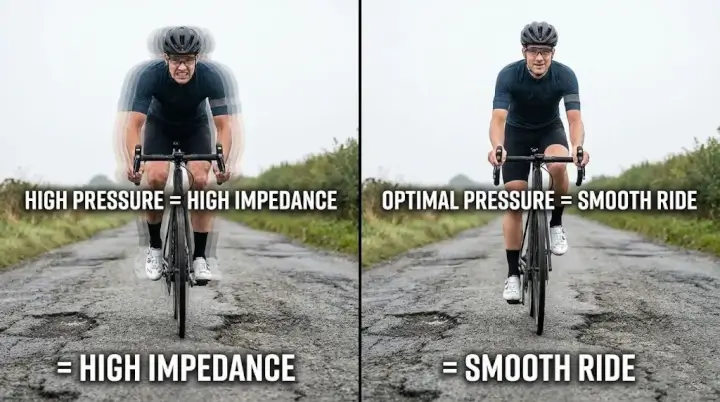
When an over-inflated tyre hits a bump, even a microscopic piece of gravel, it cannot deform around it. Instead, the entire bike and rider are lifted upwards.
This vertical movement requires energy.
That energy has to come from somewhere, and it comes from your forward momentum.
This phenomenon is called impedance loss or suspension loss.
When your bike vibrates or bounces over rough tarmac, you are effectively wasting watts to shake your body.
Trustworthy research from industry leaders like Silca has shown that at a certain point, increasing tyre pressure stops making you faster and starts making you significantly slower.
They call this the "tipping point."
Before the tipping point, adding air reduces casing friction (hysteresis) and you get faster.
But once you cross that threshold, vibration losses (impedance) skyrocket.
The penalty for being too high is much steeper than the penalty for being too low. If you are 10 PSI under optimal pressure, you might lose a watt or two to rubber friction. If you are 10 PSI over, you could be losing 10 to 20 watts as your bike chatters over the road surface.
Josh Poertner, the CEO of Silca and a former technical director for pro cycling teams, has published extensive data on this.
You can read more about their findings on the science of rolling resistance here.
Why "Fast" Feels Slow
One of the biggest hurdles to getting tyre pressure right is the human brain. We are terrible at judging speed by feel. High-frequency vibration feels fast to us.
When the bike is buzzing beneath us, our sensory input tells us we are flying. It feels energetic and race-like.
Conversely, a tyre at optimal pressure absorbs that buzz.
The ride feels muted, smooth, and sometimes even "draggy" because the high-frequency feedback is gone. It is a counter-intuitive sensation.
You might feel like you are going slower because the ride is comfortable, but the power meter and the stopwatch tell a different story.
This placebo effect is why 96% of riders get it wrong. We prioritize the sensation of speed over the reality of speed.
We pump our tyres up until they feel fast, which usually puts us squarely in the "high impedance" zone where we are bleeding watts.
The Role of Tyre Width
The tyre pressure conversation is impossible to have without discussing tyre width.
The trend toward wider tyres (28mm, 30mm, and even 32mm for road bikes) is directly linked to the science of pressure.
A wider tyre has a shorter, wider contact patch compared to the long, skinny contact patch of a narrow tyre.
This shape causes less deformation in the casing for the same pressure, meaning a wider tyre can be run at a lower pressure without increasing rolling resistance from hysteresis.
Because you can run the wider tyre softer, you gain the benefits of suspension. The tyre can absorb the road chatter, keeping your momentum moving forward rather than vibrating up and down.
Independent testing sites like Bicycle Rolling Resistance have confirmed this in controlled environments.
They consistently find that wider tyres at lower pressures often match or beat narrow, high-pressure setups in efficiency, while destroying them in comfort and grip.
It is not just about watts. Over-inflation is a safety hazard. A rock-hard tyre has a smaller contact patch with the road.
This means you have less rubber gripping the tarmac when you lean into a corner or slam on the brakes.
If you are descending a mountain pass and hit a patch of rough pavement mid-corner, an over-inflated tyre is more likely to skip and lose traction.
A softer tyre will conform to the surface, maintaining grip and keeping you upright.
Furthermore, rider fatigue is a real performance killer. If your body is absorbing road vibration for four hours, your muscles fatigue faster.
Lower tyre pressure acts as micro-suspension, saving your energy for the pedals rather than stabilizing your core against the road buzz.
How To Calculate Your Perfect Pressure
So, how do you fix it?
The days of "100 PSI for everyone" are dead. Your optimal pressure depends on five key variables:
Total System Weight: Rider + Bike + Gear.
Tyre Width: Measured width (which often differs from what is printed on the box).
Rim Width: Wider rims increase the effective volume of the tyre.
Road Surface: Fresh tarmac requires higher pressure; chip seal or gravel requires lower.
Construction: Tubeless tyres can run lower pressures safely without pinch flatting.
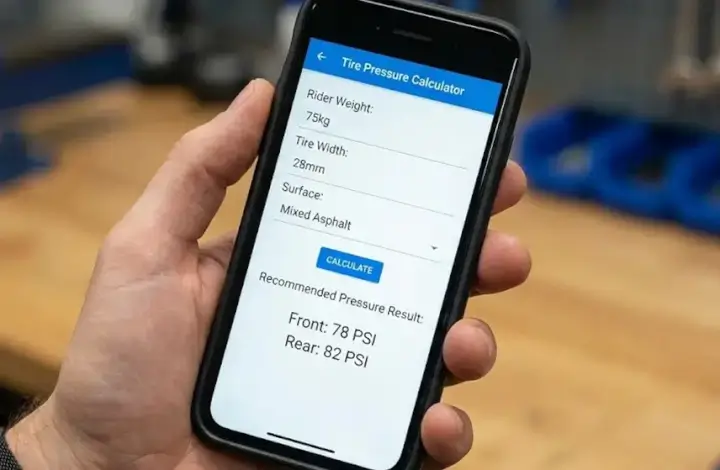
You do not need to guess. There are excellent free calculators available that use the algorithms developed from the testing mentioned above.
One of the best resources is the SRAM AXS Tyre Pressure Guide. It asks for your specific riding style and equipment to give a precise recommendation. You can try it here.
A Practical Example
Let us look at a typical scenario to see how drastic the difference is.
Consider a 75kg (165lb) rider on a 8kg road bike. They are riding 25mm tyres on standard roads.
The Old Way: They pump to 110 PSI (7.5 bar) because that is what their dad did.
The Right Way: According to the calculators, they should be running approximately 85 PSI (5.8 bar) on the rear and 80 PSI (5.5 bar) on the front.
If that same rider switches to modern 28mm tubeless tyres, the optimal pressure drops even further, likely to around 60-65 PSI. To a traditionalist, 60 PSI sounds like a flat tyre.
To a scientist, it sounds like the fastest, most comfortable setup possible.
Take Control of Your Ride
Understanding tyre pressure is just the first step in becoming a more self-sufficient and confident cyclist.
There are dozens of other simple maintenance tasks that can dramatically improve your bike's performance and save you a fortune in shop fees.
If you are tired of waiting for appointments at the local bike shop for simple fixes, it is time to take matters into your own hands.
With over 200 detailed, step-by-step videos covering everything from fixing a flat to adjusting your gears, it is the ultimate resource for cyclists who want to master their own maintenance.
It's like having a professional mechanic right there in your workshop with you.