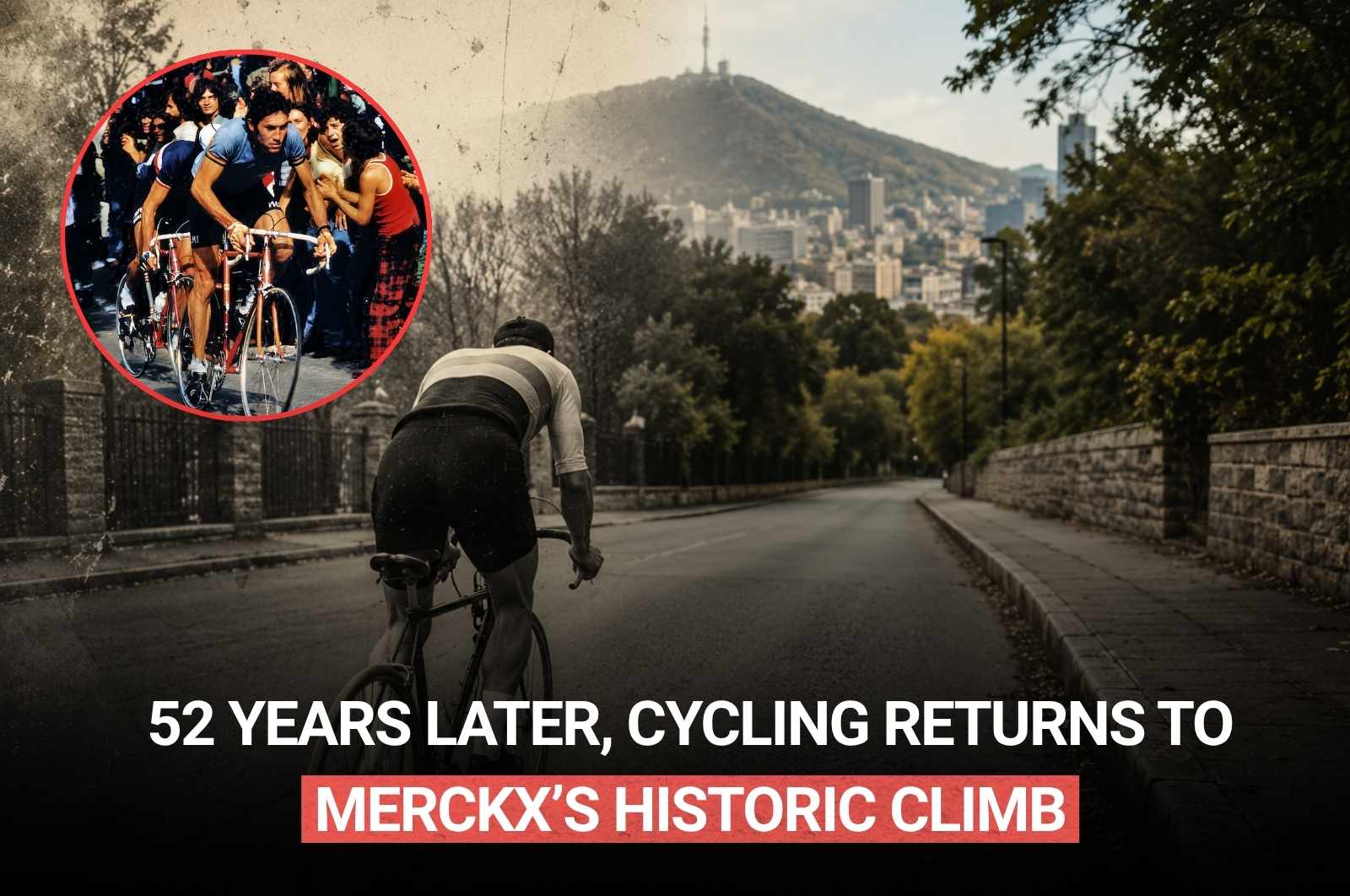
The first UCI Road World Championships held outside Europe. Fifty-two years later, the same climb, the same city, and a defending champion from thirty minutes down the road.
On August 25, 1974, Eddy Merckx rode away from the peloton on the Cote Camillien-Houde and won the road world championship on Mont Royal.
It was the first UCI Road World Championships ever held outside Europe. It was the first Worlds in North America.
And on the same afternoon, French rider Genevieve Gambillon won the women's road world title on the same circuit.
Fifty-two years later, cycling comes back.
The 2026 UCI Road World Championships run September 20 to 27 in Montreal. The road races finish on the same Mont Royal circuit.
The defending women's champion, Magdeleine Vallieres Mill, grew up an hour and a half from that finish line.
This is not a coincidence dressed up as a headline. It is one of the cleanest historical circles cycling has ever drawn.
What Happened on Mont Royal in 1974
Cycling's world championships had been held in Europe every year since 1927 (with wartime pauses). Sending them to Canada was, at the time, a genuine leap.
The Mont Royal circuit chosen for the 1974 races was hilly, technical, and used the same Camillien-Houde ascent that will decide the 2026 races. It was designed to reward puncheur-climbers, and it did.
Merckx, 29 years old and in his last full season as a dominant Grand Tour rider, took the men's title on a circuit that rewarded exactly his profile. It was his third road world championship (he had also won in 1967 and 1971).
Gambillon, then 23, took the women's race with an equally decisive move on the same terrain.
Both winners crossed the line at the top of a course that looks, on a map, almost identical to the one that will decide the 2026 Worlds.
The Leap the UCI Made
The decision to send Worlds outside Europe was, in 1974, controversial. Cycling was European.
Teams were European. The audience was European.
The Montreal experiment worked. It also opened the door for future non-European Worlds: Colorado Springs in 1986, Sicily in 1994 (technically Europe but far from the traditional heartland), Hamilton in 2003, Melbourne in 2010, Doha in 2016, Innsbruck 2018, Yorkshire 2019, Wollongong 2022, Kigali 2025.
None of those subsequent Worlds carried the same first-mover weight as Montreal 1974. And none until now has returned to a venue that already hosted a Worlds.
The 50-Year Anniversary Stack
The 2026 Worlds sit on top of two anniversaries, not one. It is 52 years since Merckx and Gambillon won here.
It is also the 50th anniversary of the 1976 Montreal Olympic Games, which used many of the same city venues and turned Montreal into an international sports capital for a generation.
Organizing committee general manager Joseph Limare called the 2026 event "the largest sporting event to return to the city since" the 1976 Games.
The city seems to agree. Montreal 2026 has been building infrastructure legacy into the event from the start: new bike lanes along the St. Lawrence for the time trial course, permanent barriers on Camillien-Houde, and a Zwift-loadable version of the Mont Royal circuit released free to the public six months out.
The Roads That Have Not Changed
The asphalt has been repaved several times since 1974. The traffic patterns have shifted.
The trees are taller.
But the road profile is essentially the same. Camillien-Houde still climbs from the Parc du Mont-Royal at roughly 6.2% for 2.3 km.
The Polytechnique kicker still has sections above 11%. The finish still comes on Avenue du Parc, the uphill false flat that decided the 1974 races the same way it will decide the 2026 races.
The physiological demand is the same. The tactical demand is the same.
The road that made Merckx work for his third rainbow jersey is the same road that will decide Pogacar's attempt at a third.
The Present-Day Rider Who Makes It Sing
History is only interesting when it walks back into the present. In 2026, it does that in the person of Magdeleine Vallieres Mill.
Vallieres Mill is Canada's first ever elite road world champion, having won in Kigali in September 2025. She defends her title on the Mont Royal circuit on September 26.
She has ridden Camillien-Houde since she was a junior at the Jeux du Quebec.
"I grew up watching the Grands Prix Cyclistes de Quebec et de Montreal," she told Canadian Cycling Magazine. "That was the first race I followed as a kid. To race there, and with the rainbow jersey, is something special."
Fifty-two years after Merckx won a road worlds on Mont Royal wearing the rainbow jersey he had won the year before, a Canadian will start on the same circuit wearing hers. That is not a coincidence.
It is the historical arc closing on itself.
What Merckx Himself Has Said
Merckx, now 81, remains one of cycling's most-quoted living figures. He has spoken publicly and often about his connection to Canada.
In interviews around the 2026 Worlds announcement, he was reported as calling the return "long overdue" and expressing hope that a Canadian could win at home.
That Canadian now exists. That home now includes a rainbow jersey.
The story that Merckx opened in 1974, Vallieres Mill has a chance to close in 2026.
The Roll of Honour That Would Change
The list of three-time road world champions is short: Alfredo Binda, Rik Van Steenbergen, Eddy Merckx, Oscar Freire, Peter Sagan. Five riders in cycling's history.
That symmetry is worth noting. Merckx was crowned a three-time world champion on the exact circuit where Pogacar could become one. Fifty-two years between the two rainbow jerseys, decided on the same climb, in the same city, by the two riders their eras respectively canonised as the greatest of all time.
If Pogacar wins on September 27, the roll of honour gets one name longer. And that name gets added on the same road where Merckx's name was carved in 1974.
The Circle That Closes on September 27
But before that milestone, cycling gets one clean historical convergence in Montreal. Same city, same climb, same finish line.
Fifty-two years apart, and closer in structure than any two Worlds courses have any right to be.
Merckx won on Avenue du Parc on August 25, 1974. Whoever crosses that same line first on September 27, 2026, will inherit a story cycling has been quietly waiting half a century to finish.
Some races are ridden. Some are simply completed.