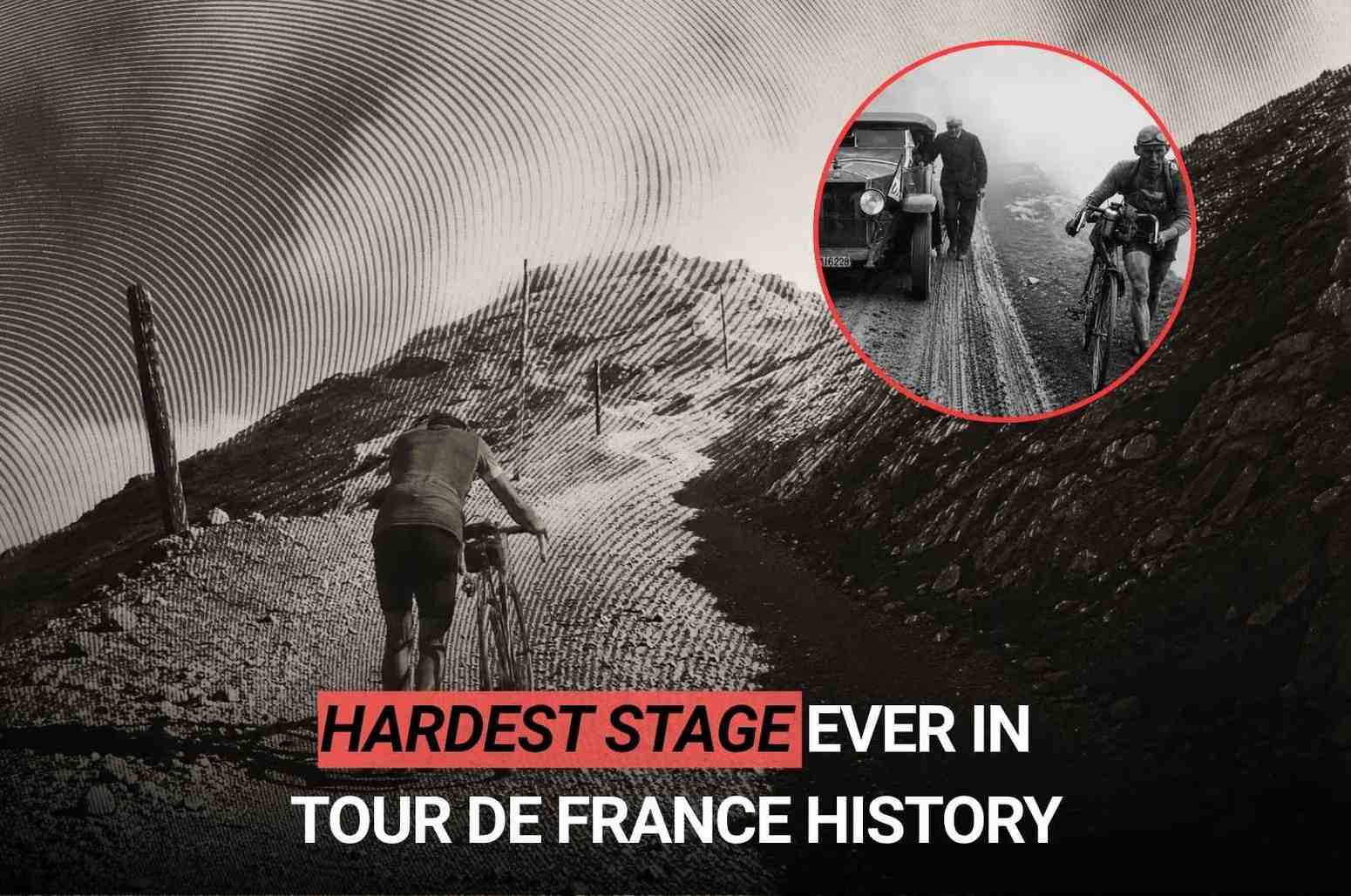
Stage 16 rolls out of Evian today, exactly 100 years after the town hosted the longest Grand Départ in Tour history: 5,745km, 17 stages, and a survival rate of 33%.
Today, stage 16 of the 2026 Tour de France rolls out of Evian-les-Bains.
It is 26km against the clock. Down to Thonon-les-Bains and back.
The riders will spend maybe half an hour on the road, at an average of 50km/h, on tarmac so smooth their aero helmets whistle over it.
Exactly 100 years ago, on 20 June 1926, 126 men rolled out of the same town for stage one of what would become the longest and most brutal Tour de France ever raced.
The route was 5,745km, spread across seventeen stages.
When it finally finished in Paris on 18 July, only 41 riders were still in the race.
That is a 32.5% finishing rate.
If the 2026 peloton lost riders at the same clip, only about 60 of the 184 who started in Barcelona would make it to the Champs-Élysées.
The ghosts of 1926 are not going to give this year's peloton much sympathy. And it is worth a moment, on the anniversary, to understand exactly why.
The Man Who Chose Evian
Until 1926, every Tour de France had started in Paris. That was tradition.
Henri Desgrange, the race's founder and its notoriously sadistic organiser, broke the pattern that year without ever fully explaining why.
The most persuasive theory involves the Aga Khan, a regular visitor to what was then the fashionable spa resort of Evian, wanting some entertainment laid on for his royal circle.
Whether that is true or apocryphal, the decision had a specific consequence.
Starting the race in the Alps meant riders climbed the mountains of eastern France twice, once at the beginning of the race, once again at the end.
Desgrange was not known for sympathy. He famously decried the invention of the derailleur, describing it as something for the elderly, and did not allow its use in his race until 1937.
He also started stages in the dark and cold hours before dawn, and levied penalties for anyone who dared take off a jersey when the sun came up.
The 1926 vs 2026 Ledger
The clearest way to feel the gap is to line up the numbers.
Total race distance
1926: 5,745km.
2026: 3,333km.
The modern Tour covers 58% of the 1926 distance. A century ago, riders essentially raced a modern Tour and a half, back to back.
Number of stages
1926: 17.
2026: 21.
Fewer stages, longer distance, no rest days worth speaking of.
The 1926 average stage was 338km. The 2026 average is around 159km.
Longest single stage
1926: Bayonne to Luchon, 326km. Four major Pyrenean climbs, including the Aubisque, the Tourmalet, the Aspin, and the Peyresourde.
2026: 209km, roughly. No queen stage exceeds it meaningfully.
That 1926 stage 10 became known as the queen stage of all queen stages. A storm hit the Pyrenees while the peloton was on the road.
Winning time and average speed
1926: winner Lucien Buysse clocked 238 hours, 44 minutes, 25 seconds total race time, at an average speed of 24.06km/h.
2026: expected winning time around 82 hours at an average speed above 41km/h.
Buysse spent about 10 days in the saddle. The 2026 winner will spend about 3.5.
Finishing rate
1926: 41 finishers from 126 starters.
2026: typically over 80% finishing rate in the modern era.
Two thirds of the 1926 field simply did not make it home. Some abandoned, some were eliminated, and some were disqualified for offences ranging from taking outside assistance to skipping a checkpoint.
The Stage That Broke Even Desgrange
On 6 July 1926, the peloton left Bayonne at pre-dawn for the 326km stage to Luchon.
Lucien Buysse was eighth in the general classification, more than 20 minutes down on race leader Gustaaf Van Slembrouck.
On the cards: the Aubisque, the Tourmalet, the Aspin, and the Peyresourde. The four peaks that make up the so-called circle of death.
By dawn on the Aubisque, a Pyrenean storm hit. Riders were pushing bikes through ankle-deep mud, drinking from mountain streams, and stripping wet wool jerseys they were not technically allowed to remove.
Buysse won the stage by more than 25 minutes, took the yellow jersey, and never lost it. The conditions were reportedly so cruel that even Desgrange, the man who had built the race to break riders, was visibly moved to sympathy.
Léon Scieur's Broken Wheel
One 1926-era Desgrange rule tells you almost everything about the era. If a rider broke a wheel, they were required to prove the wheel was genuinely broken before being allowed a replacement.
1921 winner Léon Scieur once had to strap a broken wheel to his back and carry it 300km to the finish.
Only then could officials verify the wheel was legitimately shattered. Only then was his replacement declared legal.
The 2026 rider whose derailleur clicks half a gear off has three neutral-service motorcycles behind them within 90 seconds.
Why Modern Riders Are Not Soft
None of this means today's Tour is easy.
The 2026 peloton faces heat that regularly exceeds 40°C on-road surface temperature, sustained watts at threshold that the 1926 riders could not have generated on their steel-framed 12kg bikes, and a media, doping, and sponsor pressure environment that Desgrange never had to worry about.
The physiological ceiling of a modern GC contender is roughly 6.5 to 6.9 watts per kilogram for extended climbs. Buysse's numbers, as best they can be reconstructed, were probably around 4.5.
So the modern rider is faster, more powerful, and more efficient. But they are also racing on a course cut in half, on tarmac Desgrange would have called cheating, and with recovery science he would have called malingering.
What the Anniversary Actually Marks
The 2026 organisers know exactly what they are doing by rolling out of Evian today.
One hundred years ago, this town watched 126 men set off on the hardest race ever attempted.
Two thirds of them did not make it back.
The one who did, Lucien Buysse, became a Belgian folk hero and a name almost forgotten outside of cycling history books.
When Pogačar rolls down the Evian start ramp today, he will be racing for stage time on a course that is roughly 1.2% the length of the 1926 route.
He will be doing it in about half an hour, on a bike lighter than Buysse's spare tyres, with a support car, a radio, and 42 team-issue bidons waiting at the roadside.
None of that makes his ride easier.
Different tests are still tests.
But if any part of the modern peloton wants to complain about a hot day, a bad hotel, or a 2am doping knock, they should look up at the ghost of Léon Scieur, walking his broken wheel across the Pyrenees, and consider keeping it to themselves.