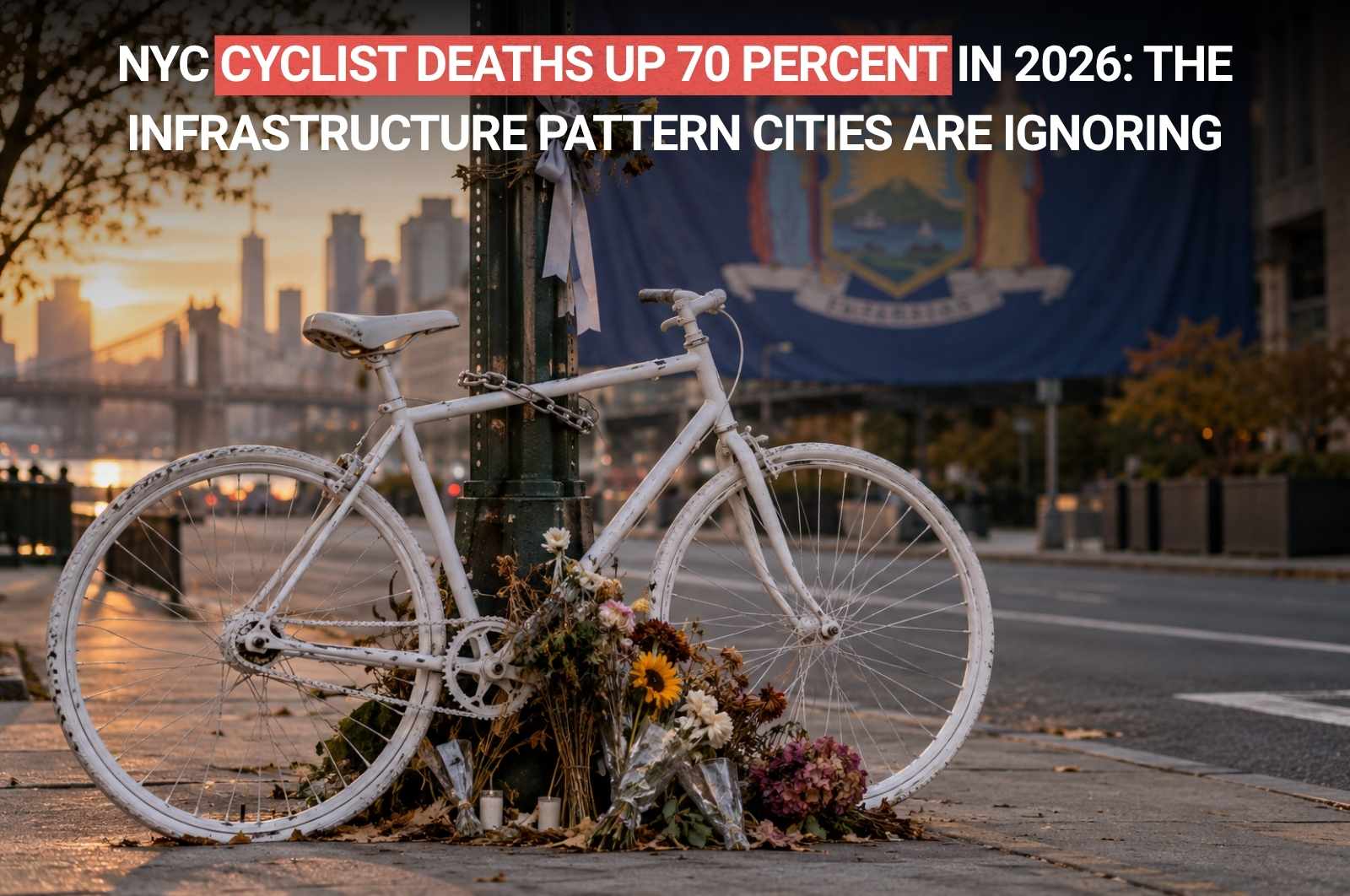
Paulina Tec Choch, Angelo Camara, Mamadou Diallo. Bike deaths in New York are up 70 percent this year.
In one week in August, four hit-and-run drivers killed four people on New York streets. Three of the four were cyclists.
By the end of that week, the year-to-date fatality count had climbed to 17 riders killed, versus 10 at the same point in 2025. That is a 70 percent jump in cycling deaths in the country's largest cycling city, in the same year the mayor's office is rebuilding its Vision Zero programme.
Paulina Tec Choch, Angelo Camara, Mamadou Diallo. Three names, three separate crashes, three drivers who left the scene.
What The Three Crashes Actually Had In Common
Mamadou Diallo was 40 years old. He was attempting a left turn from Avenue I onto southbound East 54th Street in Flatlands, Brooklyn, at 11:49 pm on a Thursday, when an eastbound BMW driver struck him head-on and kept going.
The other two cyclists died within the previous 48 hours, both in hit-and-runs, both on arterial roads without protected bike infrastructure.
The overlap is not random. According to a mid-year analysis from Transportation Alternatives, 10 of the 13 cyclists killed in the first six months of 2026 died on streets without a bike lane. Not without a protected lane. Without any bike lane at all.
That is the number City Hall is not putting on a press release.
The Vision Zero Math That Nobody Argues With Anymore
The Transportation Alternatives report from July covers the specific street-level features that separate a fatal intersection from a survivable one.
The finding is not subtle.
Not a single pedestrian was killed in the first half of 2026 at an intersection with hardened daylighting, meaning curb extensions, planters, or bollards that stop drivers from parking in the sight lines of crossings.
31 pedestrians, 85 percent of the total, died at intersections that lacked daylighting.
The same physics applies to cyclists. A driver who cannot see a rider approaching a corner because a legally parked SUV occupies the last 20 feet of the curb hits that rider.
This is not a theory. It is a repeated pattern in six months of crash reports.
The Political Piece That Makes This Worse
Mayor Zohran Mamdani ran on Vision Zero. He backed universal daylighting during the campaign. He rides a bike to work.
Since taking office, his transportation department has committed to daylighting at roughly 500 of New York's 40,000 intersections. That is 1.25 percent.
The city's own reasoning, as reported by Gothamist, is that reducing parking near corners "actually makes them less safe." That framing directly contradicts the Transportation Alternatives data on the 85 percent pedestrian fatality distribution, and it directly contradicts Mamdani's own campaign position.
Something happened between the campaign and the desk. The most likely explanation is the one City Hall will not name: parking constituencies vote, and dead cyclists do not.
What The Numbers Actually Say
Read the numbers. Then compare them with what the Department of Transportation is publicly funding.
The report's core finding is that 86 percent more bike riders were killed in the first six months of 2026 than in the same period of 2025. It is one of the sharpest year-over-year cycling fatality spikes in New York since Vision Zero began.
Three thousand people have now died on New York streets since the city launched Vision Zero in 2014. Ex-mayor Bill de Blasio pledged to get to zero by 2024. The 2024 fatality count was 250-plus.
Why This Is A National Story, Not A New York One
New York has the country's most granular crash-reporting apparatus, its most organised advocacy pipeline, and its most public political fight over street design. It is the one city where the specific relationship between arterial road geometry, daylighting, protected bike infrastructure, and cyclist survival is being measured in real time.
Every other US city is running the same experiment with less data.
The 1,155 US cyclist deaths in 2023 reported by the National Highway Traffic Safety Administration were up 5 percent year over year.
Bicyclist deaths accounted for 2.8 percent of all US motor vehicle traffic fatalities. Those numbers do not reveal the infrastructure geography that New York's Transportation Alternatives data reveals, because most cities do not measure it.
What New York's numbers strongly suggest, and what quiet cycling infrastructure advocates have been saying for a decade, is that road design accounts for more of the cyclist fatality gap than driver behaviour does.
The driver who hit Mamadou Diallo made a choice.
The road that made that crash possible was designed.
Both facts are true. Only one of them is being addressed.
The Argument That Keeps Cyclists Alive Elsewhere
Hoboken, New Jersey has gone seven years without a traffic fatality. Its population is roughly 60,000 and its street network is dense.
What it did differently was daylighting at every intersection, protected bike infrastructure on arterials, and 25 mph speed limits enforced with automated cameras.
Helsinki, Oslo, and Hoboken are the three cities Transportation Alternatives cites in its report as the working models.
None of them are running fundamentally different technology than New York. They are running fundamentally different road geometry, enforcement priorities, and speed limits.
What This Actually Means For Cyclists Reading This
If you ride in a US city, the specific pieces of infrastructure that raise or lower your survival odds are, in rough order:
Protected bike lanes, meaning physical separation from traffic, not painted lines. Daylighted intersections, meaning no parking within 20 to 25 feet of a crossing. Speed limits under 25 mph on the roads you are most likely to encounter drivers on.
None of these are things individual cyclists can add to their commute. All of them are things city councils can, and are largely not.
The nine essential cycling rules for safer roads still matter. Wearing a helmet, running lights front and rear, taking the lane where the geometry demands it, those are the parts you control. What kills the cyclists in the Transportation Alternatives data is not the parts they controlled. The Question Nobody At City Hall Wants To Answer
Mayor Mamdani has been in office for eight months.
In that time, the city's cyclist fatality rate has climbed roughly 70 percent. The mayor's transportation department has publicly walked back universal daylighting. Its Vision Zero Reimagined action plan runs to 100-plus pages of goals and commits to daylighting at roughly 1.25 percent of intersections.
Ben Furnas of Transportation Alternatives put the question directly in the mid-year report. His words, not ours: "Where is Mayor Mamdani's Vision Zero plan?"
Two months after that question was asked, it still does not have an answer.
What Cycling Cities Are About To Learn
The pattern of the last month is that the cycling press will cover cyclist deaths individually. The names, the ages, the crash locations, the neighbours' quotes.
That is not a full accounting.
The full accounting is the sentence buried in a report almost nobody has read: 10 of 13 cyclists killed in the first half of 2026 died on streets without a bike lane. That is a policy failure, not a driver-behaviour story. Every American city with a rising cyclist fatality rate is running the same failure.
The lesson from New York is not that cyclists need to be more careful.
The lesson is that road design accounts for who lives.