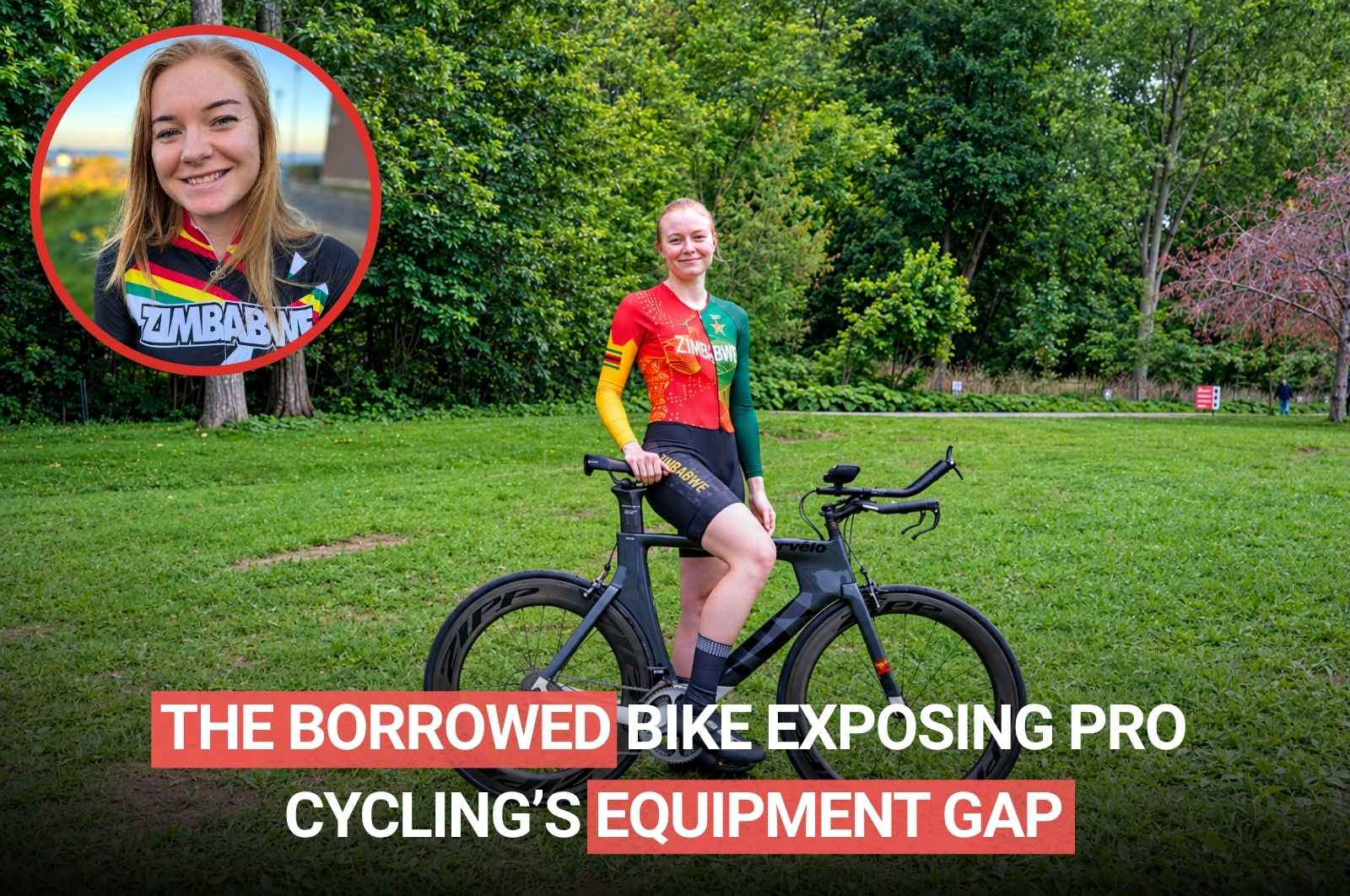
The World Championships officially started with her. Then everyone else showed up on frames worth more than her country's federation budget.
Media Credit : Anne-Marije Rook
The 2026 UCI Road World Championships officially opened at 9:19:30 local time in Montreal, when Skye Davidson rolled down the start ramp. She was the first rider in a field of 48.
She was also riding a bike that broke the day before.
Not her bike. Her bike snapped during course recon on Saturday.
What she raced on Sunday was a 2015 Cervelo P3 borrowed from Zimbabwe team manager Nathan van Vuuren, complete with rim brakes, mechanical Shimano Dura-Ace, Profile Design clip-on aerobars, and a size that did not quite fit her.
That is the bike that opened the World Championships.
The Numbers On What She Was Actually Riding
The Cervelo P3 was a serious TT machine in 2015. Zipp 404 front, Zipp 808 rear, Pirelli P Zero tyres. It won plenty of races in its era.
That era ended a decade ago.
The current WorldTour TT bike costs roughly $18,000 to $22,000 fully specced, uses disc brakes, electronic shifting, integrated cockpits, and CFD-optimised tube shapes that did not exist when Davidson's borrowed frame was built.
Aero wind tunnel testing suggests roughly 20 to 40 watts of drag saved between a 2015 rim-brake TT bike and a 2025 disc-brake equivalent at 45 km/h. Over a 39.9 km course with 195 metres of elevation, that gap is not cosmetic.
That is a 90 second to 3 minute headline number, before the size mismatch is even factored in.
Who Skye Davidson Actually Is
Davidson is a multi-time Zimbabwean national road race and time trial champion. She rode for the University of Edinburgh cycling team while studying astrophysics.
She had not raced a time trial in a couple of years before Sunday.
She still lined up. She still opened the biggest bike race in the world.
Her post-race comments, reported by Cycling Weekly, were the opposite of self-pity. On starting first, she said it "kind of removes all of the pressure." On the motorbike lead, she said it was "quite nice." On the technical opening, she said the temptation was to attack too aggressively into the corners.
That is the voice of a rider who understood exactly what she was doing on Sunday morning.
The Equipment Gap Nobody At The UCI Wants To Name
This is the part where the story stops being about one Zimbabwean rider and becomes about pro cycling's actual structure.
Cayman Islands sent Alyssa Burgess, Kenya sent Monica Kiplagat, Iran sent Sajedeh Siyahian, Saudi Arabia sent Mishael Alhazmi. Behind them: Indonesia, Bulgaria, Estonia, Rwanda, Mexico.
The first twelve riders down the start ramp on Sunday came from federations that do not have a full WorldTour equipment sponsor between them.
Then the WorldTour teams' national champions started rolling. Reusser last, on a Cervelo P5 Disc with the Swiss federation's full support.
Vollering second-last, on the same generation of equipment. Backstedt, Kopecky, Longo Borghini, Faulkner, all on current-generation kit tuned for that specific 39.9 km course.
The gap between the front of the start list and the back is not a fitness gap. It is a funding gap, an equipment gap, and a development gap the UCI has spent two decades quietly not fixing.
The Nine-Year-Old Bike Is The Story
Cycling Weekly buried the equipment detail in a colour piece. The rest of the mainstream cycling press did the same, treating it as a charming footnote.
It is not charming.
A rider from a country with a real cycling tradition, a former WorldTour development program alumna, an astrophysics graduate racing at the highest level her federation can send her to, raced Worlds on a decade-old borrowed bike a size too big because her own bike had failed in course recon less than 24 hours earlier.
That is what pro cycling's participation model looks like at ground level.
What Actually Fixes This
The obvious answer is money, and the obvious answer is wrong on its own.
The UCI runs a Solidarity programme.
It has funded a track cycling centre in Aigle, a training base in South Africa, junior development squads across Africa and Asia.
What it has not done is fund race-day equipment access for federations whose riders qualify for Worlds without a WorldTour equipment sponsor behind them.
A pool of current-generation TT bikes, held in Aigle or at each Worlds venue, sized and fitted for riders from smaller federations, would cost the UCI less than one round of ProSeries hosting fees.
It has not happened because nobody at the top table has publicly asked why it has not.
Where This Goes Next
Davidson's Worlds are not over. She races the women's elite road race on Saturday, 26 September, on the same 180.1 km Brossard course the WorldTour riders will contest.
The Cervelo P3's Worlds are not over either. The bike is scheduled to make another appearance in the junior men's time trial, according to Cycling Weekly's reporting.
One bike, two riders, two Worlds appearances, both from a federation whose entire equipment budget for a Worlds week runs shorter than the retail price of a single current-generation team bike.
The Statement Cycling Just Made
The UCI has spent the last three seasons talking about safety, about the sport's professionalisation, about closing the men's and women's competition gap.
The first rider on the start ramp at the 2026 World Championships opened the meet on a 10-year-old borrowed bike. She did it with more grace than most WorldTour riders show after a bad Sunday.
That is a statement about pro cycling's participation model, and the sport did not make it. Skye Davidson did.
The next question is who at the UCI is going to answer it.