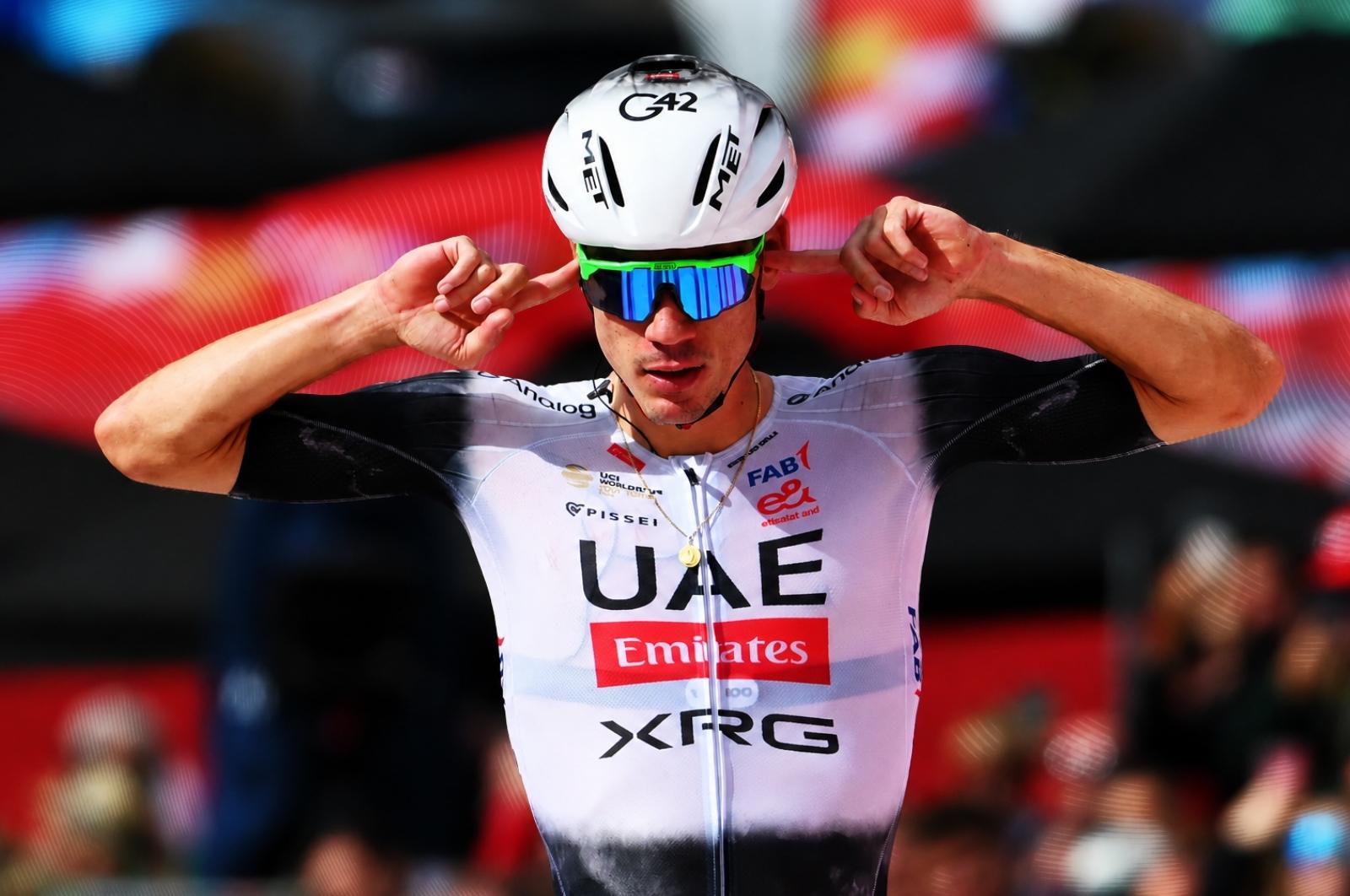
At 23. A Vuelta podium finisher. A rider with the biggest team in cycling. And a departure that says more about the sport's direction than his own.
Picture from Tim de Waele/Getty Images
Juan Ayuso was 23. He had a contract with the best team in cycling.
He had a stage win at the Giro d'Italia, a Vuelta a Espana podium in 2022, and a resume already deeper than most riders manage in a decade.
He also had a public falling-out with UAE Team Emirates XRG that escalated across the 2025 season and became one of the sport's defining transfer stories.
Lidl-Trek signed him anyway.
That signing tells a bigger story than one 23-year-old moving teams. It says something about where professional cycling as a business is heading.
And, quietly, about how much it is starting to look like the NBA.
The Departure That Started It
Ayuso's UAE Team Emirates XRG exit was fractious from the outside and reportedly worse from the inside.
The team took issue with his post-race comments, his contract demands, and reportedly, at times, his relationship with Tadej Pogacar and team leadership. Ayuso, for his part, spoke publicly about wanting to lead Grand Tour campaigns rather than serve as second option to Pogacar. By the end of 2025, the split was announced. Contract terminated.
Ayuso free to negotiate. The cycling media described it as the most consequential team-rider breakdown since the Bradley Wiggins-Chris Froome era at Team Sky in 2012.
That comparison is instructive. Wiggins and Froome had the same problem: two riders capable of winning the Tour de France, one team, one leadership slot.
Why Lidl-Trek Said Yes
Lidl-Trek is not the biggest team in cycling. It is the team most transparently trying to become the biggest.
The signing of Jonathan Milan in 2024 delivered a green jersey Tour de France sprinter. The signing of Mads Pedersen delivered a Classics engine.
The signing of Elisa Longo Borghini to the women's roster delivered a Giro d'Italia Donne winner. The team has been aggressively buying performance for two years.
Ayuso is the highest-ceiling Grand Tour prospect on the market. Signing him gives Lidl-Trek what it did not have: a young rider with a realistic 10-year peak window and a legitimate shot at winning the Vuelta or Giro outright.
The team's calculated bet: Ayuso's UAE conflict was not about being a bad teammate. It was about being at the wrong team.
Give him a leadership role, and the friction disappears.
The NBA Comparison That Cycling Has Been Avoiding
For most of its history, cycling has treated rider-team relationships as fundamentally different from NBA franchise-player dynamics. Teams built long-term rosters around stable leadership.
Riders stayed with sponsors for years. Contract disputes were rare and usually handled privately.
That has changed fast. Remco Evenepoel demanded a leadership guarantee to move to Red Bull-Bora-Hansgrohe.
Adam Yates left Visma-Lease a Bike entirely and quit racing rather than accept a reduced role. Sepp Kuss, after his Vuelta win in 2023, publicly navigated a leadership contest with Vingegaard and Roglic that would have felt entirely at home in NBA free agency.
Ayuso's exit fits the same pattern. Young rider with a max-contract profile.
Public leverage. Media cycle.
New team. New role.
Same rider, different situation.
The Vaughters Argument
Jonathan Vaughters, the EF Education-EasyPost team boss, said the quiet part out loud on the Domestique Hotseat podcast late in 2025: "The commercial model of bike racing is absurd."
Vaughters' argument, condensed: cycling teams are effectively marketing platforms for their title sponsors, but the value the riders generate has become disconnected from the sponsorship revenue. That is a structural mismatch that will keep producing conflicts like Ayuso's.
The NBA solved a version of this problem with salary caps, revenue sharing, and a collective bargaining agreement. Cycling has none of those.
Which is why the sport's version of Kevin Durant leaving Oklahoma City looks like Ayuso leaving UAE.
What Ayuso Actually Is
Setting aside the transfer drama, what did Lidl-Trek actually buy?
A 23-year-old Spanish climber-time trialist with a 2022 Vuelta a Espana podium (third overall, third youngest ever). A rider who has beaten Vingegaard in a time trial.
A rider whose career trajectory, on paper, matches Pogacar's or Evenepoel's if it develops without interference.
The 2022 Vuelta detail matters. Ayuso was 20 at the time.
He beat riders in their late twenties who had years of Grand Tour racing behind them. His climbing was measured, his time trial competitive, and his tactical calm in the final week was the reason he podiumed.
That version of Ayuso, if Lidl-Trek can rebuild it, is a top-five Grand Tour rider for the next decade. The version that spent 2025 arguing with UAE is a wasted talent.
The Del Toro Contrast
Ayuso's departure from UAE also has to be read against Isaac Del Toro, the young Mexican who is currently the team's designated succession plan and reportedly on his way to a long-term extension.
Del Toro's rise is 2025's genuine success story for UAE. It also created the roster logjam that made Ayuso's future at the team difficult. Two riders with Grand Tour leadership ambitions, plus Pogacar, is one too many by any team math.
What the Transfer Signals for 2027
The 2027 season lines up as one of the most competitive in modern cycling. Pogacar continues his prime years.
Vingegaard has a Grand Tour triple in his palmares and a Tour de France to defend. Evenepoel is fully embedded at Red Bull.
And Ayuso, if Lidl-Trek's bet works, becomes the fifth rider in the top tier of Grand Tour contenders.
That is a fundamental shift from the 2020-2024 era, when Pogacar and Vingegaard had the top of the sport largely to themselves.
The tactical implication is significant. A five-rider top tier changes the tactical structure of every Grand Tour.
Teams cannot afford to work for each other. Alliances form and dissolve within one stage.
The kind of team-level tactics that Visma used to isolate Pogacar in 2022 become impossible when there are four other legitimate winners in the same race.
The Sponsor Question Behind It All
Lidl-Trek's aggressive spending on riders like Ayuso is enabled by title sponsor Lidl (a German discount grocery chain that has been in cycling since 2021) taking a public-facing role in team marketing.
Whether that model is sustainable is the question that hangs over the sport. Ineos-Grenadiers, Movistar, and Bahrain-Victorious have all publicly discussed sponsor pressure.
Accell Group's insolvency earlier in 2026 is a structural warning.
Ayuso to Lidl-Trek is a bet that Lidl-Trek keeps its budget. If that budget falters in 2027 or 2028, Ayuso becomes the same kind of asset his contract structure at UAE originally made him: a rider whose value is untethered from any specific team's ability to keep him.
The Rider, and the Sport That Is Changing
Ayuso will start the 2027 season in Lidl-Trek colours, with a leadership role at either the Giro or the Vuelta. He is 24 by then.
He has roughly a decade of prime cycling ahead of him.
That decade will happen inside a sport that is finally accepting what it has been avoiding: rider-team dynamics look increasingly like professional sports leagues, not like the tight-knit European team culture that defined cycling for most of the last century.
The romance of a rider spending his entire career with one team is over. The romance was always partly a myth anyway; Miguel Indurain spent 10 years at Banesto, but Merckx spent his career across four teams and Coppi across five.
What is genuinely new is the transparency of the leverage. Ayuso did not leave UAE quietly.
He left publicly, dramatically, and on his own terms.
In cycling in 2026, that is not a scandal anymore. It is just how the transfer market works.