From youngsters and potential battles to the heat and the demanding uphill finishes, this Vuelta has everything to become a memorable race.
The third and last Grand Tour of the year is just around a corner, and there are several reasons why this edition could be an iconic one.
While Pogacar will likely dominate the race from day one, that doesn’t necessarily mean that we will have a boring race.
Records could be broken and we will certainly see some young talents become household names.
Next to Pogacar there are also many other superstars on the start line who could all do something extraordinary.
Lastly, this year’s parkour might just be the hardest yet, so we could see some legendary collapses and unbelievable turnarounds.
With all that in mind, here are the five most intriguing storylines to keep an eye one at this year’s Vuelta a España.
The Points Classification is Wide Open:
With Pogacar at the start line, the fight for the red jersey is practically over even before the race had began. If the Slovenian manages to stay on his bike and avoid any sickness then it’s hard to see how he doesn’t win.Based on how dominant he has been in the last few seasons, he would probably still win by minutes without any teammates.
However, luckily the red jersey is not the only distinctive jersey up for grabs. The battle for the green jersey should be the exact opposite of the one for the Maillot Rojo. The route doesn’t feature a lot
of opportunities for the sprinters, which makes this fight probably the most unpredictable.
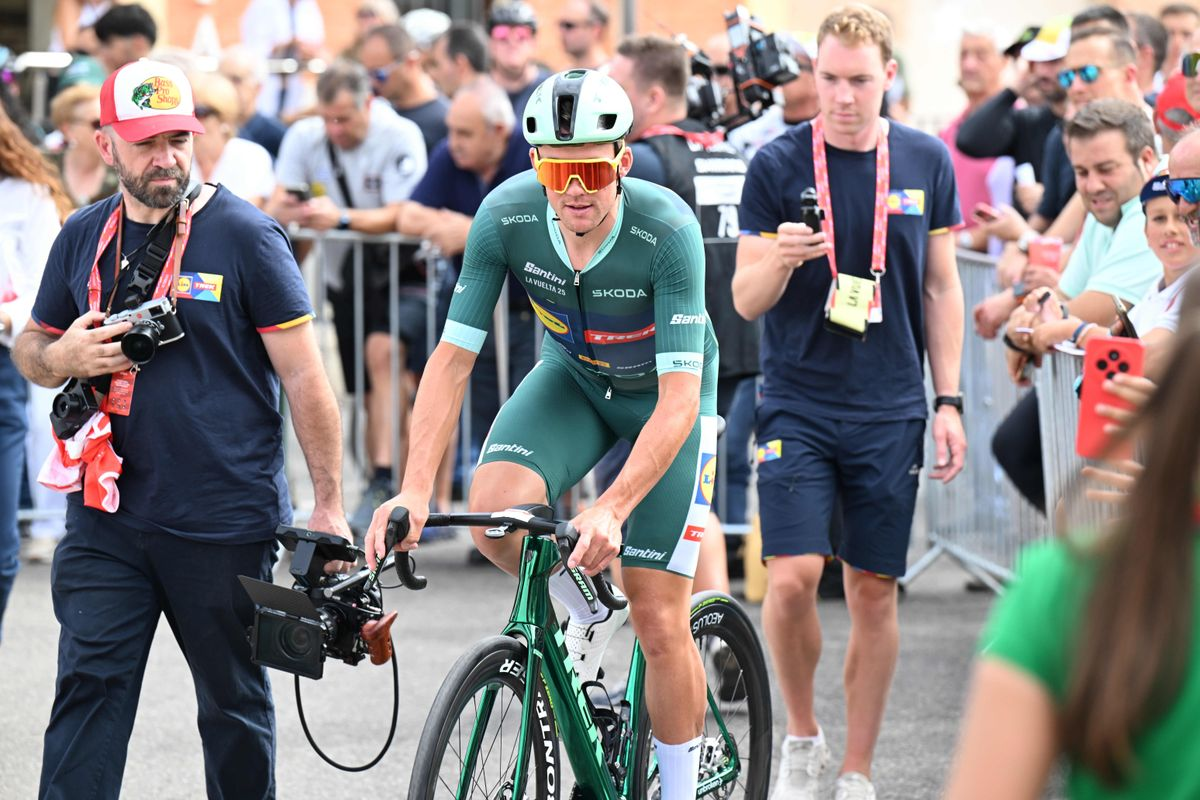
According the the race’s official website the pure fast men will only have four chances to take a stage and earn points. Even in the Tour, where we had six bunch sprints, a versatile sprinter in Mads Pedersen took home the green jersey. The Dane was constantly jumping into the breakaways to collect points at the intermediates, which in the end was enough for him to complete his collection of points classification jerseys.
Pedersen will also lineup at the Vuelta, but unlike the Grand Boucle he won’t be the only versatile sprinter at the start line. His biggest opponent will likely be Wout van Aert, who was forced to skip the Tour de France due to an elbow injury he had suffered at the Tour Auvergne - Rhône-Alpes.
The Belgian is coming into this race after a very successful return at the Tour of Denmark, where he won the first three stages and took home the GC as well. Two out of those three stage wins came on very demanding city circuits featuring multiple short, but steep ascents.
He also showed his top-end speed on the second stage, where he managed to outsprint Alpecin’s Jensen Plowright. While the Aussie is not a household name, the sprinting field in this Vuelta will feature similar quality of riders, so Van Aert’s win over him is a nice indicator that he is on the right track.
However, Van Aert is not the only sprinter Visma can count on, as they are also bringing Matthew Brennan. The young Brit was levels above everybody last week at the Vuelta a Burgos, where he dominated the first two stages, including an impressive win on an uphill kicker.
While Brennan is probably less versatile compared to Pedersen and Van Aert, he is probably faster than them on a flat road, which makes him a serious contender for the green jersey. He is still quite inexperienced as this will be only his first Grand Tour, but he has already proved it that he can go toe-to-toe with the best despite his age.
These three riders are very closely matched, but Visma’s duo probably has the edge due to the presence of Christophe Laporte. The Frenchman is one of the best leadout men in the world and his chemistry with Brennan and Van Aert could make the difference against the former world champion. 
Next to the trio of favorites there are also other riders who have to be taken into consideration.
Alpecin is a traditional sprinting powerhouse team and in Kaden Groves they are bringing a rider who has already won the points classification two times before.
They have a full team dedicated around the Australian, which is a rarity in a race such as the Vuelta. If Groves
is at his best then he could definitely win multiple stages and a third green jersey as well. However, he has been struggling with injuries this season, which is the main reason people don’t put him into the same tier as Van Aert and Pedersen.
On the other hand, Jordi Meeus has been having a career year and he is looking to make it even better by winning his first ever points classification in a Grand Tour.The Belgian has already won on the mighty Champs-Élysées, which proves that he is one of the fastest and most powerful riders in the entire peloton.
Although he can get over hills relatively well, he is still considered a worse climber that Pedersen.T
he key for him will be to win as many of the pure sprints as he can and remain close to the front on days that suit his rivals more.
He is also reportedly on his way out of Red Bull-Bora, so he will definitely want to end his career with the Germans on a high note.
While traditionally the points jersey is usually decided between the sprinters, we have seen in past Vueltas that even a climber can take home the green jersey. Valverde, Froome and Roglic are just three of the many non-sprinters who have won the points jersey before. 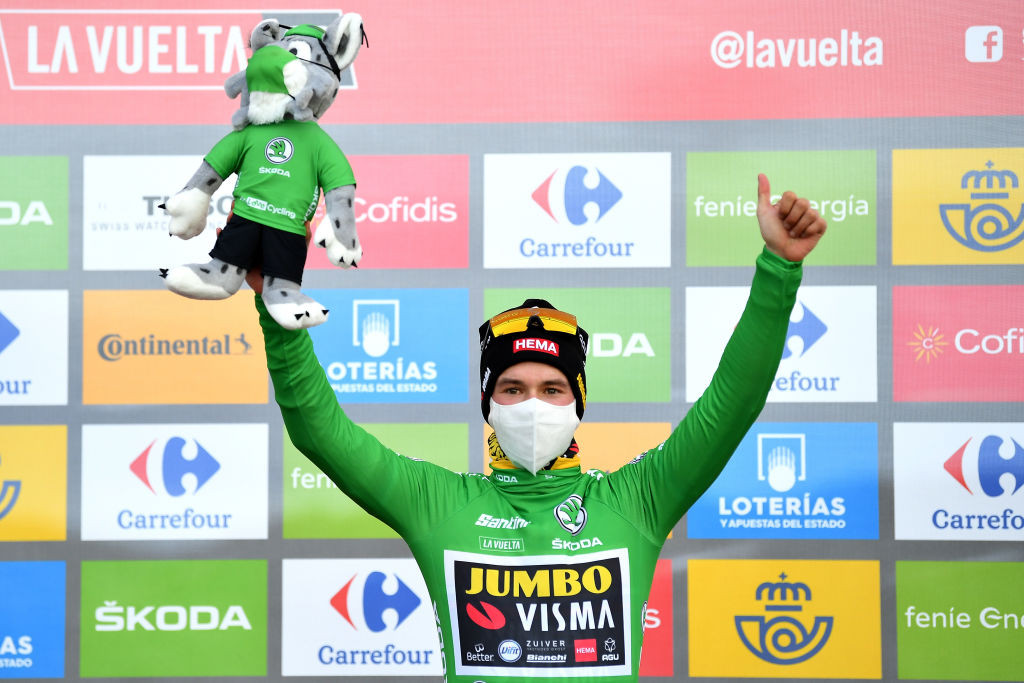
With the limited number of sprint stages in this year’s parkour, Tadej Pogacar has a legitimate chance at taking this classficiation as well.
However, for that he would likely need to win at least 7 stages, which would require a lot of effort from both him and his teammates.
And knowing that the World Championships starts only a couple of weeks after the last stage in Granada, it might be smarter for the Slovenian to race in a conservative way.
But if someone upsets the sprinters, then it will most likely be the world champion.
The Hardest Grand Tour of the Year:
The Vuelta is usually overlooked by most fans due to it being the last Grand Tour of the season.However, while both the Tour and the Giro attract more people in terms of total viewership, the Spanish Grand Tour stands above both of them in one category: toughness.
For years the Vuelta’s parkour has been regarded as the hardest out of the three, and this year is no exception either. Interestingly, at 3275km it is quite a bit shorter than the other two, but the real difficulty comes in the total elevation gain, which sits just above 57 000m.
Just for comparison, the Giro had around 48 000m, while the Tour had a little more than 54 000m. But it isn’t only the total climbing what makes the Vuelta the hardest. During the 21 stages the riders will face several brutal summit finishes, including Alto de Aitana, Calar Alto, Peñas Blancas and the monstrous Collado del Alguacil in the Sierra Nevada.
You could argue that we also saw multiple high-mountain stages at the Giro and the Tour, which is true. However, in both of those races the so called “transition stages” gave the riders a few days of rest between the extremely demanding etapes.
But at this year’s Vuelta that won’t be the case. Even the hilly/medium mountain stages that on paper should suit the baroudeurs are tough enough to create chaos in the GC.And let’s not forget just how few sprint stages we’ll have during the three weeks.
According to the race’s website, there are only 4 flat stages across the 21 stages, which is far less compared to the Giro and the Tour, where we saw six bunch sprints if not more.
However, even those four stages are far from flat. In three of them there’s a climb near the finish where we could see some attackers trying to get away and hold off the sprinters.
The only “pancake” flat day is the one on stage 17, which ends in Sevilla. And last but not least, the heat will make this race even more demanding. Other than the opening three stages abroad and the one that ends in Andorra we have practically no stages in the northern part of the country.
Spain is the hottest country in all of Europe, especially in the regions of Andalucia and Valenciana.
It’s quite common to have days with temperatures above 40 degrees there, while at the same time Giro stages often get cancelled because of landslides and heavy rain.
All in all, despite the Vuelta having probably the least reputation out of the three Grand Tours, it is definitely the hardest one.
The route and the heat are what make this race so demanding, so even with Pogacar at the start line, there is a high chance that we will see one big GC favorite unexpectedly collapse on one of the stages.
And that’s one of the many reasons why this Vuelta will be so fascinating to watch.
The Fight for the Podium (2nd and 3rd):
As we have already mentioned, if nothing bad happens to Pogacar then he will almost surely take the red jersey and become only the 9th rider to complete the Grand Tour Trilogy.
However, without the second-tier GC riders (Evenepoel, Vingegaard, Seixas, Del Toro, Lipowitz) at the start line, the rest of the podium places are completely up for grabs.
At the moment the bookmakers think that Decathlon’s Felix Gall is the favorite to finish runner-up behind the Slovenian.
The Austrian has already finished second at a Grand Tour before (2026 Giro d’Italia), and has just won the Vuelta a Burgos with an inpressive performance on the Puerto del Escudo.
What is also in his favour is the large number of summit finishes, on which he usually thrives on.
Decathlon also think that he could podium this race, so they are backing him with probably the deepest climbing squad in the entire race.
Gall will be supported by his compatriot Gregor Mühlberger, who was one of the best mountain domestiques in the Giro in May.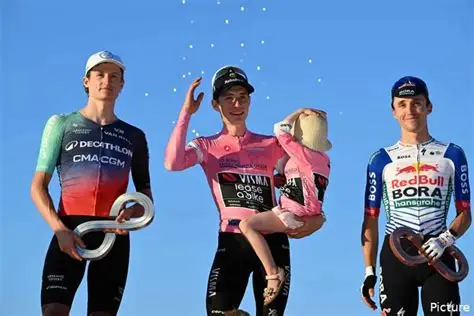
On the steep gradients it will be up to last year’s white jersey winner Matthew Riccitello to help Gall, while Callum Scotson and the young, but extremely talented Léo Bisiaux will offer further support on the uphill terrain.
However, Gall still has some huge weaknesses, which could be exploited by his podium competitors.
Firstly, he often struggles with descending, which has already lost him some races.
Earlier this year at the Volta a Catalunya Remco Evenepoel smashed one of the descents to try to drop the Austrian so that Lipowitz can overtake him in the GC.
Gall tried everything, but he eventually lost contact with the front group, which left him alone chasing the favorites in a 20km long valley.
As a result he lost more than two minutes and dropped all the way down to 6th in the overall standings. Next to his descending skills, he also struggles on the time-trial bike.
Gall is the definition of a pure climber. His position is not aerodynamic at all, which is why he loses minutes in the TTs.
This Vuelta has two time-trials, one on stage 1 and one late in the third week.
While the first one is less than 3km long, it runs through the city centre of Monaco and features more than 20 corners.
Knowing how awful his cornering skills are, it wouldn’t be surprising to see Gall lose significant time relative to his rivals.
However, the second effort against the clock is the one that might lose him the podium.
Distance wise it is a little longer than 32km, which is long enough for the others to gain north of three minutes on the Austrian.
Speaking of the others, let’s name them as well.
Oscar Onley has been struggling with injuries this season, but he finished 2nd behind Gall in the Vuelta a Burgos, which indicates that he is nearing his 2025 Tour de France level. The most complete GC rider other than Pogacar is probably Lidl-Trek’s Mattias Skjelmose.
The Dane finished just outside of the top five at the Tour de France. However, what made that achievement even more impressive is the fact that he started the race as the prime domestique for Juan Ayuso. But as we got deeper and deeper into the the third week, the roles have started to shift between the two.
The decisive day was undoubtedly the final time-trial, where Skjelmose did the performance of his life and finished 3rd on the stage, only behind Pogacar and Evenepoel. This time, he will be the team’s leader from day one, so if he managed to stay in shape after the Tour, then he is definitely someone who could find himself on the podium in Granada.
The home fans will be hoping that 3-time runner-up Enric Mas can improve on his 5th place at the Vuelta a Burgos and put Spain back into the podium picture. Mas usually thrives in hot conditions and given his history at this race, he shouldn’t be underestimetd, even despite of his recent struggles.
Finally, the two “veterans” should also be mentioned. Primoz Roglic and Richard Carapaz are two riders who have dominated Grand Tour racing in the last decade. The Ecuadorian seems to be in the shape of his life this time as well, but the same can’t be said about Roglic.
The Slovenian is having probably the worst season of his career, but it got even worse in late July, when he got hit by a car during a training ride, which forced him to skip two important preparation races. So, he is coming into this Vuelta with more than two months without racing and after a not ideal preparation.
However, as a 4-time winner, he still has the capabilities to compete for the podium at the least. Meanwhile Carapaz is in an very different situation to his former rival. He saved EF’s Tour de France by winning two mountain stages and also taking home the polka-dot jersey. 
He could also achieve same results at this Vuelta, if he decides to go for the breakaways, but he has already stated that this time his focus is completely on the GC. Knowing his attacking racing style and how many mountain stages this Vuelta has, it wouldn’t be surprising at all to see him attacking from far out on the penultimate stage and turn the GC on its head.
Overall, there are at least five to six riders who we could see on the final podium in Granada. And that number might be even higher if we take into account all the young GC talents, who are ready to surprise us.
The Youngsters:
Speaking of the young talents, just like in previous years we’ll see plenty of them this year as well. While the Giro and the Tour are usually dominated by experienced and proven riders, the Vuelta is the Grand Tour where most young riders breakout, just look at the favorite’s career for example.
Just like many talents, Pogacar’s first Grand Tour was also the Spanish one back in 2019, where he immediately finished on the podium behind Alejandro Valverde and his coompatriot Primoz Roglic, who he then less than a year later beat to win his maiden Tour de France.
So, which riders could replicate the world champion’s performance this time around? There’s another Slovenian in Jakob Omrzel who is already being called as the next Pogacar. Similarly to Pogacar, this will also be Omrzel’s first Grand Tour, however he has already shown a lot of promise.
Last year he won the Giro Next Gen and as a neo-pro he podiumed his home stage race, the Tour of Slovenia. Bahrain doesn’t bring an out-and-out GC leader, so on paper he should have the freedom to go for his own results and show people why he is regarded as Pogacar’s potential successor.
Another rider who has won the Giro Next Gen before is Lotto’s Jarno Widar. The Belgian conquered the roads of Italy in 2024, but instead of turning professional he stayed one more year with Lotto’s development team, which has paid off, as last year he finished 2nd at the Tour de l’Avenir, only 40 seconds behind Paul Seixas.
And while he hasn’t bursted onto the scene at the same rate as the Frenchman, he still showed glimpses of his talents earlier this season with a 4th place finish on the queen stage of the Tour de Suisse. If he can stay consistent throughout the three weeks, then he might just be a sneaky contender for the podium in the GC.
In 2022 two young Spaniards introduced themselves to the cycling world. Juan Ayuso finished 3rd in his first professional season, while Carlos Rodríguez just finished outside of the top five. Each year the home fans are hoping that the next Contador will appear from nowhere and lead them back to glory.
This year the candidates are NSN’s Pau Martí, UAE’s Pablo Torres and EF’s Markel Beloki. Martí is more of a puncheur, so he is probably more comparable to a rider like Alejandro Valverde. Beloki however is a true GC rider who shines both in the mountains on the the time-trial bike.
He skipped the U23 ranks entirely and turned professional at just the age of 19. As most teenagers, he also struggled to adapt to the high speeds of the peloton, but in his third year as a pro he has seemingly finally arrived.
wo weeks ago he dominated the Tour de l’Ain which he followed by an impressive 8th place at the Vuelta a Burgos, so he enters this Vuelta as the next Spanish GC hope.
Meanwhile, Torres has come through the development ranks of UAE and now gets to learn from Pogacar.
He will most likely support the Slovenian, but that has an advantage as well. Unlike many youngsters, he has no pressure on his shoulders to perform, which could result in him showing his qualities while working for his leader.
While the uncertainty regarding Roglic’s current shape is far from ideal for Red Bull-Bora, it could open up the opportunity for one of their young prospects to shine.
Luke Tuckwell first showed his potential in last year’s Giro Next Gen, where he lost the Maglia Rosa on the final day.
Many riders would’ve been disappointed by the way he lost, but this loss made him even stronger, which resulted in an amazing debut season amongst the pros, highlighted by a 2nd place at the Tour Auvergne - Rhône-Alpes.
It is still unclear whether he can replicate that performance for 21 days in a row, but Australia might have just found another future Grand Tour winner.
Speaking of future Grand Tour winners, France have been looking for one since the 1980s, but with the emergence of Paul Seixas they have probably found their saviour.
However, in Seixas’ shadow Decathlon have another promising GC star in the making.
Léo Bisiaux’s main task will be to help Felix Gall, but if anything happens to the Austrian than he is more than capable of taking over as the team’s leader.
Meanwhile, Visma’s Jorgen Nordhagen won’t have any domestique responsibilities, as the Dutch team doesn’t bring a true GC leader.
This will allow the young the fromer cross-country skier to show his talents to the world, especially on the steeper climbs.
Don’t forget that Jonas Vingegaard also broke out at the Vuelta and Nordhagen has everything to become Visma’s future Grand Tour winner.
Nordhagen was actually a cross-country skier before he had signed with Visma
Next to the climbers there’s also a young sprinter who we should keep our eye on, especially as the sprinting field is far from the best. Lotto-Intermarché’s Steffen De Schuyteneer is a sprinter who can also get over a hill relatively well, which is not a bad thing knowing the parkour.
However, his biggest strength is his top-end speed. He is quite small for a sprinter, but thanks to that he sprints in a very aerodynamic position, which compensates for his lack of size and power.
At just 21 years old he still has a lot of time to develop, but this Vuelta could prove to be a decisive race in his career.
As you can see, there will be countless young riders trying to knock off the veterans at this year’s Vuelta.
Due to their age, we can’t expect all of them to immediately win a stage or finish high up in the GC, but don’t be surprised either if one of them manages to achieve something extraordinary.
Historical Records and Greatness:
Pogacar winning by minutes will probably bore a lot of fans, but his achievements still have to be acknowledged. As mentioned before, he is just 21 stages away from joining an elite club of riders.
By taking the red jersey he would become only the 9th rider in cycling history to win all three Grand Tours.
Next to that he would also complete the Tour-Vuelta double, a feat that was last achieved by Chris Froome in 2017. The main question is not whether he will win the GC, but how many stages will he take along the way.
He currently has 35 Grand Tour stage wins, which is the 10th most out of all riders.
The record is unsurprisingly held by “The Cannibal” Eddy Merckx with 64 victories, so Pogacar still has quite a bit of ground to make up.
However, if he goes all-in and tries to win as many stages as he possibly can, then he could easily end this race with eight to ten victories, which would move him into the top five in the all-time rankings.
Pogacar is probably the only rider who has shot at beating Merckx's Grand Tour stage wins record
Speaking of the all-time rankings, the record or the most Vuelta GC wins is currently held by two riders: Roberto Heras and Primoz Roglic. While Heras has already retired, Roglic could still increase his tally by winning for the 5th time, albeit the chance for that to happen is quite low.
Even before his crash him winning would’ve been very unlikely, but after his pre-race interview on Thursday it looks like that even he doesn’t know where he is at compared to his competitors.
“If you would ask me now still, 10 days back or something. I wouldn’t say that I could sit on the TT bike. I mean, putting my socks on my feet was the hardest thing to do for at least three weeks. I mean, I definitely still feel it. I can’t lay on my right side. But whatever, forget about it, good enough to ride the bike and to come here to start the Vuelta.”
“I'm lucky that it's not a 30km time trial, that you have to be in the position, I don't know, to do 20 minutes in a row. With this kind of parcours, maybe, yes, I can start with, and then we will see the next days how it goes. Probably, wanted or not, with these stages, I will get already some answers. And it depends on that, we will see then for later on, for the second and third week, actually how to manage it and how to turn it,” said Roglic about the challenges of week one.
So, the biggest questionmark still remains unsolved. One thing is for sure, Roglic will do everything he can to win his 5th Vuelta, even if it seems impossible at the moment.
Overall, this Vuelta likely won’t be remembered for the insane fight for the overall victory, however the battle for the podium and the possible emergence of youngsters are two reasons we should watch all 21 stages.
And lastly, next to the points classification, the KOM jersey is also up for grabs for almost everybody, so there are plenty of stories to keep our eye on in the next three weeks.
Sources: CyclingWeekly, Domestique, CyclingNews, Wielerflits, HLN