“We don’t want to be in this position again because it sucks.” That is how Geraint Thomas described Netcompany Ineos’ Tour de France.
The Brits went into the Grand Boucle with big aspiriations, but they eventually came away with nothing.
But, how did a team that used to dominate Grand Tours become almost invisible in just a span of a few years?
To get our answer we have to back in time to the team’s inception and go through their successes which ultimately led to their downfall.
The Early Years (2010-2011):
The creation of Team Sky was part of the revolutionizing process that happened in British Cycling in the late 2000s. As a result, Team GB took 14 medals at the Beijing Olympics, which was a promising sign with London 2012 on the horizon.
However, in professional cycling they were still nowhere near the powerhouse nations such as the Belgians, the French and the Dutch just to name a few.
However, in 2010 everything changed. James Murdock, who was the chairman of Sky UK, wanted to sponsor a new sports team. The billionaire was a huge cycling enthusiast with a special dream in mind: forming a corporate-funded cycling team with a roster of world-class British athletes.
And that is how Team Sky was founded. They might have been a new team but already from the start they had big ambitions: their main goal was to win the Tour de France in the next few years with a British rider.
As a consequnece they put a lot of emphasis on Grand Tours and other stage races. The original roster was built around Olympic stars Bradley Wiggins and Geraint Thomas plus other British cyclists and international signees.
However, due to their past as track cyclists, neither Wiggins nor Thomas were good enough climbers to compete for a Grand Tour right away. However, the team’s General Manager, Dave Brailsford had a very unique plan, something that has we have never seen in cycling before.
Brailsford, who himself was also a cyclist (albeit only at an amatuer level), based his plan around the aggregation of marginal gains. It was the philosophy of searching for a tiny margin of improvement in everything you do.
“The whole principle came from the idea that if you broke down everything you could think of that goes into riding a bike, and then improve it by 1 percent, you will get a significant increase when you put them all together” said the Brit.
Brailsford and his staff began by making small adjustments to the bikes and the technical sides of things. They redesigned the bike seats to make them more comfortable and rubbed alcohol on the tires for a better grip.
Furthermore, they also tested various fabrics in a wind tunnel and had their outdoor riders switch to indoor racing suits, which proved to be lighter and more aerodynamic. However, they didn’t stop there.
They continued to find one percent improvements in areas others that other teams didn’t even have on their radar. They were the first ones to design personalized pillows and mattresses, which significantly improved the recovery of their riders.
Thanks to these small changes combined with Sky’s yearly investment of €15 million, the expectations heading into 2010 then were extremely high, especially from people in the UK.
But despite of their modern approach and the financial resources they had, their first season amongst the pros was largely underwhelming. In total they won 22 races, which from a newly formed team was actually quite impressive.
However, most of those victories came in one-day races and time-trials. Meanwhile, other than a short stint by Wiggins in the Maglia Rosa at the Giro d’Italia, they mostly underperformed in the general classifications.
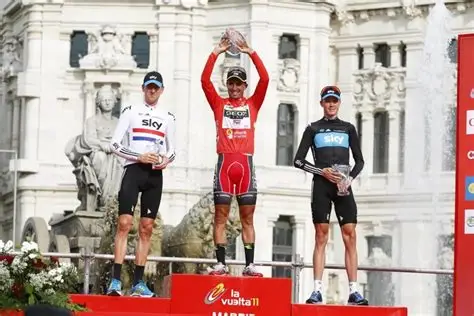
Nevertheless, instead of making massive changes Brailsford continued to trust the process and that already paid off in the following year. The highlight of their second season was undoubtedly the Vuelta a España, where Wiggins and the young Chris Froome finished 2nd and 3rd, behind Juan José Cobo.
However, a few years later the Spanish rider was retroactively disqualified due to evidence of cheating, making Froome the first-ever British winner of a Grand Tour.
But earlier in the summer Wiggins crashed out of the Tour, which left the team without a GC leader for the rest of the race. Still, overall the 2011 season was a very successful one, with 33 wins in total and a significant improvement in stage races.
Everything was pointing towards in the right direction and the breakthrough at the Tour finally came in 2012.
The Breakthrough (2012):
Following such a promising season Brailsford and his staff knew that they were not far away from their main objective. Most importantly, they had two riders in Wiggins and Froome who were capable of winning a Grand Tour, they just needed a better supporting cast to have a genuine shot at the Tour de France.
So, without any hesitation they went out and signed a couple of world class climbers in Richie Porte and Sergio Henao. Next to the new recruits they continued to fine-tune the “marginal gains” method as well.
Following these drastic improvements, it wasn’t a surprise that they started the season hot. Wiggins immediately announced himself as a true contender for the Grand Boucle by becoming the first British rider to win Paris-Nice since Tom Simpson.
Later in the Spring Wiggins also dominated the Tour de Romandie but he still managed to find another gear as he triumphed at the Critérium du Dauphiné as well. As a result the former Olympic champion came into the 2012 Tour de France as one of the favorites.
Team Sky sent an incredibly strong team to support Wiggins’ GC quest, with climbers such as Froome, Porte and Michael Rogers. Wiggins set the tone right on the first day with an impressive 2nd place in the opening prologue, where he only lost to Fabian Cancellara.
Then came stage 7 with the first mountain-top finish, where the Brits obliterated the entire field. They controlled during the entire stage and Chris Froome proved to be the strongest on the final climb, but Wiggins finished not far behind his compatriot, which was enough for him to take the yellow jersey.
And thanks to the work of his teammates Wiggins was able to keep the Maillot Jaune all the way until Paris. On stage nine’s ITT he increased his lead, while on the following mountains stages Porte and Froome made it almost impossible for both Nibali and the reigning champion Cadel Evans to gain any time, as they neutralized all of their attacks.
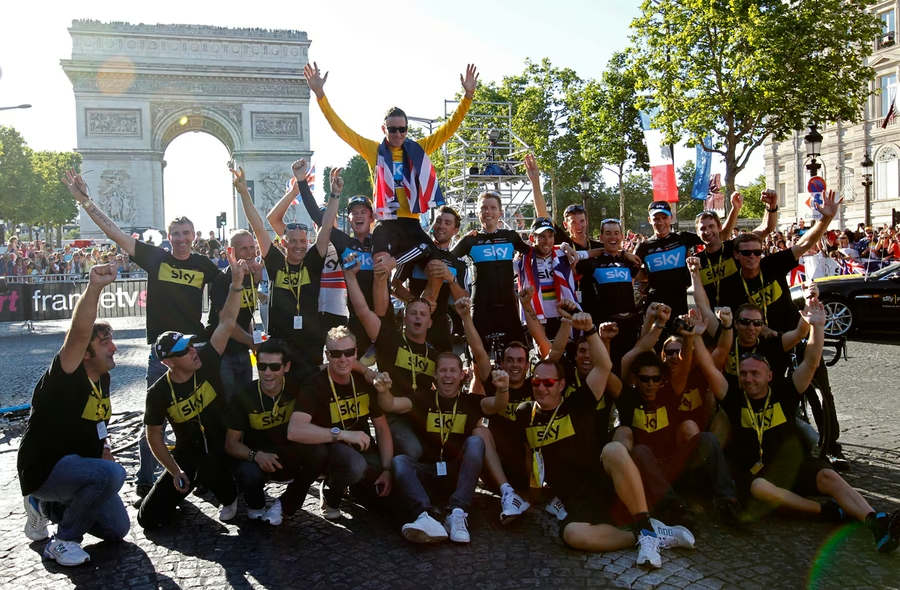
Wiggins capped of the Tour in style with another time-trial win on the penultimate stage. What made Team Sky’s Tour even more impressive is that despite all the domestique work Chris Froome still managed to finish in a remarkable 2nd place, making it a historic 1-2 finish for the Brits.
However, the way they won was even more important than the result itself. Wiggins was definitely not the strongest rider in the mountains, but thanks to the “marginal gains” he stayed consistent throughout the entire race.
The time he gained in the time-trials allowed him and his team to race passively during the rest of the stages and only focus on defending the lead they have already had.
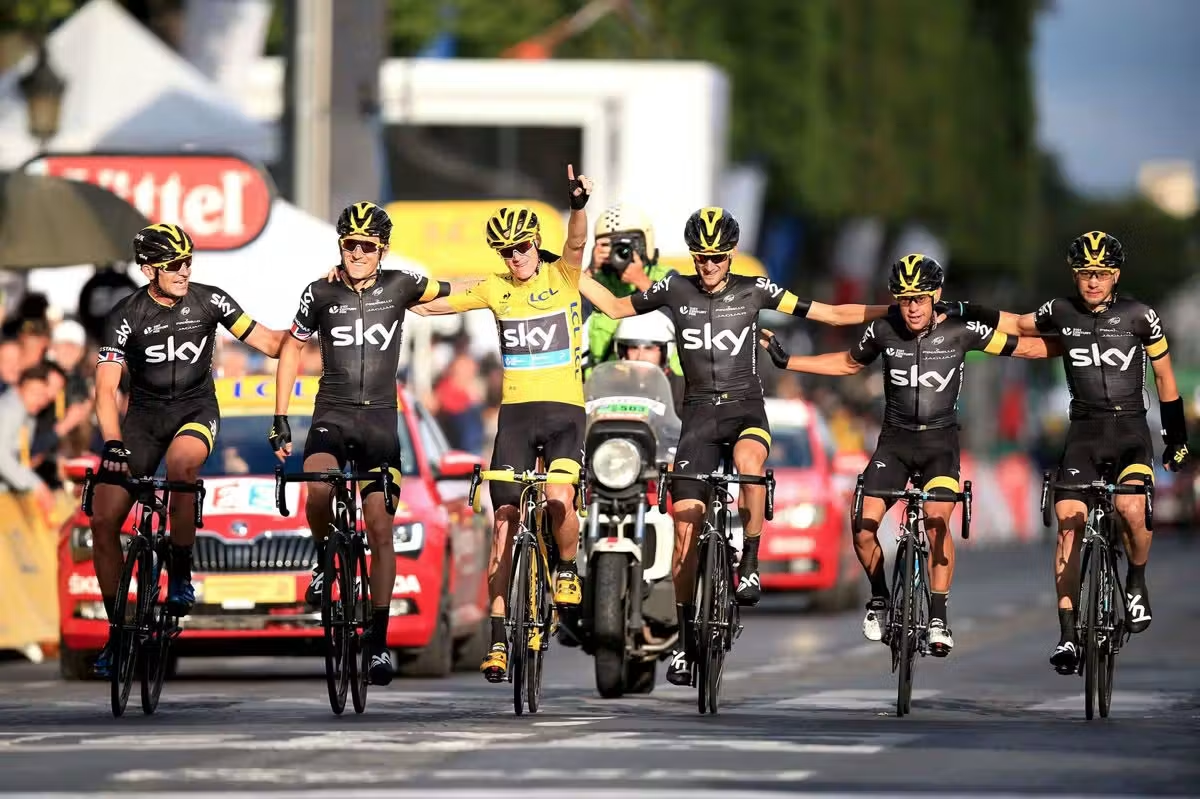
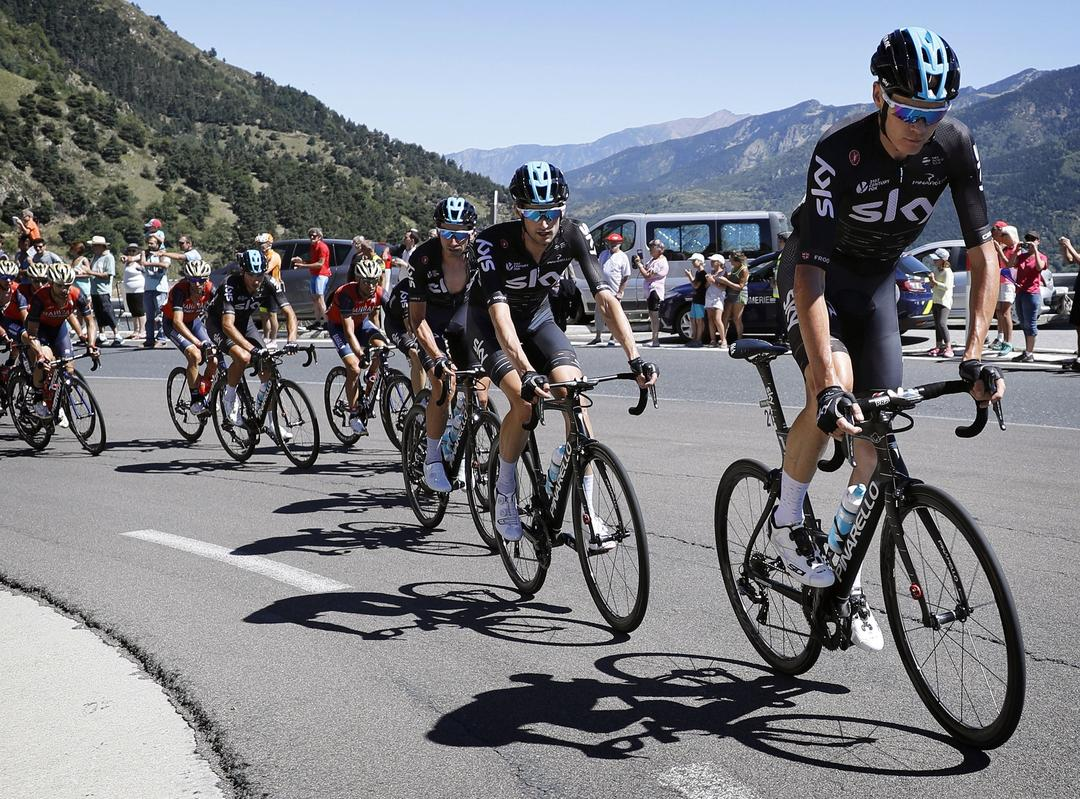
This was the first race where we saw the infamous “Sky Train”, which became a common sight in cycling during the coming years. Their season was already legendary, but a month a later it became iconic.
Wiggins, Froome, and Geraint Thomas took medals as Team GB topped the cycling table at the London Olympic Games. They ended the year with 50 victories and for the first time topped the UCI World Tour Teams classification, by more than 2000 points ahead of Quick-Step.
However, 2012 was just the start of one of the most one-sided eras of pro cycling.
The Froome Era and Doping Allegations (2013-2018):
By the start of the 2013 season Team Sky has established a superteam, which allowed them to not just win but also dominate every Grand Tour in the 2010s.
Everybody assumed that Bradley Wiggins would remain as the center piece of the team, but the reigning Tour de France champion decided to hand the torch over to his young compatriot. In 2013 Chris Froome stepped up and became the out and out team leader.
Froome has already showed in previous years that he is one of the best stage racers of his generation. The rider from Kenya joined the team in 2010 as an inexperienced prospect with a lot of untapped potential.
It was obvious that he had a very high ceiling, the only question was how quickly he could reach it. Just in his second season he finished 2nd at La Vuelta, but later he got promoted to first following Juan José Cobo’s disqualification.
Then as we know in 2012 he got 2nd at the Tour, which was very impressive considering that he was one of Wiggins’ primary domestiques. Already in that year he showed that he is a better climber than his compatriot.
He was skinnier and lighter then Wiggins, which was a huge advantage on the steep climbs. And in spite of his size, he was surprisingly fast on the TT bike as well. If any team manager could’ve created a perfect stage racer, then that rider probably would’ve looked like Froome.
So, they had the most complete GC rider and also arguably the most dominant team we have ever seen. Thanks to these two things and the relevations in recovery, training and nutrition they virtually became unbeatable.
In the next 6 years they won 5 Tour de Frances, four with Froome (2013, 2015, 2016, 2017) and one with Geraint Thomas (2018). The only year they didn’t win the yellow jersey was in the 2014 edition, which was marked by Froome’s withdrawal due to injury.
Thomas’ victory showed what we had already known before: they didn’t just rely on one rider’s excellence, the rest of the team was also full of riders who could step up if necessary.
After winning the Tour for the 4th time Froome was looking for new challenges, and he decided to pursue the Giro-Tour double, a legendary feat that was last time achived in 1998 by Marco Pantani.
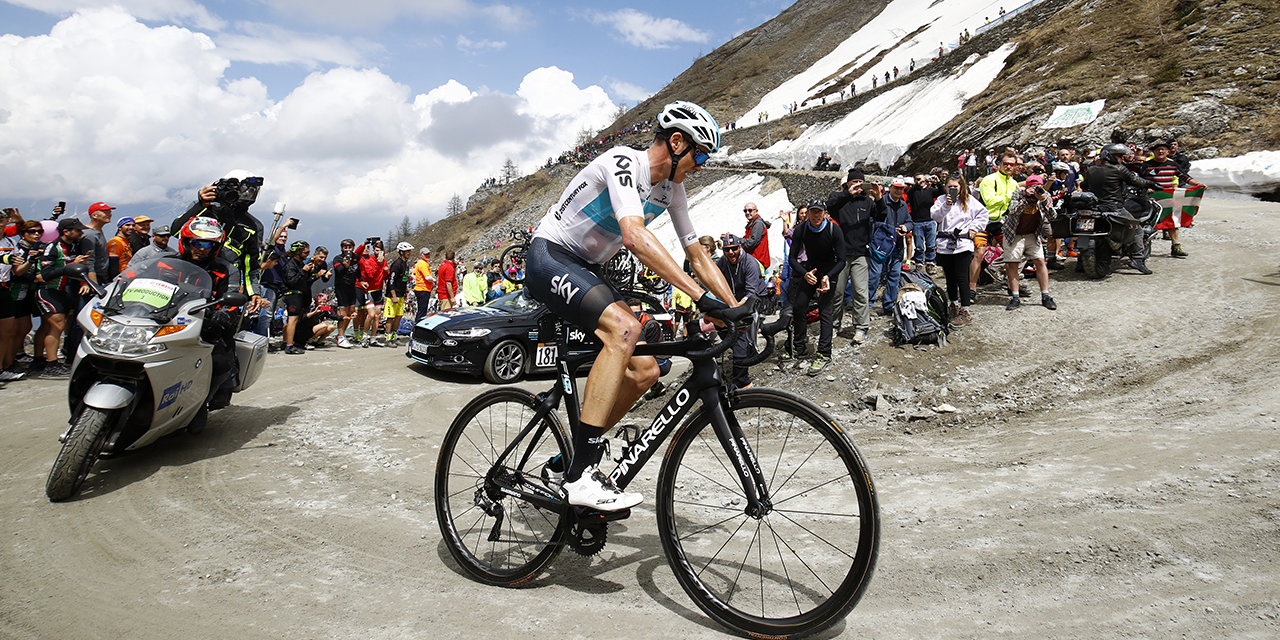
The Brit managed to win the Giro, but he had to dig extremely deep to comeback in the final week. Prior to stage 19 he was trailing Simon Yates by more than 3 minutes. But what happened on the queen stage was truly iconic.
Froome asked his teammates, Wout Poels and Sergio Henao to go to the front and set an unrelenting pace on the infamous Colle delle Finestre. The only problem was that from the top of the climb there was still 80km left to ride.
But that didn’t stop Froome from attacking. He saw that Yates was struggling and without any hesitation he made his move.
His chances of going all the way were relatively slim, but against all odds he managed to turn the GC completely on its head an took the Maglia Rosa, which he then easily kept on the final two stages. However, later in the summer he paid for his efforts at the Tour de France.
He was far from his best in July, but that didn’t stop Sky from retaining the Maillot Jaune. Up until that point everybody thought that it was only a one man show, but the victory of Geraint Thomas completely silenced all the critics.
And that’s why this 2018 season was the pinnacle of their dominance. Between 2013 and 2018 they won an astonishing 218 times and were constantly in the top three of the yearly UCI Team rankings. And they achieved all of that without a sprinter nor a classics specialist.
After the disappointing 2010 season, almost everybody gave up on them. Many people would have given up in that moment, but the team led by Dave Brailsford continued to trust their philosophy. And this initial trust was the reason they became so successful.
However, most fans argued that there was something else behind their incredible dominance. Bradley Wiggins won the Tour de France in 2012, which was the starting point of a something extraordinary, but that was not what made 2012 so memorable.
Later that year the USADA published its reasoned decision outlining the banning of Lance Armstrong for doping offenses. This news couldn’t have came at a worst time for professional cycling.
Before the 2006 Tour de France the infamous Operación Puerto doping case came out. It involved several of the world's most famous cyclists and teams at the time. What followed was the biggest doping case we have ever seen.
Multiple Grand Tour winners, including Alberto Contandor, Ivan Basso, Jan Ullrich and Marco Pantani all got suspended and retrospectively stripped of their results. When Alejandro Valverde got suspended in 2010, the case was finally more or less wrapped up.
Cycling was building its reputation back, but Armstrong’s fall from grace derailed that process entirely, creating suspicious mood within the fans. Team Sky was founded with a no-doping police, but their US Postal like dominance understandably raised some eyebrows.
People were especially pointing at Froome, who became the best GC rider in the world from literally nobody in just a span of two years. In 2014’s Critérium du Dauphiné Froome was intensely criticized for using an inhaler during the race.
Froome is asthmatic and therefore this was allowed, however, the rules were soon changed, and Team Sky would later face serious scrutiny over such “Therapeutic Use Exemptions” (TUEs). Following his withdrawal from that year’s Tour de France the public calmed down a bit, however that didn’t stay like that for long.
He bounced back in 2015 with an even more dominant performance, which put him into the spotlight again. The media suggested that there was something going on at Team Sky that the public didn’t know about. This time Team Sky provided the USADA with all existing data they’d collected on Froome’s physiology to date for them to analyze, but the investigators didn’t find any red flags.
However, that wasn’t the case a year later. In 2016 Russian hackers revealed Wiggins and Froome’s applications for Therapeutic Use Exemptions, showing that Wiggins used anti-inflammation steroids before his Tour win.
Wiggins defended himself as he suffers with severe allergies and asthma, however, the UK House of Commons later released a report claiming “ethical lines” had been crossed.
Then Team Sky weathered two further investigations. One looked into an infamous package delivered to Wiggins in the 2011 Critérium du Dauphiné by the UKAD (UK Anti-Doping), while another examined irregularities detected in Froome’s blood during his winning 2017 Vuelta.
No wrongdoing was proven, but the team’s reputation took a major hit. As a result Sky started to distance itself slowly from the team and at the end of 2018 they completely withdrew its sponsorship for the team.
Regarding the doping allegations, we will probably never know the exact truth. However, the fact remains that no Team Sky member has ever officially been found to be cheating (at least whilst riding for the team).
So, after almost a decade of supremacy Sky officially stepped down, but that presented an opportunity for other wealthy investors to get into pro cycling, and due to their recent success the British side still remained a very attractive option.
Ineos Takes Over with Initial Success (2019-2021):
In the end it was Jim Ratcliffe, the billionaire CEO of petrochemical giants Ineos, who ended up buying taking over as the team’s new owner. Ratcliffe, who was and is still regarded as Britain’s richest man, has reportedly pumped 40 million euros a year into his new WorldTour team.
This meant that Ineos still remained one of the wealthiest teams in pro cycling. Other than his large investement, Ratcliffe stayed largely out of sporting related things, so the backroom staff mostly remained the same.
Regarding the team’s roster, it also didn’t change massively. As a consequence, the team entered the 2019 season with similar goals to prior years. And overall they didn’t disappoint.
During the early stage races a new star started to emerge in the presence of Egan Bernal. The Colombian had already been an important rider in the previous season, as he had played a key role in Geraint Thomas’ Tour win.
However, early in 2019 he cemented himself as the team’s future Tour de France leader. Prior to the Grand Boucle he won both the Paris-Nice and the Tour de Suisse and also finished 3rd at the Volta Ciclista a Catalunya.
As a result, he came into the Tour de France as one of the top favorites. Bernal was quiet for most of the race, but he consistently finished near the front on the mountain stages, which was enough to stay in contention for the yellow jersey before the final queen stage.
And with another outstanding performance he capitalized on Julian Alaphilippe’s collapse and moved into the race leader’s jersey, with the reigning champion Geraint Thomas closely behind him.
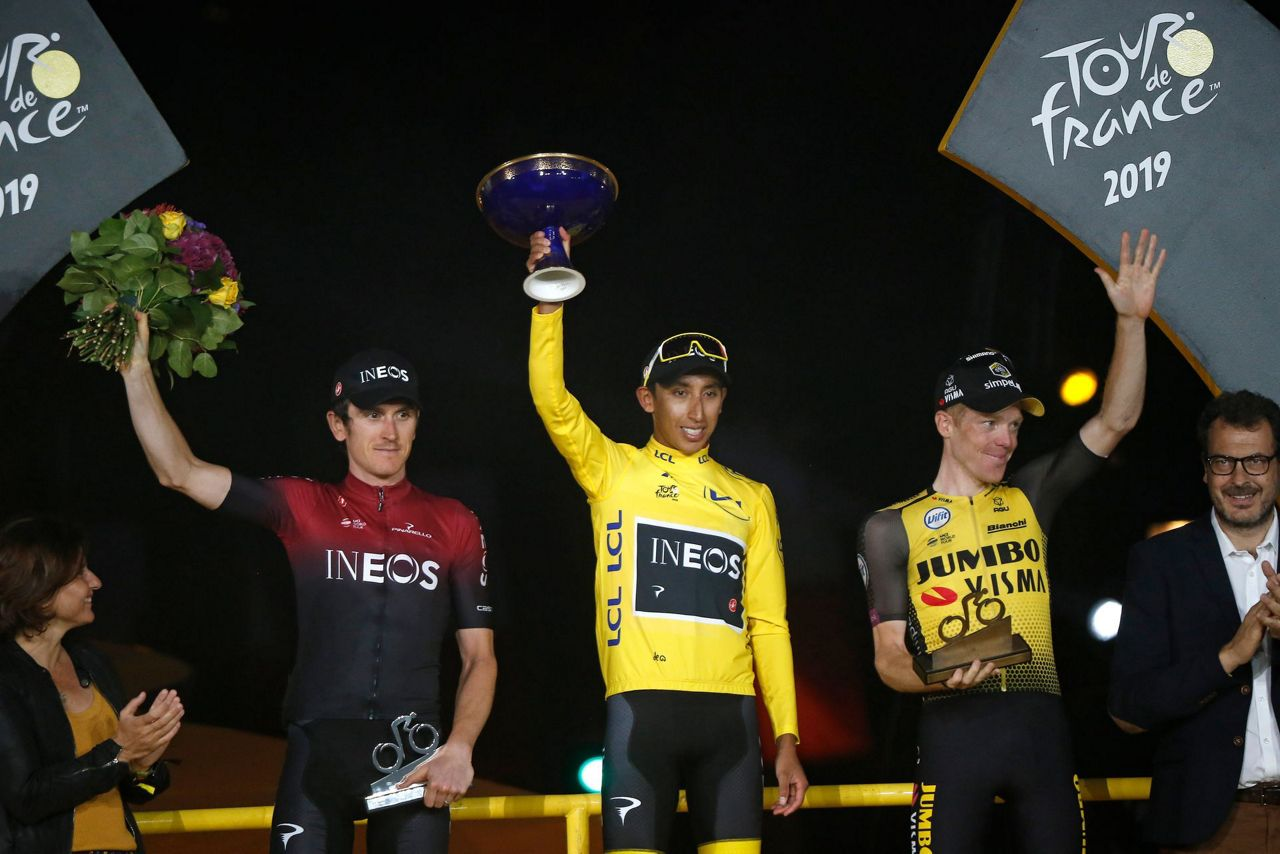
The standings stayed the same after the last mountain time-trial as well, which meant that for the first time in their history Ineos ended their Tour de France with a 1-2 finish in the GC. So, after such a disruptive seasons with all the doping drama and the eventual change in ownership, it seemed to not affect the team’s performance on the road at all.
However, even though the great results, the 2019 season was still not perfect. Chris Froome was supposed to be in the Tour squad next to Thomas and Bernal, but at the Critérium du Dauphiné disaster struck.
On 12 June 2019, Froome was hospitalised with a fractured right femur, a fractured elbow, and fractured ribs, after a high-speed crash into a wall while training for the 4th stage. He tried to comeback the following year after a lengthy recovery process, but due to his age he could never reach his peak form again, so unsurprisingly Ineos decided to let him leave at the end of his contract in 2020.
Losing Froome was a hard hit for everybody, but that didn’t stop Ratcliffe and the backroom staff to improve an already strong team even further. Next to Froome, Geraint Thomas and multiple other domestiques from the Tour winning teams were also not getting any younger, so in order to keep winning they had to find some replacements.
They had the resources and the pedigree to attract the biggest stars in the world, which made recruiting a lot easier. In the end they landed on the reigning Giro d’Italia winner Richard Carapaz with his loyal domestique Andrey Amador from Movistar.
Next to the two South Americans they also managed to pick up Richie Porte from Bahrain and Carlos Rodríguez, who was regarded by many as one of cycling’s biggest prospects. Everything pointed towards another dominant campaign, but then something unexpected happened that changed the entire cycling world.
That something was the global pandemic caused by the newly found Covid-19 virus. As in almost every sport, races got cancelled and no one knew when the show could restart.
After almost half a year of waiting the racing could finally begin in August, but with a completely restructured calendar. The UCI had to squeeze the races into just 3 months, which resulted in a very congested schedule, including only the most important races.
The Tour kicked off unusually late at the end of August with not a lot of races beforehand, so no one really knew who were the real favorites. Ineos sent a star studded lineup, including the reigning champion and still extremely young Egan Bernal who was supported by two of their new recruits in Carapaz and Porte.
But unlike 2019, when everything had gone perfectly, this edition was the complete opposite. Bernal had to abandon the race at the start of the final week, but he was already struggling in the first two.
Meanwhile, Carapaz was far from his Giro winning form and couldn’t keep up consistently with the front runners, who were two Slovenians. Jumbo Visma’s Primoz Roglic led for most of the race, but on the final mountain time-trial his younger compatriot Tadej Pogacar manage to turn things around with a legendary performance.
It was definitely a Tour to forget for the Grenadiers, but at least Richie Porte finished 3rd behind the two new faces.
But even in a “down” year, they still managed to win a Grand Tour, as out of practically nowhere Tao Geoghegan Hart won the Giro d’Italia. Meanwhile at the end of the shortened season Carapaz bounced back from his disappointing Tour and finished 2nd in La Vuelta, only behind Primoz Roglic.
Overall, the 2020 season was a mix ups and downs. For the first time since 2015 they lost the Tour, but they still managed to win the Giro, which was a great consolation prize. However, with the emergence of Pogacar and Roglic, they finally had some legitimate opponents.
Ineos knew that the only way to compete against Pogacar and Roglic was by spending big in the transfer market again, so that is exactly what they did. They strengthened their climbing core by signing Adam Yates, Daniel Martínez and Laurens De Plus and bringing back Richie Porte, who played a key role in Froome’s dominance.
Next to the experienced climbers they also added Tom Pidcock, who has just won the Baby Giro the previous year. With these high quality additions the team had one clear goal in mind: retaking the Tour de France.
The first few months of the season were very promising for the Brits. Adam Yates proved that investing resources into him was worth it by winning the Volta Ciclista a Catalunya, while the team’s veteran Geraint Thomas continued to perform at a very high level and went onto win the Tour de Romandie.
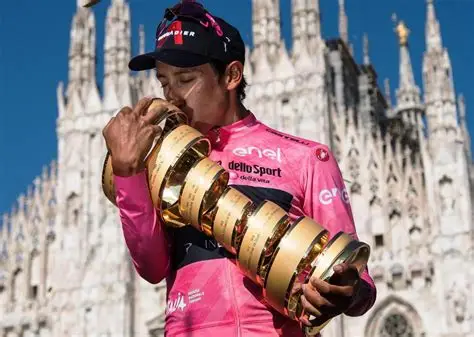
But the highlight of the first part of their season was undoubtedly Egan Bernal’s Giro d’Italia triumph, however, they did it in a very uncharacteristic way. We got used to seeing the “Sky train” dominate the high mountain stages, but for the second year in a row this wasn’t case.
They were still one of the top teams, but others managed to catch up to them, which created a more balanced field at the top. Because the top teams were so close to each other, the riders’ individual quality started to matter a lot more.
And that was exactly what they lacked in the second Grand Tour of the year. Pogacar took the yellow jersey for the second year in a row, finishing more than 5 minutes ahead of Visma’s newest prodigy Jonas Vingegaard.
Carapaz saved Ineos’ Tour with a 3rd place finish, but the rest of the team performed below expectations. They ended the year with 35 victories and finished 2nd in the UCI Rankings, but the with the emergence of the next generation, their dominace was clearly coming to an end.
The Empire Fades (2022-2023):
Changes had to made and it all started in the management, but not where most would have expected. Brailsford was sucked higher up into the Ineos machine to oversee Ratcliffe’s sprawling, and underperforming, empire: the Mercedes AMG Formula 1 team, Britannia sailing, French football club OGC Nice, the All Blacks rugby squad.
However, Brailsford still officially remained as team principal, with Rod Ellingworth taking over the team’s day-to-day management. Next to Brailsford the team also lost Tim Kerrison, the mastermind coach behind the team's most successful era.
Meanwhile on the road things took an unexpected turn as well. The team started to put more emphasis on one-day races and that paid off.
Dylan Van Baarle finished 2nd at the Ronde van Vlandeeren and a week later he managed improve on that as he went onto win Paris-Roubaix. This was the team’s first ever cobbled Mounumet win, which just shows how one-sided they were during the 2010s.
But unfortunately they couldn’t keep their winning run going in the Grand Tours. Carapaz finished 2nd again, but this time at the Giro, while Thomas got a very respectable 3rd place at the Tour.
The Welshman’s performace was encouraging for him, but it also showed that the team was still searching for their next leader, who could eventually break Pogacar’s and Vingegaard’s dominance.
For a long time Bernal seemed like the ideal candidate, as he was only 21 years old when he won the Tour back in 2019. After he took the Giro in 2021, the Colombian was set to lead the team at the Tour, but an unexpected crash in training changed his season completely.
Bernal was descending at a high speed when he collided with a standing bus that left him with severe injuries. The injuries included a fractured vertebra, a fractured temur, chest trauma and a punctured lung.
The former Tour de France winner made an incredible comeback in the following year, but even with him being healthy the team continued to go downhill. Again their best result came from Geraint Thomas, who finished 2nd at the Giro, after losing the Maglia Rosa on the penultimate day to Primoz Roglic.
Following years of developing in the background Carlos Rodríguez finally got the opportunity to lead the team at the Tour, and he awarded the team’s faith with a stage win and a 5th place in the overall standings. He was even on course to finish on the podium, but a crash on a descent in the final week ruled him out of the fight.
It was definitely an encouraging result for the young Spaniard, but for the second year in a row Ineos didn’t manage to win a Grand Tour, which was simply unacceptable for such a historic team. However, this regression wasn’t surprising at all if we look at what was going on behind the scenes.
Brailsford wasn’t part of the team’s day-to-day activities anymore, but he still had the final say in important things, which put Ellingworth into a very weird and uncomfortable position. According to two former employees of the team Ellingworth was pretty much set up to fail.
Brailsford still had the decison making power, which made for some very unusual situations. One person inside the team said that in some cases, Ellingworth agreed to rider contracts before Brailsford then blocked the deals at the last minute, leaving Ellingworth with the fun task of having to tell those riders the bad news.
Ellingworth became more and more frustrated with the team’s hierarchy and after the 2023 season he officially resigned from his role. But that wasn’t the only reason behind their sudden downfall.
Just take a look at some of the riders who have left since 2022: Adam Yates, Pavel Sivakov and Jhonatan Narváez (UAE), Richard Carapaz (EF), Dylan van Baarle and Ben Tulett (Visma-Lease a Bike), Tao Geoghegan Hart (Lidl-Trek), Dani Martínez (Red Bull-Bora-Hansgrohe), and Ethan Hayter (Soudal-Quick Step).
Even Geraint Thomas, who has been with the team since the beginning, criticized the management for letting the core of the squad leave.
“When you look at the guys who’ve gone out and the guys who’ve come in, there is a big difference, that is no surprise. That base in the team is a lot more fragile than what it used to be” said the Welshman in an episode of his Watts Occurring podcast aired in September 2024.