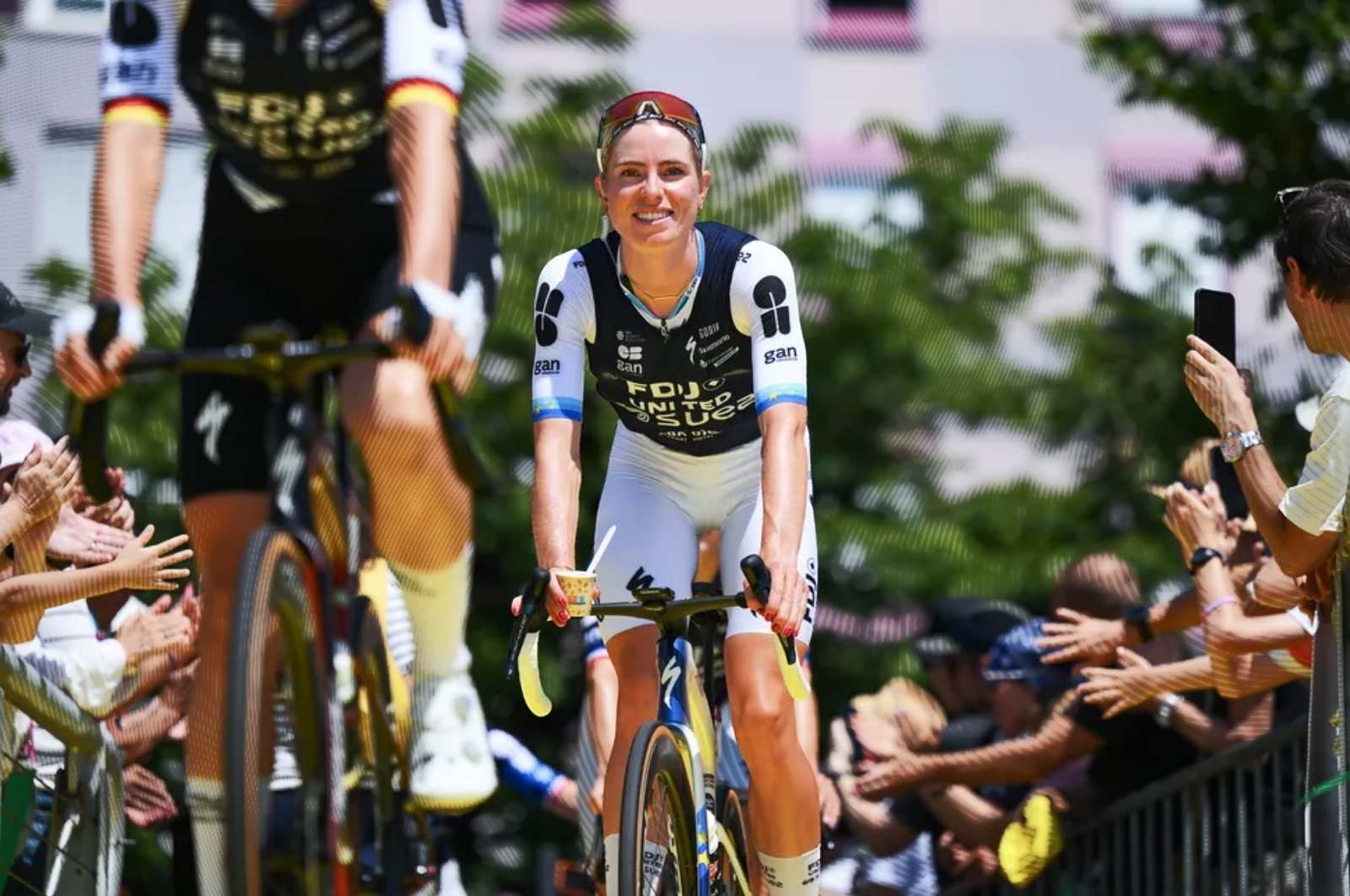
In 2025 she raced through Tour de Suisse and Dutch Nationals, arrived tired, and lost the Tour by minutes. In 2026 her team pulled her from both. On Stage 1 she gained time in a bunch sprint. The lesson translates.
Demi Vollering did not race the Tour de Suisse Women this year.
She did not race the Dutch National Championships either.
Both of those decisions were made by her team, FDJ United Suez, and both were unusual for a rider of her stature preparing for a Grand Tour.
The reigning 2023 Tour de France Femmes champion normally uses those races as sharpeners. In 2026, her team took them off the calendar entirely.
Then Stage 1 rolled out of Lausanne and she gained time in a bunch sprint.
Read the room correctly, and this is the most useful training story of the whole race.
What FDJ Actually Changed
The team's manager, Stephen Delcourt, has been open about the reasoning. Vollering's 2025 campaign was strong on paper. She finished second at the Tour de France Femmes.
But it was built on top of a hard racing block: she raced Tour de Suisse, got sick, then crashed at Dutch Nationals, then rebuilt inside two weeks before the Tour.
We learnt a lot about last season, Delcourt told Cyclingnews.
No Tour de Suisse, no Nationals, because last year she was sick after the Tour de Suisse and she crashed at the Nationals. Now she has more time.
We did a three week training camp in Tignes, with a fresh mind and fresh body.
Instead of race sharpening, the team ran a three week altitude camp at Tignes.
High volume, controlled intensity, no travel disruption, no crash risk, no bug from a shared team hotel.
Vollering's own quote to Cyclingnews was equally direct. I definitely did not push myself as hard before going to altitude, which meant I was already more relaxed going into the camp.
Why This Worked (In Sports Science Terms)
What FDJ Suez did is essentially a long form taper wrapped around an altitude block, replacing the pre race races most teams still use to build sharpness.
The taper literature backs the decision. A 2023 PLOS One systematic review and meta analysis of endurance athletes across cycling, running, and swimming found that a reduction in training volume of 41 to 60 percent, over a taper of 8 to 14 days, without cutting intensity or frequency, produced the strongest time trial performance improvements.
Vollering did not just taper.
She replaced hard racing with high altitude aerobic work, which does two useful things at once.
It maintains the training stimulus while cutting the fatigue cost of racing, and it drives a well documented haematological adaptation.
She reduced her stress load while keeping the training load high.
The payoff shows up in freshness, and freshness shows up in results on the first hard day of the target race.
Image credit: Getty Images
The Stage 1 Signal
Vollering is a climber.
Bunch sprints are not her natural terrain.
On a normal Grand Tour opening day, a climber sits in the wheels, hopes not to lose time to a split, and files the day as a rest ahead of the mountains.
Vollering did something different in Lausanne. She was near the front. She picked up small time bonuses.
She looked, in her own words afterwards, relaxed.
That is what a fresh climber looks like when the race is still easy. It is also what a rider looks like when the underlying build has been correctly loaded.
Delcourt described her as arriving with both a fresher body and a fresher mind, and the tactical read on Stage 1 matches that.
The peloton noticed.
Nine days later, we will know whether the approach delivered a second yellow jersey.
How This Translates To Age Group Cycling
The instinct for most enthusiast riders preparing for a big event, whether that is a gran fondo, a 100 mile ride, a stage race, or a target hill climb, is to add races and hard rides in the two to four weeks before.
It feels like sharpening. Most of the time it is just accumulating fatigue.
The evidence based version, and the version FDJ Suez has now built its entire Grand Tour prep around, is closer to this:
Three Weeks Out From Your A Event
Cut your race calendar.
If you have committed events between here and your target, look at them honestly.
Are they sharpeners, or are they just races you signed up for? If they add fatigue without a clear physiological purpose, cut them.
Book a training block instead.
This is where you replace the race with focused work. If altitude is not accessible, a hilly weekend training block on familiar roads, with controlled intensity, does the same job.
Two Weeks Out
Reduce volume by 40 to 60 percent, following the taper research.
Keep intensity high, and keep frequency roughly the same. Do not add rest days.
Cut kilometres from long rides and keep the interval sessions sharp.
This is where riders make the mistake of resting too much. Rest without stimulus detrains you.
The point of a taper is to reduce fatigue while preserving fitness, and the way to do that is to keep the quality of your work and cut the quantity.
Final Week
One or two short, sharp openers. Not races. Just efforts. Sleep. Eat carbs.
Protect the taper from social pressure to do just one more group ride.
If someone in your club invites you to a fast Saturday ride and your A event is Sunday of next week, decline it. FDJ Suez skipped a national championship.
You can skip a chaingang.
The Time Crunched Version
Not everyone has three weeks.
If you are training on 5 to 8 hours a week, the same principles compress into a shorter block. Cut your race calendar for the two weekends before your target.
Keep one hard midweek session in the final ten days. Trim the long ride.
The lesson is not that you need three weeks in Tignes.
The lesson is that fresh legs are undervalued by amateurs and correctly valued by professional teams.
What Vollering's Race Tells Us
Stage 1 was a small signal. The real answer arrives on Ventoux.
If Vollering wins her second Tour de France Femmes, or podiums with a strong Ventoux ride, the FDJ Suez approach will be studied by every team in the peloton and copied where possible.
If she cracks, the racing schoolers will say she needed the sharpener she skipped.
Either way, the underlying training science does not shift. Reducing volume before a target event, without cutting intensity, produces performance gains in endurance athletes.
That is what the meta analysis says. The Tour de France Femmes is providing a very public test case.
The Statement Worth Copying
Amateur cyclists tend to over race and under recover.
Professional teams have moved in the opposite direction over the last five years, and Vollering's 2026 prep is the clearest version of that shift on public display.
Do less in the two to three weeks before the ride that matters. Do it deliberately.
Skip races when the physiology says so, not when it feels comfortable to. And show up rested.
That is what the fastest climbers in the peloton are quietly doing. The rest of us should probably notice.