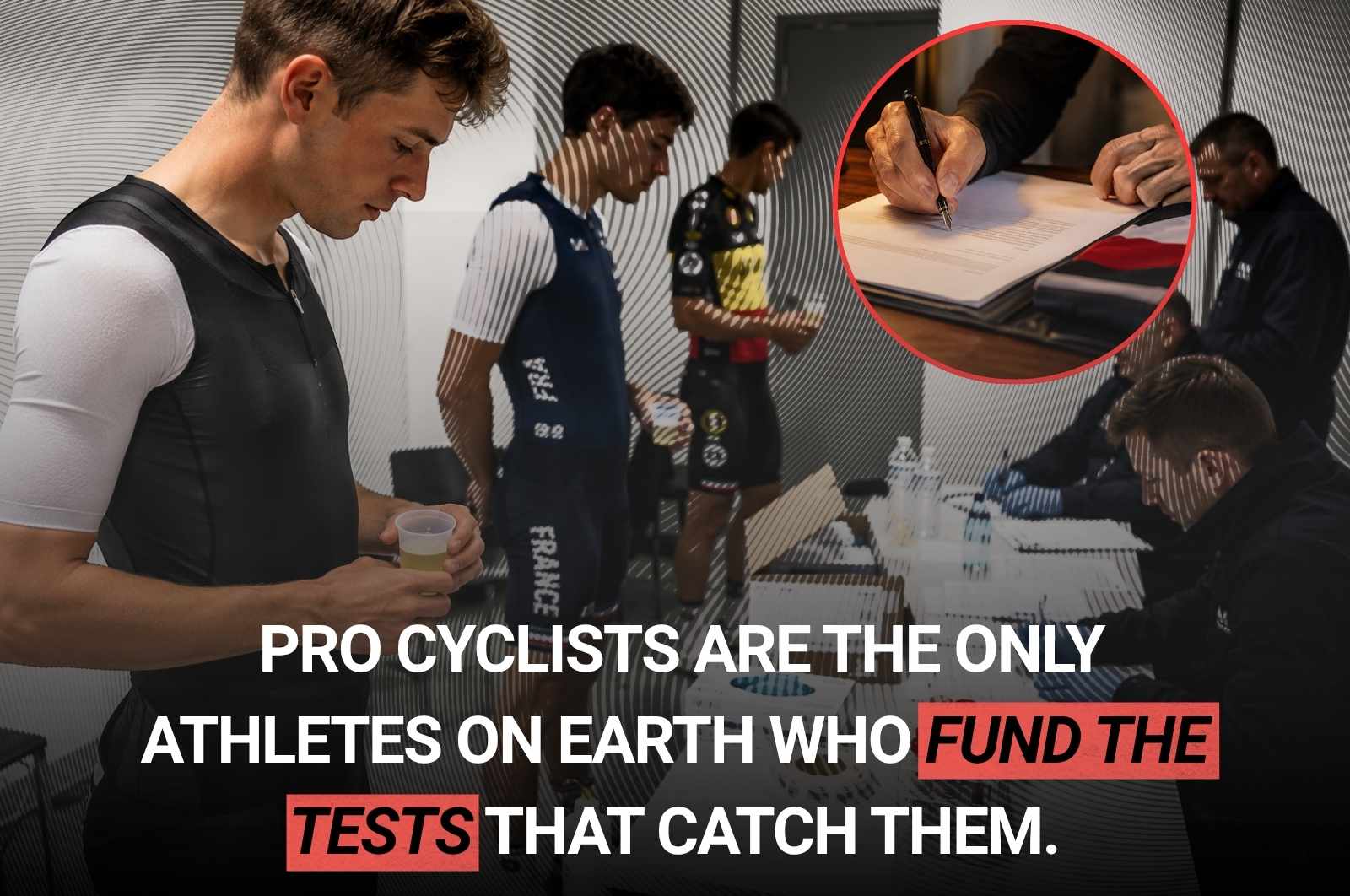
Nowhere else in Olympic sport do the athletes contribute to their own testing budget. In cycling, they do, they always have, and it changes what the current reform fight is really about.
Every outlet covering the 2am doping-test uproar at the Tour de France quoted the CPA's press release.
Almost none of them highlighted the sentence that actually changes the story.
Professional riders are the first to want a clean sport, the CPA wrote, they are the only athletes who contribute financially to testing.
Read that as a structural fact, not a rhetorical flourish.
In every other Olympic sport, testing is imposed on athletes as an external cost. In pro cycling, it is co-funded by the very people being tested.
Nowhere else does this happen. Not in athletics, not in swimming, not in tennis, not in football.
That single structural fact reframes the entire reform debate. So it is worth taking apart, slowly and specifically.
How the €10 Million Programme Is Actually Funded
Since January 2021, the UCI's anti-doping operations have been run by the International Testing Agency, an independent Lausanne-based body.
The current total spend on the cycling anti-doping programme runs at approximately €10 million per year.
That figure jumped in 2023, with an additional €1.5 million invested in intelligence and investigations, testing, and scientific capacity.
From 2024 onwards, a further €2.4 million per year was committed to long-term sample storage, re-analysis, and data analytics.
The scale is significant. The question is who pays for it.
The Funding Committee
According to the ITA's own published partner page, the cycling anti-doping budget is approved by a Funding Committee with four voting stakeholders.
The UCI, the sport's governing body.
The AIGCP, representing the professional teams.
The AIOCC, representing race organisers like ASO.
The CPA, representing the riders themselves.
Every one of those four bodies makes a direct financial contribution to the anti-doping programme. The CPA sits on the Funding Committee not just as a voice, but as a paying stakeholder.
That is what the CPA meant when it said riders contribute financially to testing. It is a structural fact of the programme's design, not a metaphor.
How Cycling Ended Up Alone Here
The historical answer is uncomfortable. Cycling built this funding model because its own doping past made no other model viable.
After the Festina scandal in 1998, the Operación Puerto raids, and the Armstrong era, the sport's credibility with sponsors, race organisers, and broadcasters was ruined.
The UCI could not afford, politically or financially, to run anti-doping alone. Neither could the teams.
So the funding model that emerged was collective.
Everyone pays. Everyone has a seat.
Why That Model Is Unusual
In athletics, doping testing is funded almost entirely by national anti-doping agencies, drawing on government grants and World Anti-Doping Agency contributions.
In tennis, the ITF Anti-Doping Programme is funded by the ITF itself, the Grand Slams, and the ATP and WTA tours. Individual players do not contribute.
In FIFA-governed football, anti-doping is funded by FIFA and the confederations. Players contribute nothing directly.
In every case, the athletes are the object of testing, not a source of its funding.
Only in cycling do the athletes buy a seat at the table by helping cover the bill.
Why This Reframes the 2am Debate
When Adam Hansen and the CPA push back on the ITA's overnight testing methodology, they are not doing it as passive complainants.
They are doing it as contributing funders of the very programme conducting the tests.
That changes the moral geometry of the debate in a specific way.
If the WTA player who takes a 3am wake-up call complains, they are complaining about a rule imposed on them by someone else.
If a cyclist complains, they are complaining about a rule they helped pay for the enforcement of.
There is a name for what that dynamic looks like in other industries. It is called being a customer with a grievance.
The Consequence Nobody Has Named Yet
The CPA has already used its Funding Committee vote to shape the programme.
In late 2025, the CPA voted to fund the UCI's legal battle with SRAM through pooled rider contributions.
Adam Hansen defended the move at the time, saying no one enjoys seeing money spent on lawyers but this is about unity.
The same voting power exists on the anti-doping budget. If the CPA decides overnight testing before mountain stages is a bridge too far, the Funding Committee is the door it can walk through.
That is not activism. That is contract law.
The Uncomfortable Follow-Up Question
If riders are helping pay for testing, does that create a conflict of interest?
This is the objection you will hear from anti-doping purists, and it deserves a straight answer.
In one sense, yes. Every contributor to any funding pool has some incentive to shape the programme in its own favour.
In another sense, no. The CPA's contribution comes with a fiduciary duty to represent all riders, including the ones being caught.
Historically, the CPA has voted for more aggressive testing when clean riders have demanded it. In 2022 and again in 2024, the CPA approved budget increases.
The record does not support the claim that rider funding softens the programme. It suggests the opposite.
What Reform Looks Like Now
The reform pressure inside the sport is broader than the doping story.
The anti-doping funding structure is a sub-plot in that story, but it is one nobody outside the ITA and the CPA is discussing openly.
For context on how the sport's ongoing doping cases interact with the funding programme, our earlier piece on the Marc Soler doping case involving his father and a banned coach lays out the intelligence-and-investigations arm that the funding increase is primarily paying for.
The Statement Cycling Just Made
The story of the 2am wake-up is being told as a rider revolt against a testing agency.
That framing is incomplete. It is closer to the truth to describe it as shareholders questioning management.
The CPA is not standing outside the system throwing rocks.
It is sitting inside the boardroom, signing the cheques, and asking why the programme it helps fund is producing outcomes it did not authorise.
If the ITA and UCI want the funding structure to continue, they have to answer that question. Legally, contractually, and publicly.
That is not nothing. That is the difference between anti-doping as an imposition and anti-doping as a partnership.
For a hundred years, cycling has been the only Olympic sport to try the partnership model. It is worth understanding, and worth defending, provided the partners on both sides remember they are actually partners.