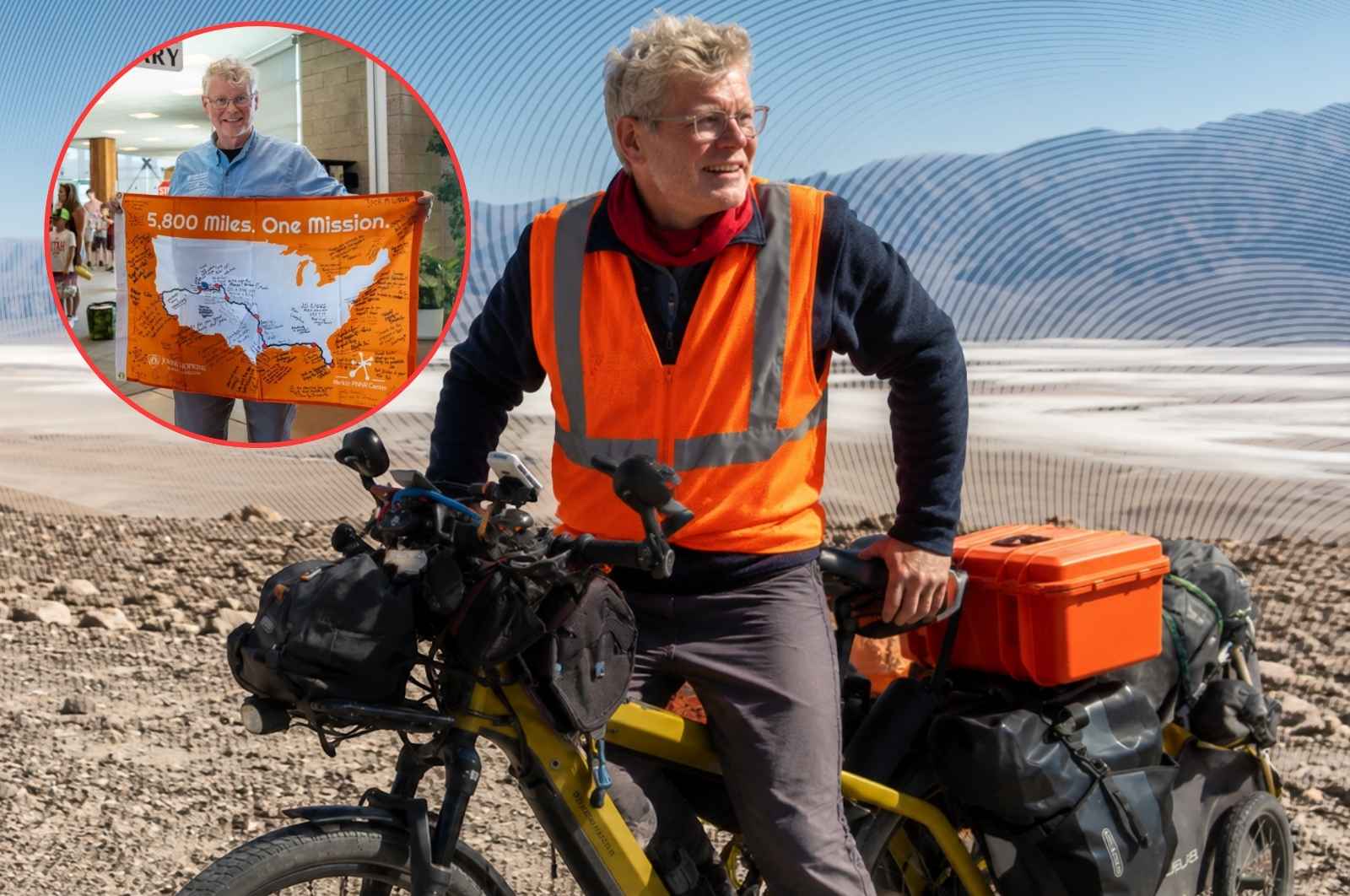
Gregory Maassen spent nearly a year unable to walk. Two coast-to-coast e-bike tours later, a Johns Hopkins neurologist calls his story a live demonstration of the only known way to regenerate small nerve fibers.
The burning sensation started near the top of his left arm.
Within a month it had spread from his ears to his feet, and Gregory Maassen could barely leave his bed.
He was 51. He had been a global development executive with a career built on travel and long hours. Now his body felt scorched, sunburn deep, and no test could explain why.
He went through two years of specialists, endoscopies, and blood draws before Johns Hopkins finally gave the condition a name: small fiber peripheral neuropathy, triggered by a nest of ticks he had walked into on a hike in South Africa in 2017.
His neurologist wrote him a prescription that sounded almost absurd. Ride a bike. Every day.
The Prescription That Sounded Like A Joke
Dr. Ahmet Hoke runs the Merkin Peripheral Neuropathy and Nerve Regeneration Center at Johns Hopkins.
He is unusually blunt about what modern medicine can and cannot offer his patients.
Right now, exercise is the only known way to regenerate nerve fibers, Hoke has said publicly, more than once.
That is not marketing copy. It is the current state of the science.
For most forms of peripheral neuropathy, which affects roughly 1 in 9 American adults, no drug has been proven to rebuild damaged sensory nerves.
The only intervention with a signal that shows up on skin biopsies is sustained physical activity.
For Maassen, the specific dose Hoke prescribed included cycling, resistance work, and roughly 30 minutes of daily movement, minimum.
A 2023 systematic review in the peer-reviewed journal Frontiers concluded that early, active physical programs promote axonal regeneration and prevent maladaptive nerve responses in peripheral neuropathies. You can read the full review here. There was one problem. Maassen could barely stand.
Why The E-Bike, Not The Road Bike
This is the part most cyclists get wrong when they hear his story.
Maassen did not white-knuckle his way back onto a race bike. He picked an e-bike, because the science of nerve regeneration does not care whether the assist motor is on.
What it cares about is volume, duration, and consistency.
The muscle contractions, the blood flow, the release of neurotrophic factors that a 2014 PLOS ONE study out of the Hopkins neurology department linked directly to nerve regrowth.
All of that happens whether or not a battery is helping you up the climb.
When people say that e-biking is cheating, maybe it is, Maassen told the Park Record earlier this year. But it is very good exercise.
He was not wrong. Even with pedal assist, he was burning around 2,500 calories a day on his cross-country routes, going through four batteries in the process.
The e-bike removed the failure mode.
On a bad symptom day, a traditional road bike would have kept him in bed. The e-bike got him out the door anyway.
That is the real mechanism. Not the motor. The showing-up.
4,685 Miles In 2022. 5,800+ Miles In 2026.
His first ride, in 2022, went from Washington, D.C., to San Francisco along the historic Lincoln Highway. 4,685 miles.
He became the first person to ride an e-bike coast to coast in the United States.
This year, he is doing it again. Bigger.
West Palm Beach, Florida, to Los Angeles. More than 5,800 miles across five months, in partnership with the Merkin PNNR Center at Johns Hopkins.
He rides with yellow wooden clogs strapped to the rear rack, a nod to his Dutch upbringing and, more usefully, a conversation starter.
He has said in interviews that the clogs do more marketing work than any press release ever could.
He is 55 now. His nerves have not been fully restored. The pain still comes back. But according to reporting from Brain & Life magazine, a publication of the American Academy of Neurology, his mobility, sleep, and daily function have improved to the point that a life in bed no longer looks likely. What This Story Says To Cyclists Without Neuropathy
Here is the part that matters if you are reading this from a training saddle, not a hospital bed.
The Maassen case is one of the cleanest real-world illustrations of a principle that keeps showing up in the endurance research: the body will regenerate tissue in response to a repeated, appropriate stimulus, and it will only do so if you keep showing up.
That applies to sensory nerves.
It also applies to mitochondrial density, capillary networks, cardiac stroke volume, and tendon collagen. Adaptations are the reward for consistency, not intensity.
Cycling is one of the very few sports that lets an ordinary rider stack that consistency for decades, well past the age at which running becomes a joint gamble. Our complete guide to cycling knee pain and joint health covers why that low-impact profile matters for long-term riders. The e-bike question is worth sitting with too.
A meaningful number of riders drop out of cycling not because they lost the fitness, but because they lost the tolerance.
Chronic back pain. Numb hands.
Post-concussion issues. A knee that flares up on climbs.
The e-bike is a category most road cyclists have quietly dismissed as being for beginners or commuters.
Maassen's case is a plausible argument that it is also a bridge back into the sport for anyone whose body will no longer accept a fully unassisted ride.
Where This Falls Short
Two honest caveats.
First, small fiber peripheral neuropathy is a specific condition with a specific mechanism.
Maassen's recovery pattern does not automatically translate to diabetic neuropathy, chemotherapy-induced neuropathy, or the numbness some cyclists get from handlebar pressure, which is usually mechanical, not systemic.
Second, the peer-reviewed evidence base for exercise-driven nerve regeneration is still weighted toward animal models, with a smaller body of human clinical trials.
The 2023 Frontiers review flagged that gap directly. Hoke's clinical prescription is grounded in the best current science, but it is not identical to a definitive answer for every patient.
The Statement Cycling Just Made
For a decade, the story cycling has told itself is that suffering is the point.
Watts per kilo, threshold intervals, the noble misery of a long ride into the wind.
Maassen's story is a different one. Cycling as a return path, not a proving ground.
A doctor prescribes it.
A man who could not walk uses it to cross a continent, twice. And a Johns Hopkins neurologist points at his skin biopsies and says, in effect, the nerves are growing back.
That is not sponsorship marketing.
That is quietly powerful.
If a bike can do that for a body that was falling apart, it can probably do more than most riders are asking of it